A Word From NASC: Hemp Legislation Update

We’re writing to share an important update on recent changes in U.S. federal law that affect cannabis seeds, hemp, and the broader cannabis industry.

Write your US Senators + Representatives Today and Let Them Know You’re Opposed to Sec 781: https://democracy.io/#!
Hemp Law Changes & Cannabis Seeds
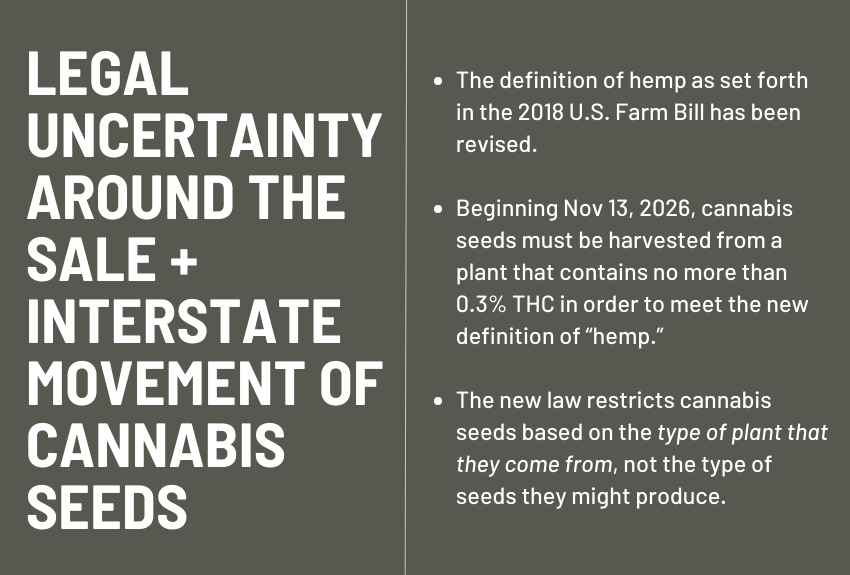
Recent revisions to the definition of hemp as originally set forth in the 2018 U.S. Farm Bill have narrowed the federal definition of hemp, including re-defining the legal parameters for when cannabis seeds are considered “hemp”. With respect to seeds, the new hemp definition still requires them to contain no more than 0.3% THC. Additionally, in order to be considered “hemp”, the new law mandates that cannabis seeds must be harvested from a plant that contains no more than 0.3% THC.  Notably, and contrary to some media reports, the new law does not prohibit seeds based on the type of plants that they might produce. Instead, it restricts cannabis seeds based on the type of plant that they come from. This has introduced new legal uncertainty around the sale and interstate movement of cannabis seeds. At a minimum, it may create regulatory and enforcement issues since the legal metric has been changed from the THC levels in a cannabis seed to the THC levels in the plant that produced the seed. It remains to be seen whether and how this new provision will be enforced. 

Federal Cannabis Reclassification
At the same time, the U.S. government has initiated the process of reclassifying ‘marijuana’ (cannabis) from Schedule I to Schedule III under the Controlled Substances Act. This represents a meaningful shift in federal policy, acknowledging accepted medical use of the plant and potentially easing regulatory and tax burdens for certain stakeholders while also setting in place the foundation for a more comprehensive policy. The rulemaking phase of the EO will provide further instruction on the specifics of the reclassification. We are closely tracking implications for seeds and interstate commerce. 

What This Means & What’s Next
Together, these changes create both opportunity and risk for the cannabis genetics community. We are actively assessing the implications and coordinating with industry partners, lobbyists, and legal groups on next steps.

What is clear is that things are changing. We are reaching out to you today to ask that you stay tuned while we work to bring clarity and guidance as the situation develops. Working together will be instrumental to protect what we’ve all built. 

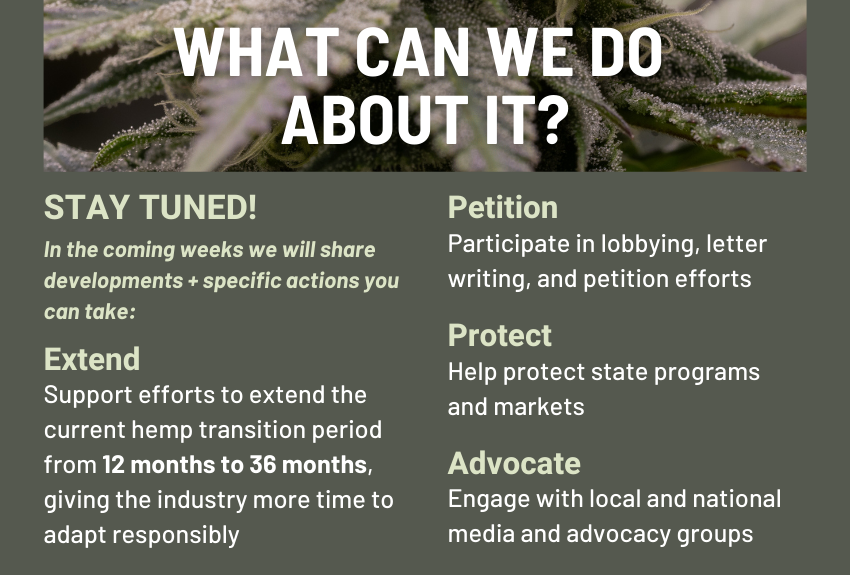
In the coming weeks, we will share specific actions you can take as part of the effort to protect access to cannabis seeds and genetic diversity, to include:

  • Participating in lobbying, petition and letter writing efforts
  • Engaging with local and national media and advocacy groups
  • Supporting efforts to,
    • extend the current hemp transition period from 12 months to 36 months, giving the industry more time to adapt responsibly
    • protect state programs and markets, or
    • other legislative proposals that further the cause

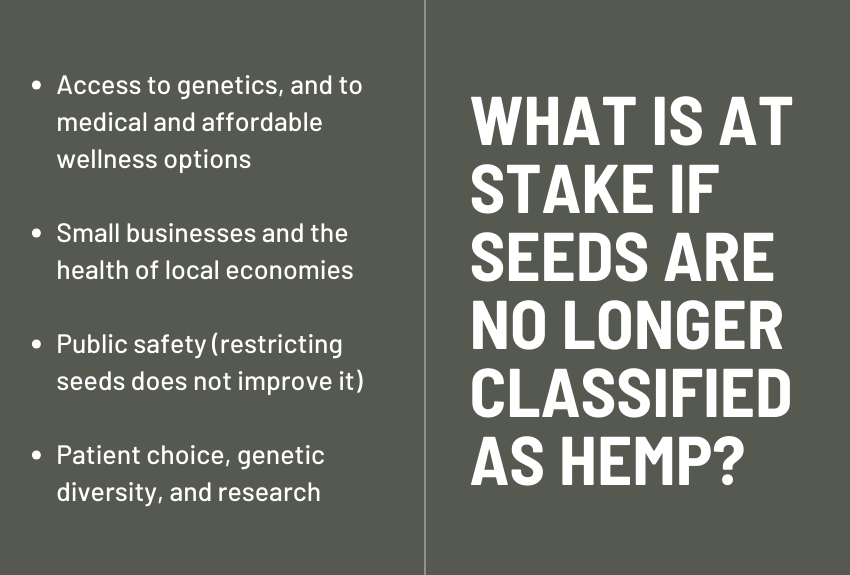
Your participation will be critical as policymakers finalize how these rules are implemented. We will need broad grass roots, veteran groups and community support to clearly demonstrate how these changes affect:

  • Access to medical and affordable wellness options
  • Small businesses and your local economies
  • Public safety (restricting seeds does not improve it)
  • Patient choice and genetic diversity
  • Fair compliance timelines — for example, extending the transition period in Section 781 from 12 months to an appropriate timeline to allow responsible businesses and consumers to adapt without unnecessary harm

Your participation will be critical as policymakers finalize how these rules are implemented. Broad grassroots support, veteran groups, and community engagement will be essential to clearly demonstrate how these changes impact access to medical and affordable wellness options, small businesses and local economies, public safety (noting that restricting seeds does not improve it), patient choice and genetic diversity, and fair compliance timelines. For example, it is important to extend the transition period in Section 781 from 12 months to an appropriate timeline, allowing responsible businesses and consumers to adapt without unnecessary harm.

Thank you for your continued trust and support. We will be in touch again soon as developments continue and further information becomes available.

-Your Friends at North Atlantic Seed Co.

  1. See Section 781 of the Continuing Appropriations, Agriculture, Legislative Branch, Military 2. Construction and Veterans Affairs, and Extensions Act, 2026 (H.R.5371).Agriculture Improvement Act of 2018, Pub. L. 115-334. 3. There has been significant confusion in the media about this issue, with many commentators incorrectly asserting that the legal status of cannabis seeds will be based on their potential to create a high THC plant. The new law is clear that the legal status of a cannabis seed is based on the plant from which it came, not the potential type of plant it can grow. 4. See, Executive Order (EO, 18.Dec.2025) Increasing Medical Marijuana and Cannabidiol Research, and the accompanying Fact Sheet.
How Are Cannabis Seeds Affected by the New Hemp Legislation?

Write your US Senators + Representatives Today and Let Them Know You’re Opposed to Sec 781: https://democracy.io/#!

Hey Fam, 

I wanted to write you all and give you a little bit of insight on what has been brewing behind the scenes here at NASC as we react to the recent legislative changes regarding hemp and cannabis seeds. 

On Nov 11, our government reopened (yay!), and with that came some unfortunate news for the cannabis seed and hemp industries (very sad…): per Sec 781 of the FY 2026 Agricultural Appropriations Bill, hemp seeds will no longer be defined based upon the dry weight basis of the seed itself, it will now be defined by the THC content of the mother plant it came from. 

Here’s a quick and simplified breakdown of the difference: 

THEN: (2018 - Present)

The 2018 Farm Bill defined hemp as any part of the cannabis sativa L plant that contains less than 0.3% THC on a dry weight basis. 

NOW: (Nov 2026 and Beyond)

The FY 2026 Agricultural Appropriations Bill largely retains the previous definition of hemp established in the 2018 Farm Bill; however, it adds several exclusions, one of which redefines cannabis seeds in particular. Sec. 781, Exclusion C states that seeds will no longer be defined as hemp if the plant the seeds came from contains more than 0.3% THC on a dry weight basis. 

While wholly unscientific by nature, and very hard to regulate, this new definition of hemp will make virtually all cannabis seeds federally illegal, making it illegal to purchase and share cannabis genetics across state lines. This legislation will impact both seeds and clones. 

OUR POSITION: When it comes to seeds in particular, we take great issue with this new law. Our legislators voted on this impactful bill with no consideration for the industry and the millions of people this will affect both personally and professionally. They did not consult any of us, and instead, quietly pushed this through as part of a much larger resolution to reopen and fund our government.

Now we have 365 days to backtrack. We have to come together. We have to try to right this ill-conceived wrong before it impacts our lives and our livelihoods. It is our collective voices that will make a difference, and we are urging everyone who cares about cannabis and about genetics to bring visibility to this issue in any way you can, and make your opinions and your stories heard.

Most importantly, we urge you to write to your legislators: your local US Representatives and Senators. Call them. Let them know you oppose Sec 781 and tell them how you feel. Below you will find a quick and easy link to do so: 

https://democracy.io/#!

COMPELLING TALKING POINTS: 

This bill will cripple a multi-billion dollar industry. Seeds are the foundation from which everything is derived and grows. We need to retain our ability to possess and share genetics, and this outright ban is totally unprecedented for many reasons: 

  1. This law is unscientific and will be very challenging to regulate. It’s impossible to predict the THC content of a cannabis seed based upon its parents, especially down to the tenth of a percentile. Genetics do not work that way. There is so much variability at play. For that reason alone, this law is unsustainable, and it forces farmers and home growers to participate in a guessing game where the stakes are federal prosecution. 
  1. Historically as a country, we do not ban things based upon what they could become. We regulate them based on what they are. Cannabis seeds do not contain THC; they do not get people high. Furthermore, cannabis is legal in some capacity in the majority of the United States. This law is crippling to business people and medical patients who are only trying to do their jobs and get by as honestly as the next person. The onus is on us, as US citizens, to follow our state and local laws. This law punishes hundreds of millions of people by prohibiting a seed based on the hypothetical scenario in which someone living in a state where cannabis is illegal might take the seed, spend 6 months growing it out in their basement, and then consume it. Where does the harm really lie here? 

Thank you all for your willingness to educate and bring visibility to this issue. Now is the time, and we urge you to join us in this movement to free cannabis seeds. 

Beth 

Join NASC in the Movement to Free Cannabis Seeds!

Write your US Congresspeople Today: https://democracy.io/#!


Contact Us

Email:
[email protected]

Mailing Address:
PO Box 2724
Waterville, ME 04903

Frequently Asked Questions

Customer Service:
Mon. to Fri.: 9am to 4pm EST

Shipping:
Monday – Friday


Disclaimer: Cannabis seeds are sold as souvenirs, and collectibles only. They contain 0% THC. It is imperative that you check your state and local laws before attempting to purchase seeds, and we are not liable for what you do with seeds after receiving them. The statements on this website and its products have not been evaluated by the Food and Drug Administration. These products are not intended to diagnose, treat, cure or prevent any disease. Consult your doctor before use. North Atlantic Seed Company assumes no legal responsibility for your actions once the product is in your possession and is not liable for any resulting issues, legal or otherwise, that may arise.