How Temperature, RH, and VPD Relates to Cannabis Growth

by Ben Morris

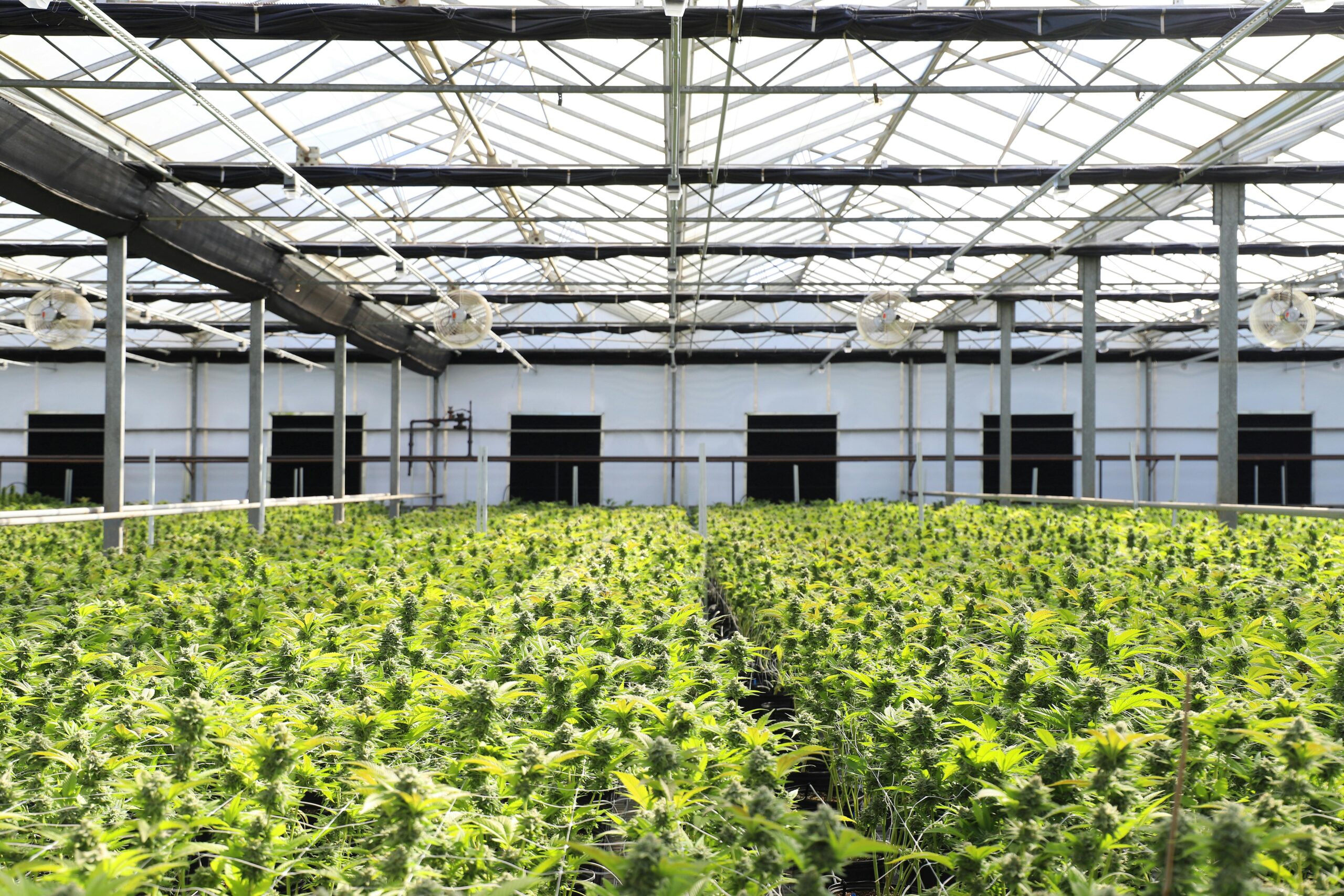
Temperature, relative humidity (RH), and vapor pressure deficit (VPD) are three major variables that growers must monitor and control, if possible, to maximize their cannabis yields and keep their grows clean from mold. In this article we will discuss all three variables and how they relate to one another in the context of growing cannabis.

Temperature: This is a variable everyone is very familiar with. It is the measure of โ€˜hotnessโ€™ or โ€˜coldnessโ€™ (i.e. the average kinetic energy of particles in a substance) expressed in terms of one of many scales (e.g. Fahrenheit, Celsius, Kelvin, etc.). The scale most people in the U.S. are familiar with is the Fahrenheit scale. Outside of the U.S. the Celsius scale, based on the freezing and boiling points of water, is more commonly employed. Regardless of the scale you use, it is important to know that cannabis prefers certain temperature ranges to maximize growth and plant health.

Vegetative Stage: Cannabis, like many plants, enjoys moderately warm temperatures usually in the range of 70-850F (~21-300C). During the vegetative stage of cannabisโ€™ life, it prefers the previously mentioned temperature range during the day (lights on) and 65-750F (~18-240C) during the night (lights off). This temperature range will promote fast and lush growth as well as efficient nutrient uptake. Temperatures above 850F can cause heat stress and may lead to leaf tips burning. Higher temps can also invite pests such as spider mites who reproduce faster in higher temperature ranges. Temperatures below 650F during the day, or during the period when grow lights are on, can limit cannabis growth and can reduce nutrient absorption.ย 

Flowering Stage: During the flowering stage a slightly lower daytime (lights on) temperature range of 70-800F (~21-270C) is recommended, with 75-770F (~23.8-250C) being the optimal day time temperature range. The optimal nighttime temperature range for the flowering stage is 60-700F (~15.5-210C).ย  A 10-150F drop in temperature at night (lights off) can stimulate resin production and can even bring out purple/pink hues in certain strains. The 70-800F temperature range during the day helps to promote vigorous growth without the risk of degrading and evaporating off a large percentage of the terpenes that makes your plant(s) so special. This temperature range also encourages dense flowers as high temps during flower can lead to airy, fluffy buds.ย 

If using CO2 to enrich the grow area, it is possible to raise the daytime temperature range to 80-900F (27-320C), although we still recommend not exceeding ~820F to avoid any chance of buds becoming too airy or โ€œfluffy.โ€ The reason for the ability to raise the temperature when supplementing CO2 is due to the higher rate of plant metabolism caused by higher temps. This allows the plant to consume more light and nutrients as well as create sugars at a faster rate of photosynthesis due to excess carbon availability. If you are not treating your grow space with CO2 it is highly recommended to keep daytime temps as close to 75-770F as possible.

Temperatures under 550F (~130C) can stall growth and induce shock in your cannabis plants so avoid letting your grow get under this temperature.  

In the last 2 weeks of flower, many growers have reported increased terpene retention, as well as increased resin production, when lowering the daytime grow room temps to a range of 65-700F (18-240C).

Relative Humidity: Humidity refers to the water vapor held in the air. Absolute Humidity is the total amount of water vapor held in the air regardless of the temperature. Relative Humidity (RH) is a measure of how much water vapor is held in the air as a percentage of the maximum amount of water vapor that could be held in the air at a given temperature. 

Absolute humidity is not temperature dependent as it is simply a measure of the total amount of water vapor in a mass of air. 

Relative humidity is temperature dependent as warmer air can hold more water than colder air can. This means that when the temperature drops at night, the air may feel โ€œstickierโ€ or โ€œdenserโ€ despite having the same amount of total moisture as it contained during the day. As the air cools, the molecules that make up the air get closer to one another and this leaves less room for water vapor to be held. This doesnโ€™t raise the absolute humidity but does raise the relative humidity of a mass of air. This is important to remember as it means the RH of your grow space will increase when the lights go off, even if no new moisture is added to the environment. Ensuring proper air flow in your grow space can help prevent micro-climates with excess moisture from building up.

Having the right relative humidity in your grow room is paramount for plant health and for suppressing pest and fungal infections. If RH is too high, it can invite mold that can ruin your crop before or during harvest. If RH is too low, it can create drought stress in the plant and invite pests such as spider mites that thrive in drier conditions.

Optimal RH ranges for cannabis vary depending on what stage of growth the plant is at.

Seedling/New Clone Stage: 60-80% RH to help plants absorb water as they grow their root system.

Vegetative Stage:ย 50-60% RH is usually a good range for the vegetative stage. Not so high that it invites quick mold infections but also not so low that it risks stressing your plant(s) out.

Some growers use a range of 55-65% RH for early veg and then a range of 45-55% for later veg.

Flowering Stage: 40-50% RH for early flower with a range of 35-40% RH for late flower (last 1-2 weeks before harvest). The plant has well established roots at this stage and doesnโ€™t require as high a relative humidity for water absorption. The lower RH range also helps to prevent bud rot (botrytis) and other fungal infections in the flowers as they finish. Take care to balance low RH with appropriate temps to not evaporate or degrade the terpenes generated by your cannabis.ย ย 

Vapor Pressure Deficit (VPD): In simple terms, Vapor Pressure Deficit (VPD) is a measure of how much โ€œspaceโ€ there is for water vapor in the air at a given temperature. This is different from relative humidity as RH is a % whereas VPD is measured with units of pressure, usually kPa or PSI (kilopascal or pounds per square inch). RH measures how much water vapor is in the air compared to the maximum amount of water vapor the air could hold at a given temperature. VPD is the difference between how much water vapor is currently in the air and how much moisture the air could hold at a given temperature, essentially measuring the remaining "space" for water vapor.

Why is this important? It is important to understand VPD as it is a primary driver of transpiration in plants which also means it is a primary driver of nutrient uptake. Plants pull water and minerals through their xylem cells from the roots to the leaves of the plant and the VPD of the surrounding environment drives this โ€œpullingโ€ (like sucking liquid through a straw). Too high a VPD can cause plants to dry out too quickly and can cause their stomata to stay closed, which does not allow for good CO2 intake from the leaf. It can also cause wilting on the leaves as well. Excessively high VPD can also cause potential nutrient burn from nutrients being pulled too quickly in too high a concentration to the leaves. Too low a VPD can decrease nutrient uptake and can lead to mold as there may be too much water vapor in the air. This can stunt a plantโ€™s growth and diminish the final yield if not remedied. Low VPD can also cause calcium deficiencies which can further lead to stunted growth of your cannabis.

VPD is related to temperature and to relative humidity in the following ways:

As temperature increases, the airโ€™s ability to hold water vapor increases exponentially. This means the potential for high VPD increases with heat (assuming RH stays constant).

As relative humidity increases, the air becomes more saturated with water vapor, reducing the deficit, and thus the potential for low VPD increases with increasing humidity (assuming temperature stays constant).

If temp increases and RH stays constant or decreases, VPD increases. (Hot/dry air)

If temp decreases and RH stays constant or increases, VPD decreases. (Cool/wet air)

If temp and RH increase, it can lead to moderate or to high VPD. This is because the air heating up allows more water vapor to be held but increased humidity decreases the space for water to evaporate from plants, thus keeping the VPD moderate to high. The resulting VPD will be most affected by whichever variable is increased to a greater degree. If temperature is raised much more than humidity, then a high VPD will be achieved due to more space in the air for water vapor. If humidity is increased much more than temperature, then a moderate, or even low, VPD can be achieved due to more water vapor being added to the air. 

The same is true if temp and RH are both decreased. Depending on which variable is decreased to a greater extent, the VPD will respond accordingly. If temp is lowered much more than RH is lowered, VPD may decrease due to less space in the air for new water vapor to be held. If RH is lowered much more than temperature is, then a higher VPD may still be possible due to the removal of water vapor from the air.

Optimal VPD for cannabis changes as the plant matures. It generally increases from lower levels in the cloning/seedling stage (to inhibit dehydration and wilting) to higher levels in late flower to encourage transpiration and prevent mold. The generally accepted VPD range for the veg stage is 0.8โ€“1.2 kPa. The generally accepted VPD range for the flowering stage is 1.0โ€“1.5 kPa to promote flower health and resin production. These values can be achieved at a few different temperature/relative humidity combinations. That is another reason why VPD is such an important factor in the health of your plants. It is not always about having an exact temperature and/or RH but about having the right balance between the two. As an example, if you are having trouble with humidity throwing off the VPD in your grow space, and if dehumidifiers havenโ€™t been effective in reducing said humidity, then raising the temperature of the space (as long as it isnโ€™t above 82-850F) can still allow you to achieve an optimal VPD for your plants.

Pulse Grow, a company focusing on data-driven monitoring solutions for indoor and greenhouse cultivation, has an amazing reference article if you wish to delve deeper into the concept of VPD which can be found at https://pulsegrow.com/blogs/learn/vpd. On this site, there is a VPD calculator growers can use to determine if the temp and RH of their grow space is creating the optimal VPD for your plants. They also have pre-made charts that make determination of VPD very fast and easy and can be an essential tool in dialing in your grow space.

One last important tip to remember when determining the VPD of your room is to use the leaf surface temperature rather than the room temperature as the surface of your plantโ€™s leaves will be 2-50F cooler than the surrounding environment. Even without a device to measure this quantity, it is easy for one to look at the room temp and simply subtract 2-50F from that value to be used when determining the temperature portion of the VPD equation. 

Below is a chart summarizing the optimal temperature, relative humidity, and vapor pressure deficit ranges for cannabis at various stages of growth.

Growth StageTemperature(Day Temp RangeNight Temp Range)Relative HumidityVapor Pressure Deficit
Seedling/Clone70 โ€“ 850F (~21-300C)
65 โ€“ 800F (~18-270C)
60-80%0.4 - 0.8 kPa
Early Veg70-850F (~21-300C)
65-750F (~18-240C)
55-65%0.8 โ€“ 1.2 kPa
Late Veg70-850F (~21-300C)
65-750F (~18-240C)
45-55%0.8 โ€“ 1.2 kPa
Early Flower70-800F (~21-270C)
60-700F (~15.5-210C)
40-50%1.0 โ€“ 1.2 kPa
Late Flower (Last two weeks before Harvest)65-700F (18-240C)
55-650F (~13-180C)
35-45%1.2 โ€“ 1.5 kPa

Check out another article by Ben!


Happy Growing!
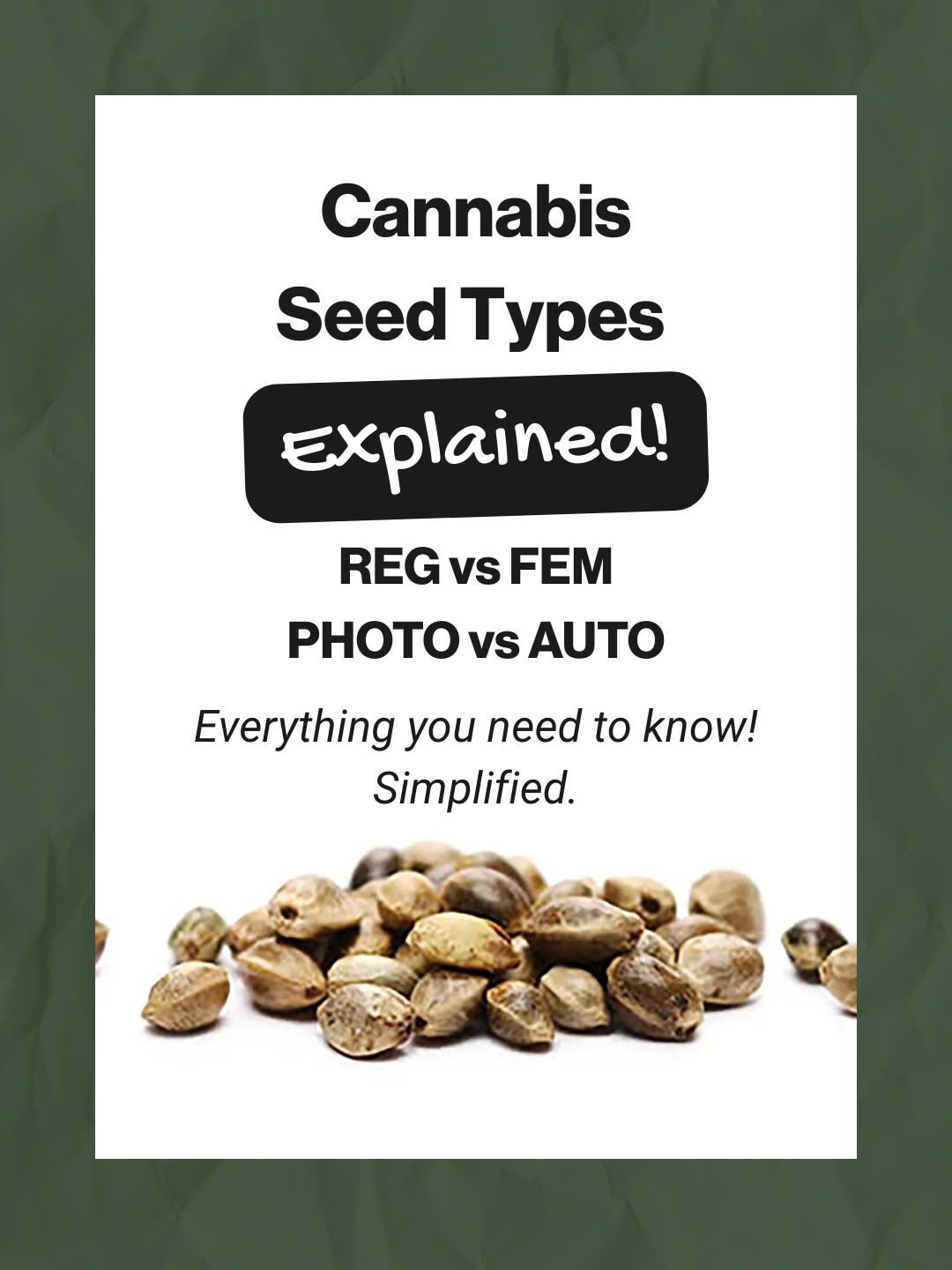
Cannabis Types Explained: Fem vs Reg / Photo vs Auto by Ben Morris

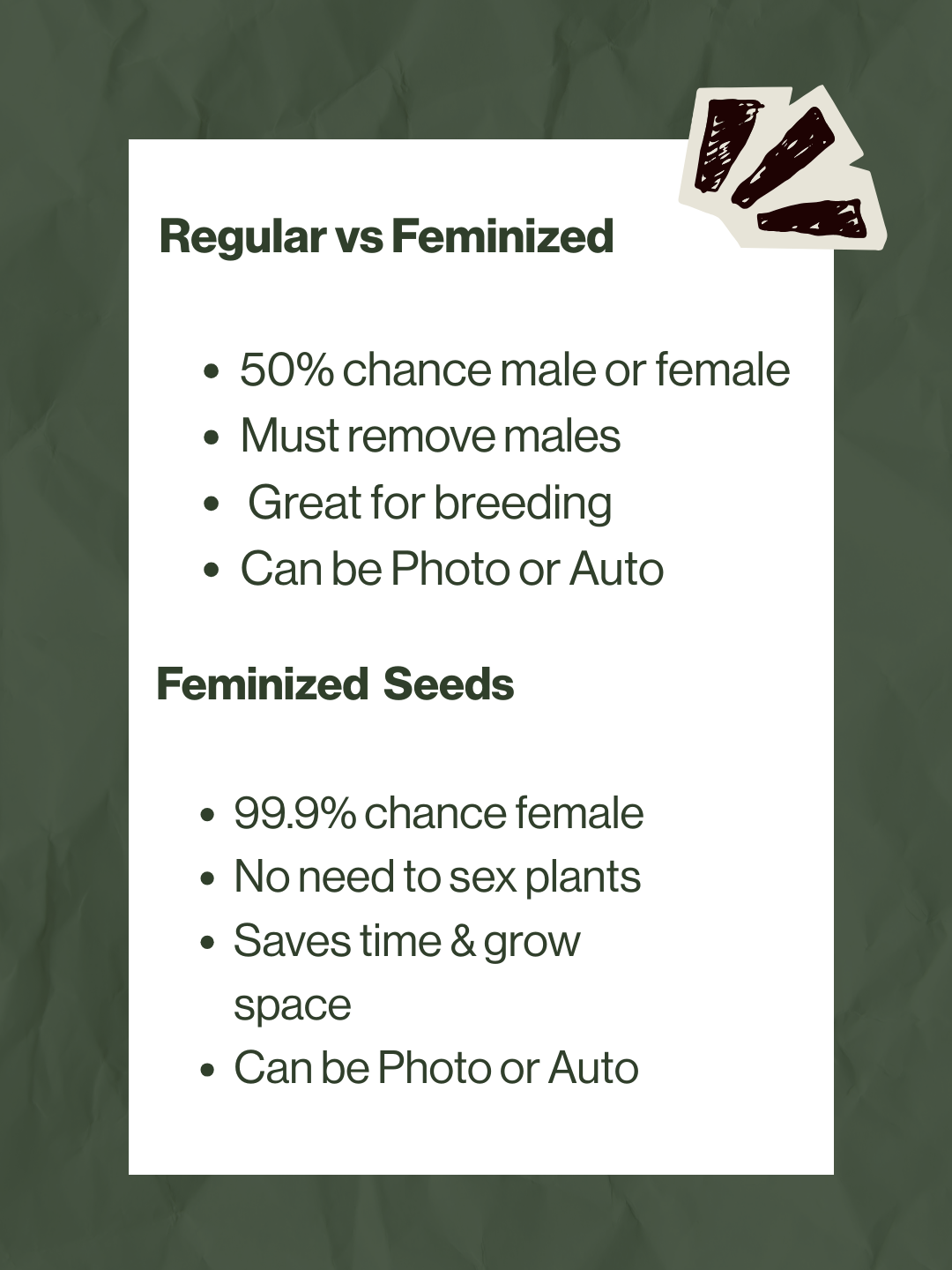
Regular vs Feminized (Reg vs Fem)

Reg or regular seed is seed produced with a natural male pollen donor and a natural female cannabis plant. Fem or Feminized seed is produced with a female pollen donor and a natural female cannabis plant.

Regular seed can produce male (XY) and female (XX) plants. Either laboratory testing or growing some seeds out and sexing them can help you identify if they are male or female. Males obviously make pollen which, when hitting a stigma, traveling through the style then into the ovary on a female plant, will cause the females to create seed. This can easily ruin a crop if a grower is going for seedless flower which makes identifying plant sex very important early in the growing process. 

There is nothing wrong with regular seeds. They can still produce amazing plants as long as theyโ€™re tended to appropriately just like with plants from feminized seeds. The main difference is knowing youโ€™ll have to pop more seeds to account for any males you may have to get rid of if youโ€™re going for seedless flower. Many people prefer regular seeds over feminized seeds for many reasons. One such reason is to breed their own strains and to create their own seed for next yearโ€™s grow.

Feminized seeds produce 99.9% female seeds due to the pollen donor being female (XX). Since a female in these instances is made to create pollen there is no โ€˜Yโ€™ chromosome to pass along thus no natural males should be able to form from the seeds produced. This results in almost all the seeds from a feminized pollen donor (XX) and a natural female cannabis plant (XX) being female. This can save much time by cutting out the need to sex plants when planning for your particular grow space and harvest goals. Feminized seeds are preferred by many people as well for many reasons. One big reason being the time and money saved on growing out many possible males and sexing or testing them before discarding them. 

Both regular and feminized seed can lead to plants that show hermaphroditism (male and female sex organs/ anthers and pistils on the same plant) if not cared for properly or if poor parental choices were made by the breeder during seed creation. It is important to regularly check on your plants to monitor for unwanted anthers and remove them or the entire plant before they pollinate the other females in the grow space.

Regular SeedFeminized Seed
50% chance of male or female plant 

Can exhibit hermaphroditism  

Can produce amazing plants with high yields
99.9% Chance of female plant

Can exhibit hermaphroditism

Can produce amazing plants with high yields

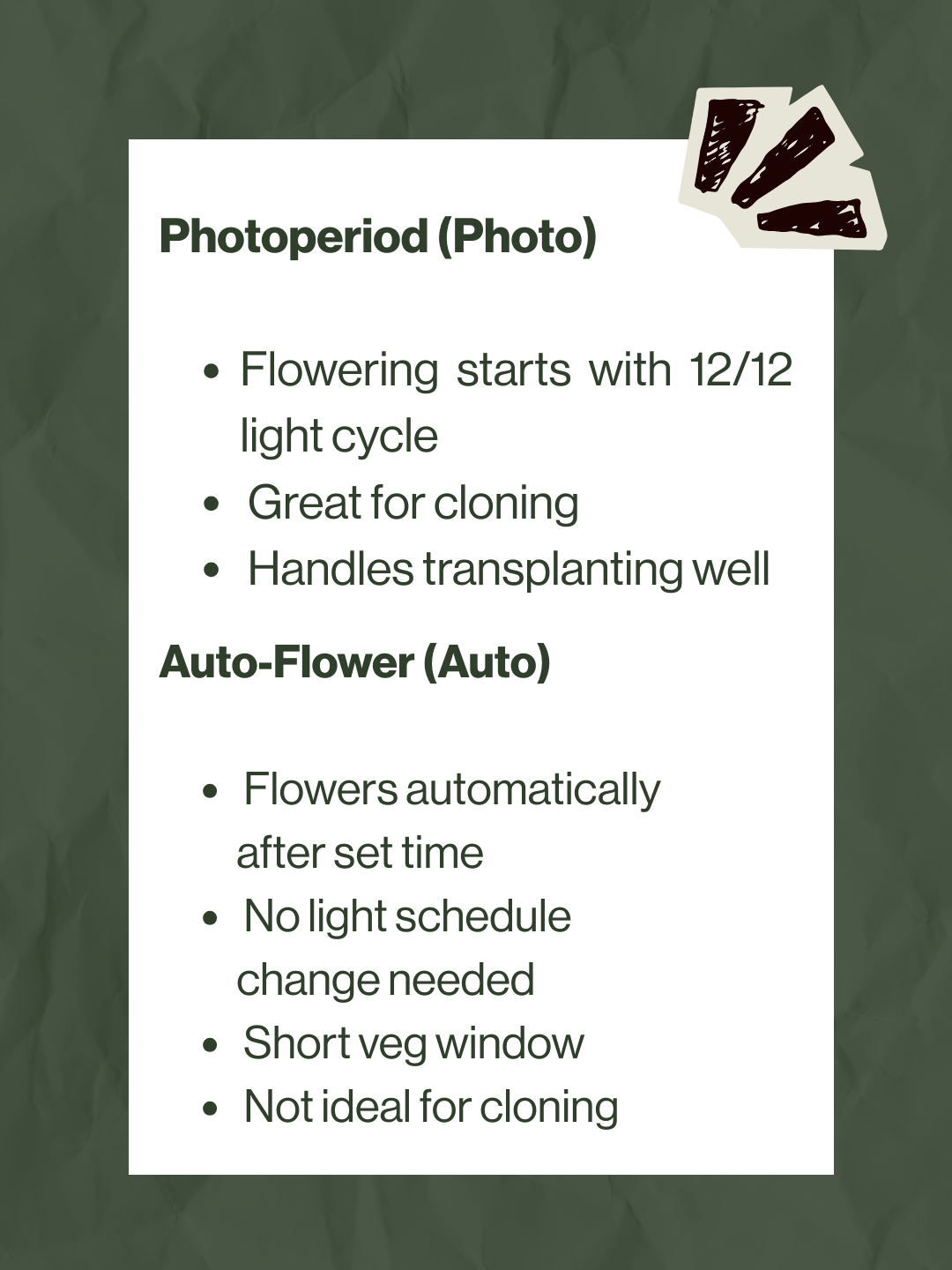
Photoperiod vs AutoFlower (Photo vs Auto)

Photoperiod plants, or โ€œPhotos,โ€ are cannabis plants that require a change in the amount of light they receive to trigger flowering. Generally 12 hours of light followed by 12 hours of darkness will prompt photoperiod plants to create their sex organs (pistils/buds for female plants and anthers for male plants) and grow their flowers. This is often called โ€œ12/12โ€ or โ€œ12/12 lighting.โ€

Auto-flowering plants do not require a change in light schedule to begin flowering and will do so after a certain number of days after being potted. This is due to the underlying genetics in auto-flower varieties that allow them to trigger flowering without any change in light schedule required. Auto-flower plants are not good candidates for cloning as they have a short window of time in vegetative growth before they start flowering out. This means any cuts taken from the โ€˜motherโ€™ will still flower around the same time the mother would, making them poor choices for mother plants.

Some breeders have labeled particular strains as โ€œFastโ€ or โ€˜Fast Flower.โ€ This generally means the plant is still a photoperiod plant and will require a change in the amount of light/darkness it received to trigger flowering but that it will complete its flowering period much sooner than the average photoperiod plant.

PhotoperiodAuto-Flower
Requires change in light schedule to trigger flowering

Can be feminized or regular seed

Handles appropriate transplanting well.

Tolerance varies by strain

Good for cloning
Flowering triggered after a certain number of days regardless of light schedule

Can be feminized or regular seed

Does not handle transplanting very well

Bad for cloning

Regular and Feminized seeds can be either photoperiod or auto-flowering varieties

Examples: 

A plant grown from a regular auto-flower seed would have a 50% chance of being male or female and would start flowering at a certain time after planting regardless of the amount of light it received. 

A plant grown from a feminized auto-flower seed would have a 99.9% chance of being female and would start flowering at a certain time after planting regardless of the amount of light it received.

A plant grown from a regular photoperiod seed would have a 50% chance of being male or female and would require a change in the amount of light it receives to trigger flowering. (12 hrs light/12 hrs dark)

A plant grown from a feminized photoperiod seed would have a 99.9% chance of being female and would require a change in the amount of light it receives to trigger flowering (12 hrs light/12 hrs dark)


HAPPY GROWING!

How Do Color, Shape, + Size Affect Seed Germination?

Results: Seed Color/Shape Viability Test

By Ben Morris / Head Breeder, Dirty Bird Genetics

To test whether a seedโ€™s size, color and/or shape influences its ability to germinate, we tested 50 seeds of various sizes, colors, and shapes. All seeds were placed in distilled water and separated into five solocup shot glasses based on their size, shape, and color. We germ-tested 10 seeds in each of the following five categories: Large-Dark, Small-Dark, Large-White, Small-White, and Dark-Odd Shaped (meaning not elliptic as most cannabis seeds are). All seeds were stored in their respective shot glasses, placed in a box together, and left in an environment with low to no light, minimal air flow, approximately 60% ambient relative humidity, and at a temperature of approximately 75 degrees Fahrenheit. The seeds were observed on day 3, day 5, and day 8 to determine germination rates and progress.

Disclaimer: As a disclaimer, I would like to state that this was a preliminary test of seed viability with a very small population size. For conclusions that are statistically significant, more testing will need to occur with larger population sizes. This is by no means a definitive test of seed viability but rather a preliminary inquiry into this issue. This test was mainly to show that seeds with lighter colored to white seed coats, as well as abnormally shaped seeds, and smaller seeds can still be viable.

Day 1:

The 10 seeds of each category are laid out before being placed in germinating cups.

From Left to Right: Odd Shaped, Small-White, Large-White, Small-Dark, Large-Dark.

The 10 seeds of each category in the germinating cups as seen from above.


Day 3 Germination Results:

After 3 days the seeds were laid out on a background for observation of germination progress. The images below show the results found. The white seeds from both the small and the large categories turned a darker color after 3 days in the water in the cups, but these are the same seeds of those categories as shown in the first image of all the seeds in this study.

The Large-Dark seeds showed 8/10 seeds with the radicle exposed after 3 days.

The Small-Dark seeds showed 10/10 seeds with the radicle exposed after 3 days. The lesser amount of seed coat on the Small-Dark seeds may have allowed faster imbibition (taking up of water by the seed).

The Large-White seeds showed 7/10 with exposed radicles after 3 days.

The Small-White seeds showed 2/10 with exposed radicles after 3 days.

The Odd-Shaped seeds showed all 10/10 radicles exposed after 3 days. One seed appears to have 2 radicles coming from a single seed coat. This is most likely due to 2 zygotes forming within the plant ovary very shortly after pollination or due to 2 seeds fusing as they formed.


Day 5 Germination Results:

After another few days in the dark and in the distilled water the seeds were again taken out and observed. Below are images of the results on day 5 of this experiment.

All 10/10 Large-Dark seeds are now showing exposed radicles after 5 days.

  All 10/10 Small-Dark seeds continue to show exposed radicles after 5 days.

Large-White seeds are showing 7/10 exposed radicles after 5 days.   

Although difficult to see, 3/10 Small-White seeds are now showing exposed radicles after 5 days.

After 5 days, 10/10 Odd-Shaped seeds are still showing exposed radicles. One of the โ€œtwinโ€ radicles broke off of one of the Odd-Shaped seeds. The first seed all the way to the left of the image does have an exposed radicle but its slightly darker color makes it difficult to see. Once zoomed in, anyone can see that a small, discolored radicle is exposed.


Day 8 Germination Results:

After 8 days total the seeds were observed for a final time to see the results pictured below.

After 8 days, 10/10 Large-Dark seeds show exposed radicles.       

     After 8 days 10/10 Small-Dark seeds show exposed radicles and 3/10 even show cotyledon.

After 8 days 7/10 Large-White seeds showed exposed radicles.   

       After 8 days 3/10 Small-White seeds showed exposed radicles.

All 10/10 Odd-Shaped seeds are still showing exposed radicles after 8 days.


RESULTS:

Preliminary Conclusion:

  • Many shapes, colors and sizes of seeds can be viable. 
  • Dark seeds have the best germination rates, regardless of whether they are small or large. 
  • White seeds are significantly more viable if they are larger. Small white seeds performed poorly in this germination test. 
  • Seed shape has no affect on viability. 
  • Using our germination method, seed viability was determined and unchanged by Day 5. 

Based on the limited results of this preliminary study, many shapes/colors/sizes of seeds can still be viable. They donโ€™t all have to be large and dark colored although having a dark colored seed coat does seem to have a positive correlation with germination viability. It also seems that a larger seed may have a better chance of germinating as seen in the results between the Large-White and Small-White seeds with the Large-White having a 70% germination rate and the Small-White only having a 30% germination rate.  From the limited results of this simple experiment, it appears that seed shape didnโ€™t affect germination rates with the Odd-Shaped seeds having 100% germination just like the seeds in the Large-Dark and Small-Dark categories.

One parameter not reflected in these results is the pressure with which you can apply to a seed to test viability. Lightly (very lightly) pinching a seed between your thumb and pointer finger and seeing if the seed deflates or pops can be a relatively reliable method of determining germination viability. Just a light pressure should give the kinetic feedback to know that the seed is โ€œsolidโ€ and probably will germinate or will deflate/pop the seed and thus that seed was not viable. One thing many people seem to do is apply too much pressure to seeds when they check in this way. Again, light pressure is all that is required. One does not need to squeeze as hard as they can as this can give false results since enough pressure can pop any seed regardless of viability.

For more info on how we germinate, please see our Germination Guide here.


As Always, Happy Growing!

NASC Cast: Brothers Grimm Interview

In our newest entry to the NASC Breeder Spotlight Series, Beth + Caitlyn interview Mr. Soul, the brains and the brawn behind the legendary Brothers Grimm Seeds.

Mr. Soul has traveled the world breeding, growing, and smoking cannabis. With decades of experience in the industry, you are sure to learn a lot from this in-depth conversation.

We hope you enjoy it!


Shop Brothers Grimm Seeds!

Contact Us

Email:
[email protected]

Mailing Address:
PO Box 2724
Waterville, ME 04903

Frequently Asked Questions

Customer Service:
Mon. to Fri.: 9am to 4pm EST

Shipping:
Monday โ€“ Friday


Disclaimer: Cannabis seeds are sold as souvenirs, and collectibles only. They contain 0% THC. It is imperative that you check your state and local laws before attempting to purchase seeds, and we are not liable for what you do with seeds after receiving them. The statements on this website and its products have not been evaluated by the Food and Drug Administration. These products are not intended to diagnose, treat, cure or prevent any disease. Consult your doctor before use. North Atlantic Seed Company assumes no legal responsibility for your actions once the product is in your possession and is not liable for any resulting issues, legal or otherwise, that may arise.