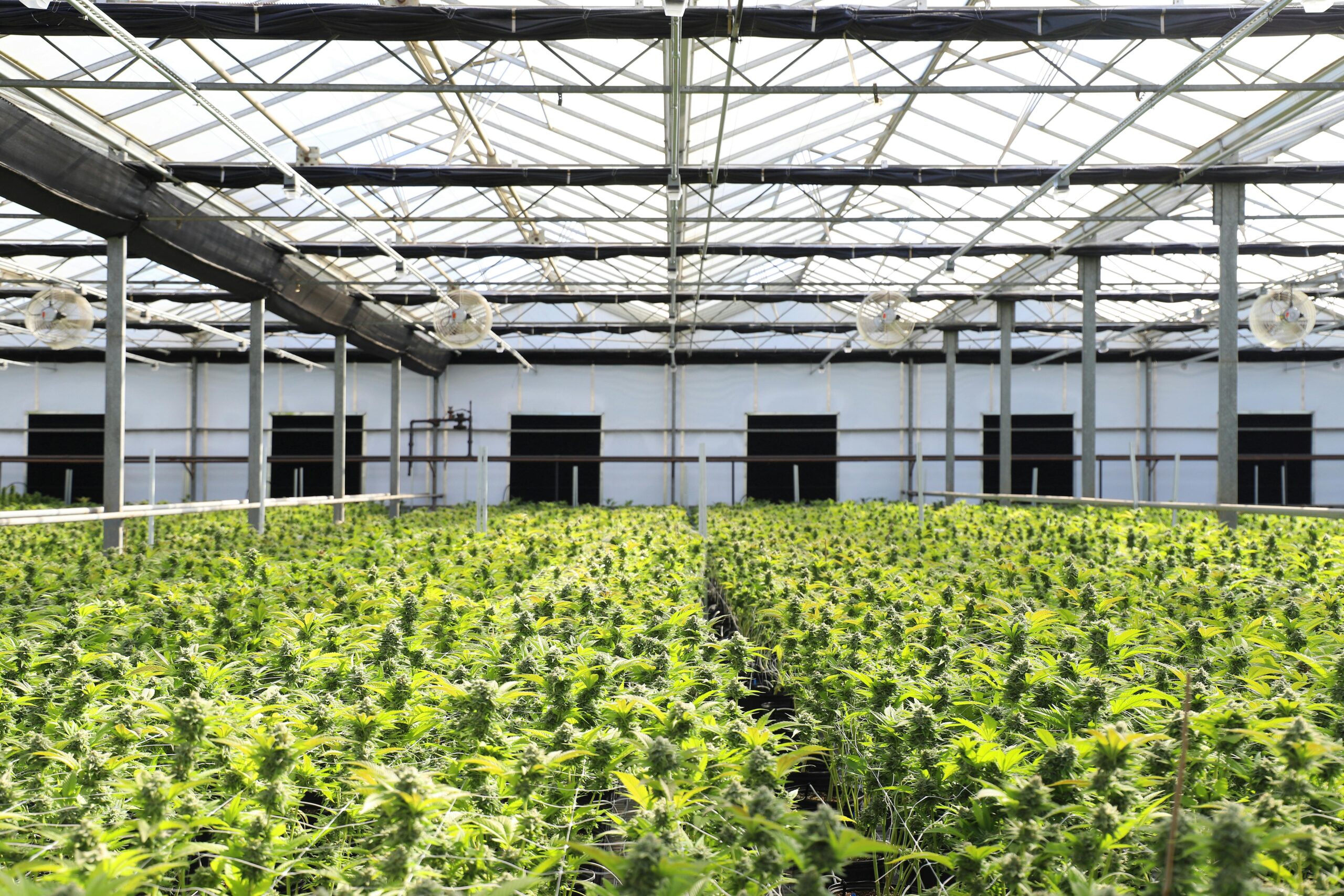
Temperature, relative humidity (RH), and vapor pressure deficit (VPD) are three major variables that growers must monitor and control, if possible, to maximize their cannabis yields and keep their grows clean from mold. In this article we will discuss all three variables and how they relate to one another in the context of growing cannabis.
Temperature: This is a variable everyone is very familiar with. It is the measure of ‘hotness’ or ‘coldness’ (i.e. the average kinetic energy of particles in a substance) expressed in terms of one of many scales (e.g. Fahrenheit, Celsius, Kelvin, etc.). The scale most people in the U.S. are familiar with is the Fahrenheit scale. Outside of the U.S. the Celsius scale, based on the freezing and boiling points of water, is more commonly employed. Regardless of the scale you use, it is important to know that cannabis prefers certain temperature ranges to maximize growth and plant health.
Vegetative Stage: Cannabis, like many plants, enjoys moderately warm temperatures usually in the range of 70-850F (~21-300C). During the vegetative stage of cannabis’ life, it prefers the previously mentioned temperature range during the day (lights on) and 65-750F (~18-240C) during the night (lights off). This temperature range will promote fast and lush growth as well as efficient nutrient uptake. Temperatures above 850F can cause heat stress and may lead to leaf tips burning. Higher temps can also invite pests such as spider mites who reproduce faster in higher temperature ranges. Temperatures below 650F during the day, or during the period when grow lights are on, can limit cannabis growth and can reduce nutrient absorption.
Flowering Stage: During the flowering stage a slightly lower daytime (lights on) temperature range of 70-800F (~21-270C) is recommended, with 75-770F (~23.8-250C) being the optimal day time temperature range. The optimal nighttime temperature range for the flowering stage is 60-700F (~15.5-210C). A 10-150F drop in temperature at night (lights off) can stimulate resin production and can even bring out purple/pink hues in certain strains. The 70-800F temperature range during the day helps to promote vigorous growth without the risk of degrading and evaporating off a large percentage of the terpenes that makes your plant(s) so special. This temperature range also encourages dense flowers as high temps during flower can lead to airy, fluffy buds.
If using CO2 to enrich the grow area, it is possible to raise the daytime temperature range to 80-900F (27-320C), although we still recommend not exceeding ~820F to avoid any chance of buds becoming too airy or “fluffy.” The reason for the ability to raise the temperature when supplementing CO2 is due to the higher rate of plant metabolism caused by higher temps. This allows the plant to consume more light and nutrients as well as create sugars at a faster rate of photosynthesis due to excess carbon availability. If you are not treating your grow space with CO2 it is highly recommended to keep daytime temps as close to 75-770F as possible.
Temperatures under 550F (~130C) can stall growth and induce shock in your cannabis plants so avoid letting your grow get under this temperature.
In the last 2 weeks of flower, many growers have reported increased terpene retention, as well as increased resin production, when lowering the daytime grow room temps to a range of 65-700F (18-240C).
Relative Humidity: Humidity refers to the water vapor held in the air. Absolute Humidity is the total amount of water vapor held in the air regardless of the temperature. Relative Humidity (RH) is a measure of how much water vapor is held in the air as a percentage of the maximum amount of water vapor that could be held in the air at a given temperature.
Absolute humidity is not temperature dependent as it is simply a measure of the total amount of water vapor in a mass of air.
Relative humidity is temperature dependent as warmer air can hold more water than colder air can. This means that when the temperature drops at night, the air may feel “stickier” or “denser” despite having the same amount of total moisture as it contained during the day. As the air cools, the molecules that make up the air get closer to one another and this leaves less room for water vapor to be held. This doesn’t raise the absolute humidity but does raise the relative humidity of a mass of air. This is important to remember as it means the RH of your grow space will increase when the lights go off, even if no new moisture is added to the environment. Ensuring proper air flow in your grow space can help prevent micro-climates with excess moisture from building up.
Having the right relative humidity in your grow room is paramount for plant health and for suppressing pest and fungal infections. If RH is too high, it can invite mold that can ruin your crop before or during harvest. If RH is too low, it can create drought stress in the plant and invite pests such as spider mites that thrive in drier conditions.
Optimal RH ranges for cannabis vary depending on what stage of growth the plant is at.
Seedling/New Clone Stage: 60-80% RH to help plants absorb water as they grow their root system.
Vegetative Stage: 50-60% RH is usually a good range for the vegetative stage. Not so high that it invites quick mold infections but also not so low that it risks stressing your plant(s) out.
Some growers use a range of 55-65% RH for early veg and then a range of 45-55% for later veg.
Flowering Stage: 40-50% RH for early flower with a range of 35-40% RH for late flower (last 1-2 weeks before harvest). The plant has well established roots at this stage and doesn’t require as high a relative humidity for water absorption. The lower RH range also helps to prevent bud rot (botrytis) and other fungal infections in the flowers as they finish. Take care to balance low RH with appropriate temps to not evaporate or degrade the terpenes generated by your cannabis.
Vapor Pressure Deficit (VPD): In simple terms, Vapor Pressure Deficit (VPD) is a measure of how much “space” there is for water vapor in the air at a given temperature. This is different from relative humidity as RH is a % whereas VPD is measured with units of pressure, usually kPa or PSI (kilopascal or pounds per square inch). RH measures how much water vapor is in the air compared to the maximum amount of water vapor the air could hold at a given temperature. VPD is the difference between how much water vapor is currently in the air and how much moisture the air could hold at a given temperature, essentially measuring the remaining "space" for water vapor.
Why is this important? It is important to understand VPD as it is a primary driver of transpiration in plants which also means it is a primary driver of nutrient uptake. Plants pull water and minerals through their xylem cells from the roots to the leaves of the plant and the VPD of the surrounding environment drives this “pulling” (like sucking liquid through a straw). Too high a VPD can cause plants to dry out too quickly and can cause their stomata to stay closed, which does not allow for good CO2 intake from the leaf. It can also cause wilting on the leaves as well. Excessively high VPD can also cause potential nutrient burn from nutrients being pulled too quickly in too high a concentration to the leaves. Too low a VPD can decrease nutrient uptake and can lead to mold as there may be too much water vapor in the air. This can stunt a plant’s growth and diminish the final yield if not remedied. Low VPD can also cause calcium deficiencies which can further lead to stunted growth of your cannabis.
VPD is related to temperature and to relative humidity in the following ways:
As temperature increases, the air’s ability to hold water vapor increases exponentially. This means the potential for high VPD increases with heat (assuming RH stays constant).
As relative humidity increases, the air becomes more saturated with water vapor, reducing the deficit, and thus the potential for low VPD increases with increasing humidity (assuming temperature stays constant).
If temp increases and RH stays constant or decreases, VPD increases. (Hot/dry air)
If temp decreases and RH stays constant or increases, VPD decreases. (Cool/wet air)
If temp and RH increase, it can lead to moderate or to high VPD. This is because the air heating up allows more water vapor to be held but increased humidity decreases the space for water to evaporate from plants, thus keeping the VPD moderate to high. The resulting VPD will be most affected by whichever variable is increased to a greater degree. If temperature is raised much more than humidity, then a high VPD will be achieved due to more space in the air for water vapor. If humidity is increased much more than temperature, then a moderate, or even low, VPD can be achieved due to more water vapor being added to the air.
The same is true if temp and RH are both decreased. Depending on which variable is decreased to a greater extent, the VPD will respond accordingly. If temp is lowered much more than RH is lowered, VPD may decrease due to less space in the air for new water vapor to be held. If RH is lowered much more than temperature is, then a higher VPD may still be possible due to the removal of water vapor from the air.
Optimal VPD for cannabis changes as the plant matures. It generally increases from lower levels in the cloning/seedling stage (to inhibit dehydration and wilting) to higher levels in late flower to encourage transpiration and prevent mold. The generally accepted VPD range for the veg stage is 0.8–1.2 kPa. The generally accepted VPD range for the flowering stage is 1.0–1.5 kPa to promote flower health and resin production. These values can be achieved at a few different temperature/relative humidity combinations. That is another reason why VPD is such an important factor in the health of your plants. It is not always about having an exact temperature and/or RH but about having the right balance between the two. As an example, if you are having trouble with humidity throwing off the VPD in your grow space, and if dehumidifiers haven’t been effective in reducing said humidity, then raising the temperature of the space (as long as it isn’t above 82-850F) can still allow you to achieve an optimal VPD for your plants.
Pulse Grow, a company focusing on data-driven monitoring solutions for indoor and greenhouse cultivation, has an amazing reference article if you wish to delve deeper into the concept of VPD which can be found at https://pulsegrow.com/blogs/learn/vpd. On this site, there is a VPD calculator growers can use to determine if the temp and RH of their grow space is creating the optimal VPD for your plants. They also have pre-made charts that make determination of VPD very fast and easy and can be an essential tool in dialing in your grow space.
One last important tip to remember when determining the VPD of your room is to use the leaf surface temperature rather than the room temperature as the surface of your plant’s leaves will be 2-50F cooler than the surrounding environment. Even without a device to measure this quantity, it is easy for one to look at the room temp and simply subtract 2-50F from that value to be used when determining the temperature portion of the VPD equation.
Below is a chart summarizing the optimal temperature, relative humidity, and vapor pressure deficit ranges for cannabis at various stages of growth.
by Ben Morris, Head Breeder of Dirty Bird Genetics
Hop Latent Viroid (HLVd) is a highly infectious pathogen that consists of a single stranded loop of RNA.1 It is many times smaller than a typical virus and is actually a “Viroid.” It is also known as “dudding” or the “dudding disease.” HLVd was first discovered in Hops in 19872 and has since then been discovered in Cannabis.3 One study has shown that up to 90% of grow facilities in California have tested positive for HLVd at some point and that the infection has spread across cannabis in the US.8 Other sources have stated that up to 40% of flower from retailers and dispensaries in Canada have also had positive test results for the pathogen.6
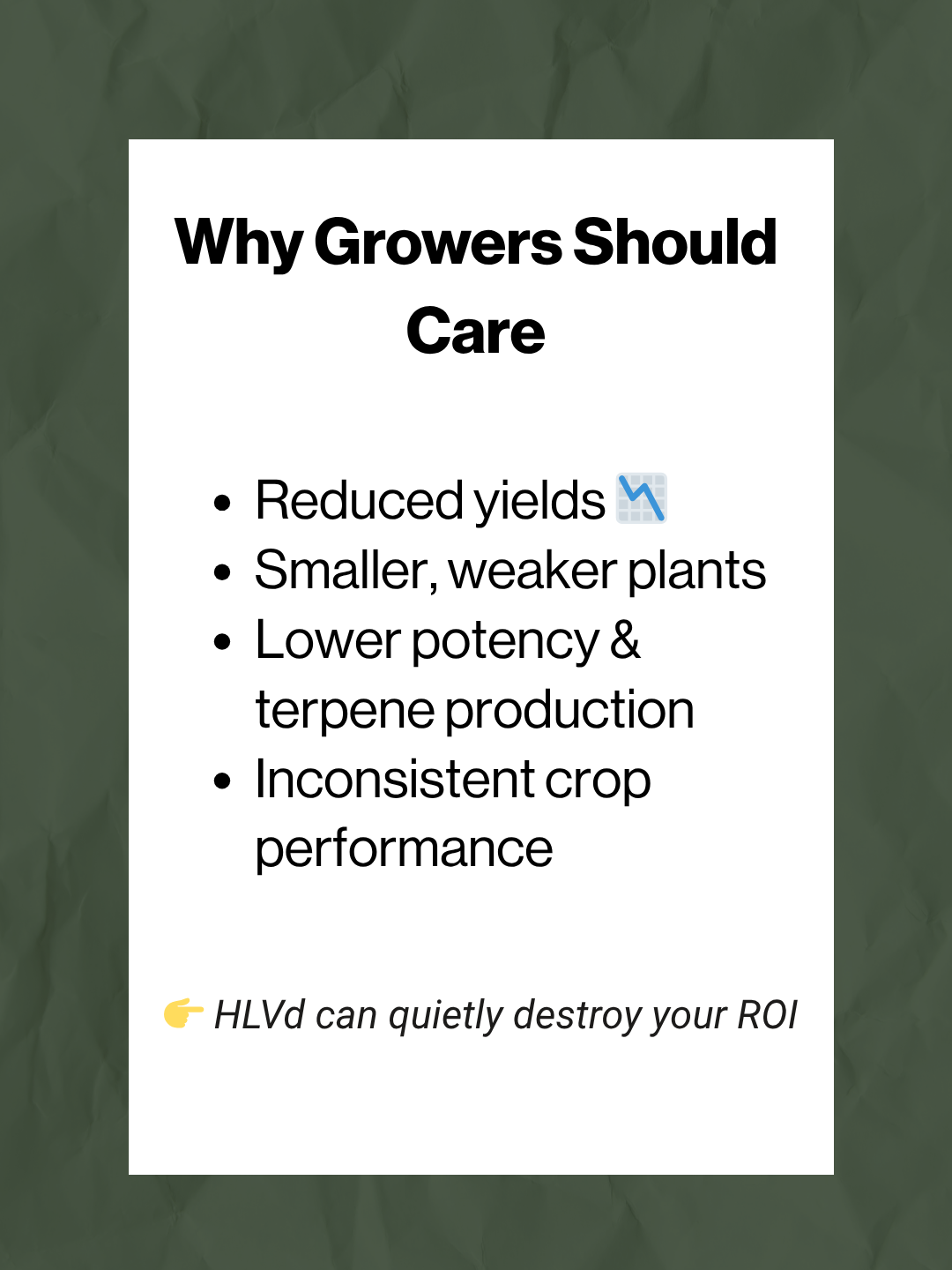
HLVd has caused significant crop loss for Cannabis farmers in the form of lower yields (translating to a possible 33% loss financially across some state markets),8 lower trichome content, and reduced terpene profiles.3
HLVd is not only highly infectious but it remains hidden or dormant (latent) to observation until the cannabis plant experiences a secondary stress such as heat, over watering, pest infestation etc. that causes visual symptoms to occur.4
Sometimes HLVd can start showing symptoms during the flowering stage, even if not visually detectable during the entirety of the vegetative growth. It can cause the plant to develop small, abnormal (sometimes spiky), and less potent buds all over resulting in loss of yield and potency.3,8
Some infected cannabis plants never show symptoms throughout their entire lives and this is another reason why HLVd can be spread so easily as growers may sell or trade cuttings or clones with others and not have any suspicion that those pieces of plant material may be harboring the viroid.4 Improper sterilization of cutting tools and the reuse of gloves across different plants can quickly spread the viroid throughout your grow room as well.3,5
HLVd can exist in most of a plant’s tissues (stems, leaves, roots, etc.) but largely resides in the roots of cannabis plants. This does not mean leaves, stems, and buds are unaffected. The Viroid can take time to migrate through the entire plant as it enters the phloem (the vascular tissue responsible for conducting sugars and other metabolic products downward from the leaves) through a cut or tear in a stem or leaf, travels to the roots, and then spreads throughout the rest of the plant.6
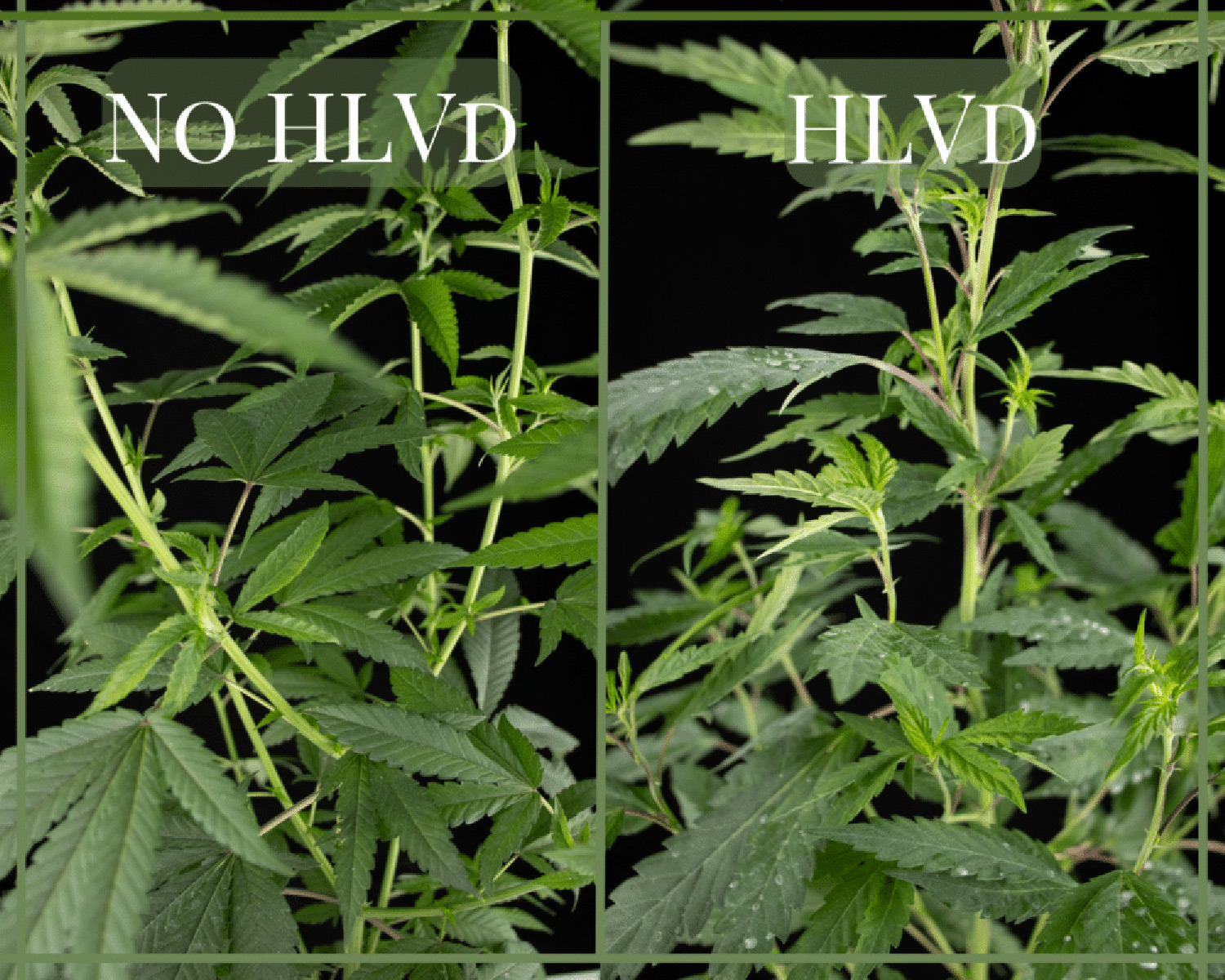
Left: a young veg plant showing normal leaf distribution with common morphology. Right: An HLVd positive plant early in its vegging stage, showing clustering of new leaf growth and aberrant leaf morphology.
Symptoms
Shorter internodal spacing
Smaller leaves (sometimes with higher rates of chlorosis)
Stunting of bud size and morphology
Reduction of trichomes
Reduction of terpenes
Reduced overall plant vigor (weaker apical/main and lateral stalks)
How to Identify
As previously stated, visual observations of HLVd can include smaller buds with reduced trichome and terpene content during flower as well as abnormal leaf formation and stunted growth during all stages of a cannabis plant’s life. However, visual observations can occur too late after a grow has already invested significant time and money into flowering many plants which results in loss of crop and profit.
The most accurate way to assess the status of cannabis plants is through one of two processes known as Reverse Transcription PCR (RT-PCR) and Quantitative PCR (qPCr) which can be performed by many commercial labs across the US.3,9
Routine testing of mother plants, as well as any new clones or mothers introduced from outside your facility, is highly recommended. A schedule of up to 4 tests per nursery plant over a period of a month and a half has been suggested by one source.8 Another source has suggested isolating new plants for 30 days and testing on the third week of isolation.3 Regardless, testing is critical to ensuring the prevention and/or spread of existing HLVd in your grow facility.3,6
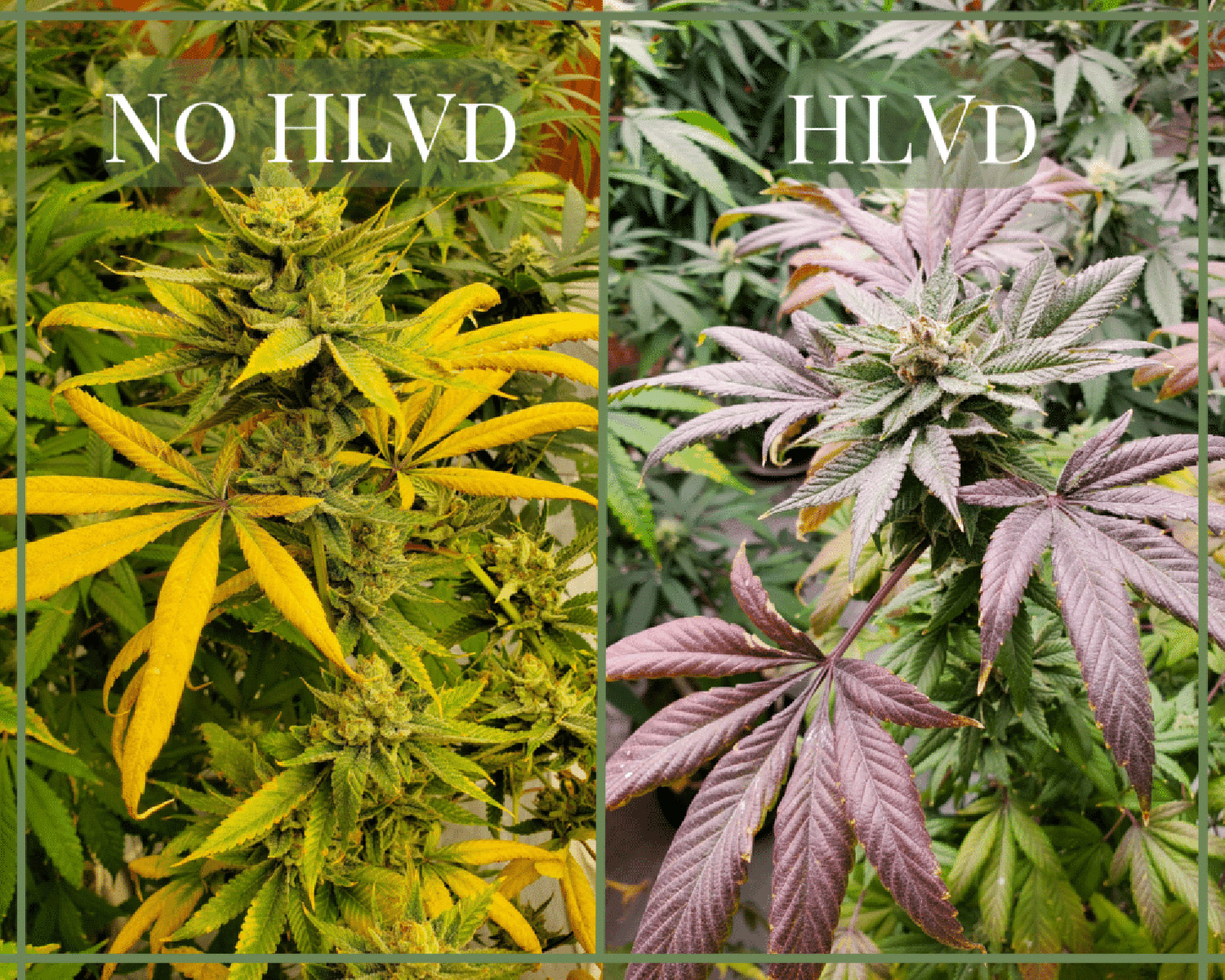
Left: A plant from the same pack of seeds at the same time in flower (week 7). Note the greater yield and more normal spacing on the leaves. This is closer to the normal presentation for this strain when uninfected by HLVd. Right: A plant late in flower (week 7) showing greatly reduced yield from the norm. Note the small bud size and the tight spacing on the clusters of leaves. Reduced yield and leaf bunching are two of the most common observable effects of HLVd or the ‘dudding virus.’
Transmission
HLVd is mainly spread by mechanical transmission.5,6 This refers to dirty cutting tools, unwashed hands, dirty gloves, and any other contaminated objects coming in contact with a plant’s tissue.
HLVd can also be spread through aqueous transmission (through water). For example, a non-infected clone can become infected if it is in the same cloner as an infected clone. Even if the two clones never have root-root contact, HLVd can move through the water from one infected plant to the roots of all the other clones in the same cloner. This also means plants that share drip trays or saucers could potentially end up infecting healthy plants when water run off from the bottom of an infected plant’s pot can mix with the roots and soil of the healthy plant.5,6
There are no published reports currently that show insect transmission of hop latent viroid in cannabis. However, many other viroids are spread by insects, making insect transmission of HLVd a high possibility. It is good practice to limit your cannabis plants exposure to bugs (best pest management practices, healthy plants, good environmental controls, etc.) as many other viruses and pathogens are spread by insects.7
Best Practices for Prevention
Isolate any new cuttings or established plants coming from outside of your facility. Make sure to test these plants before integrating them with the rest of your grow.
Change gloves when working with multiple plants. One pair of gloves per plant.
Clean cutting tools with at least a 10% solution of bleach that contains 5.25% sodium hypochlorite for at least 10 seconds in between taking cuttings from one plant to the next. Also clean any work surfaces that come in contact with plant material. 3,4,5 Isopropyl alcohol will not kill the viroid so bleach is required for efficient removal of HLVd from cutting/workstation surfaces.10
Avoid having plants share drip trays/saucers if possible (due to aqueous transmission).5,6
Destroy any plants that are infected or remove them from your grow to be treated for HLVd through tissue culture (only recommended if the cultivar is critical to your business due to time and financial cost of tissue culture).
Summary
HLVd can be a devastating issue for any grower whether it’s the home or commercial cultivator. HLVd can remain dormant for a long time and may never show symptoms while it spreads throughout a grow. Mechanical transmission through dirty/used cutting tools and gloves is the number one method of transmission of the viroid. Through routine testing, via RT-PCR or qPCR methods, and employing best practices in cleanliness all growers can limit the spread of this pernicious pathogen and get the quality flower we all love.
3: Adkar-Purushothama C.R., Sano T, Perreault J.P. (04 March 2023). Hop Latent Viroid: A Hidden Threat to the Cannabis Industry. MDPI. doi: 10.3390/v15030681. PMID: 36992390.https://www.ncbi.nlm.nih.gov/pmc/articles/PMC10053334/
9: Punja, Z K (2021). Emerging diseases of Cannabis sativa and sustainable management. Pest Management Science 01 February 2021. https://doi.org/10.1002/ps.6307
Disclaimer: Cannabis seeds are sold as souvenirs, and collectibles only. They contain 0% THC. It is imperative that you check your state and local laws before attempting to purchase seeds, and we are not liable for what you do with seeds after receiving them. The statements on this website and its products have not been evaluated by the Food and Drug Administration. These products are not intended to diagnose, treat, cure or prevent any disease. Consult your doctor before use. North Atlantic Seed Company assumes no legal responsibility for your actions once the product is in your possession and is not liable for any resulting issues, legal or otherwise, that may arise.
Are you 21 or older?
You must be 21+ to enter this site.
Sorry, you must be 21 or older to enter this site.