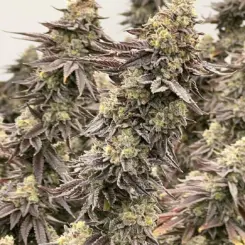
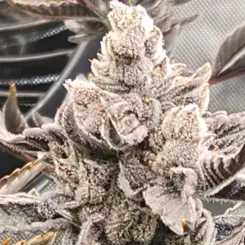
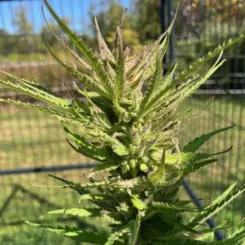
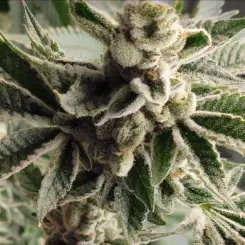
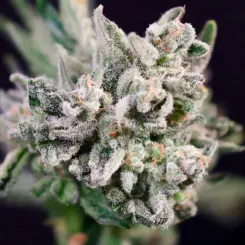
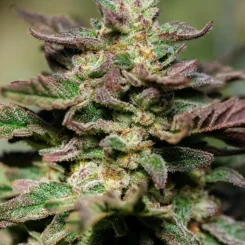
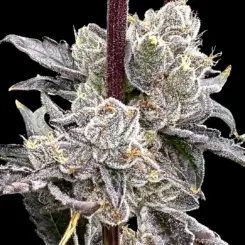
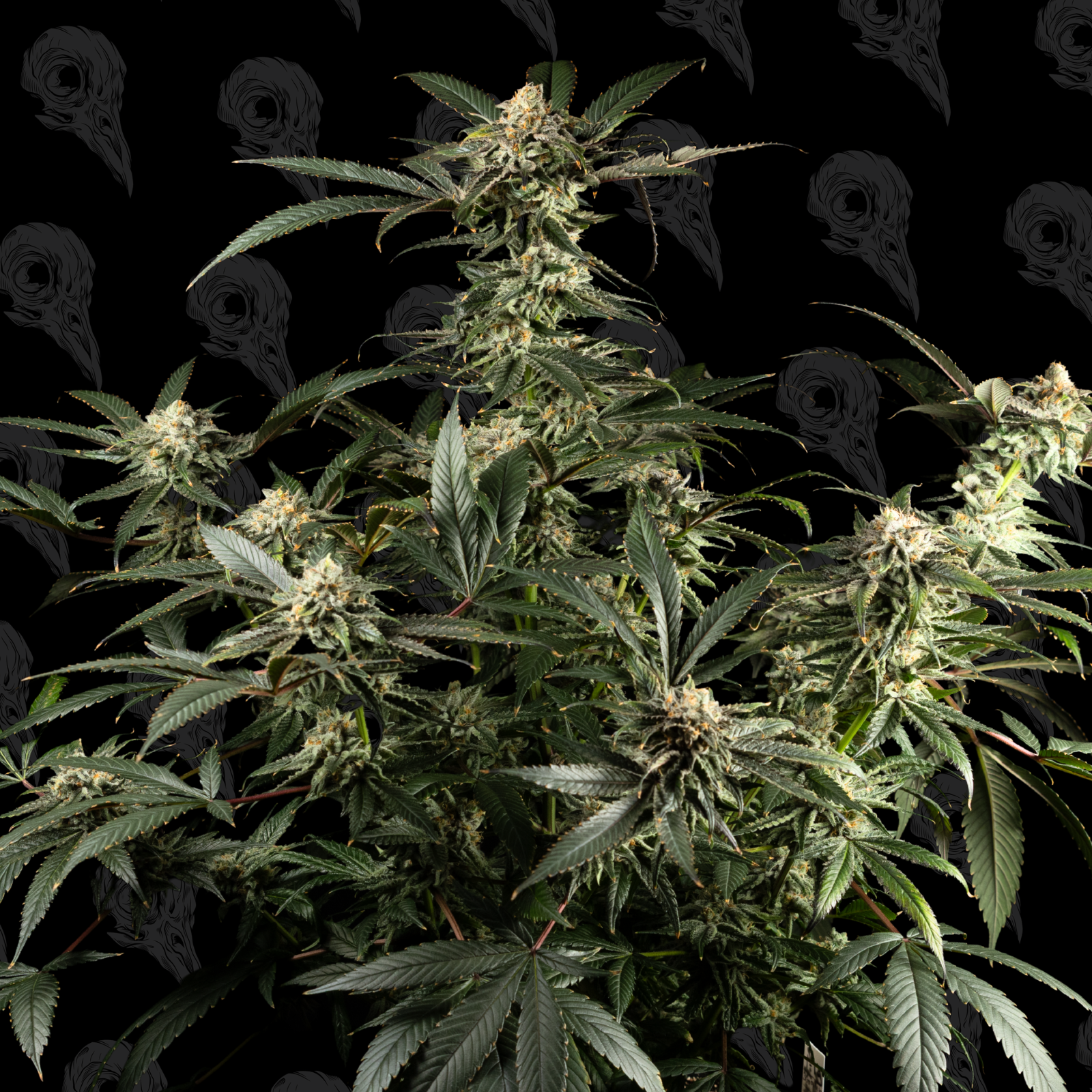
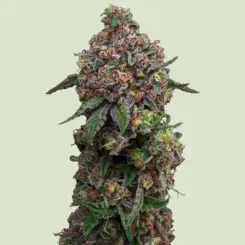
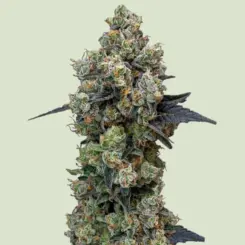
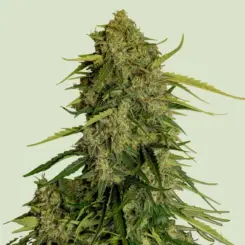
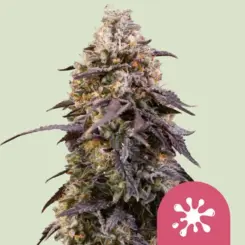
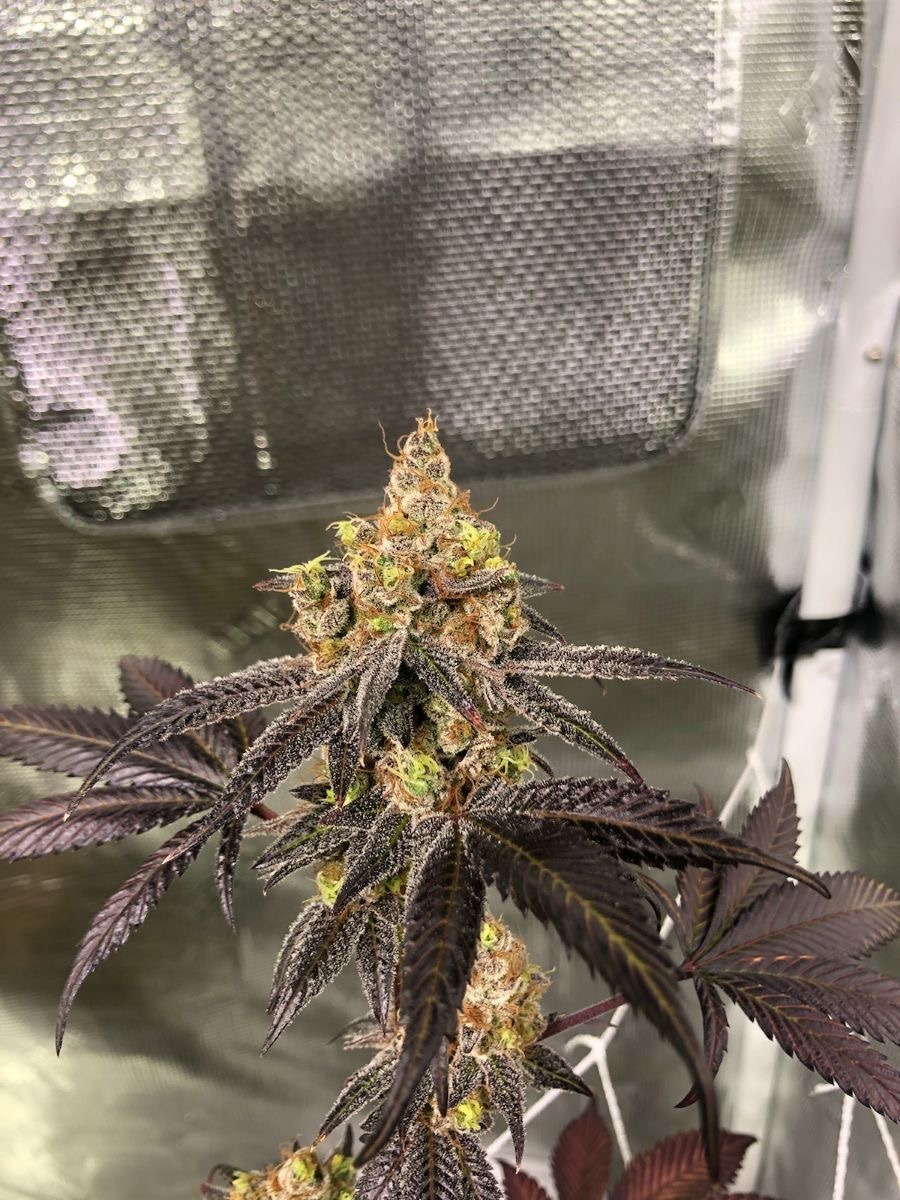
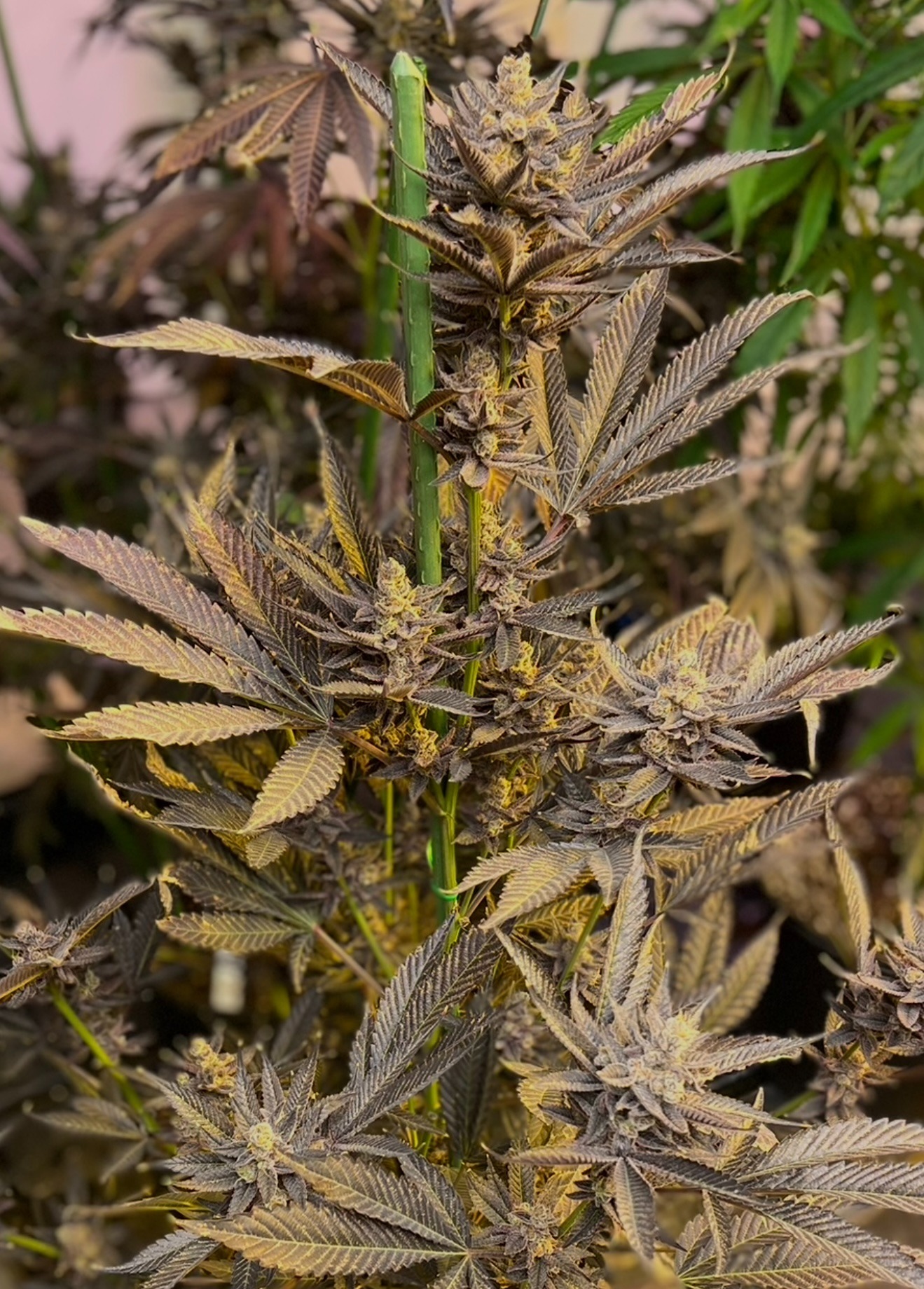
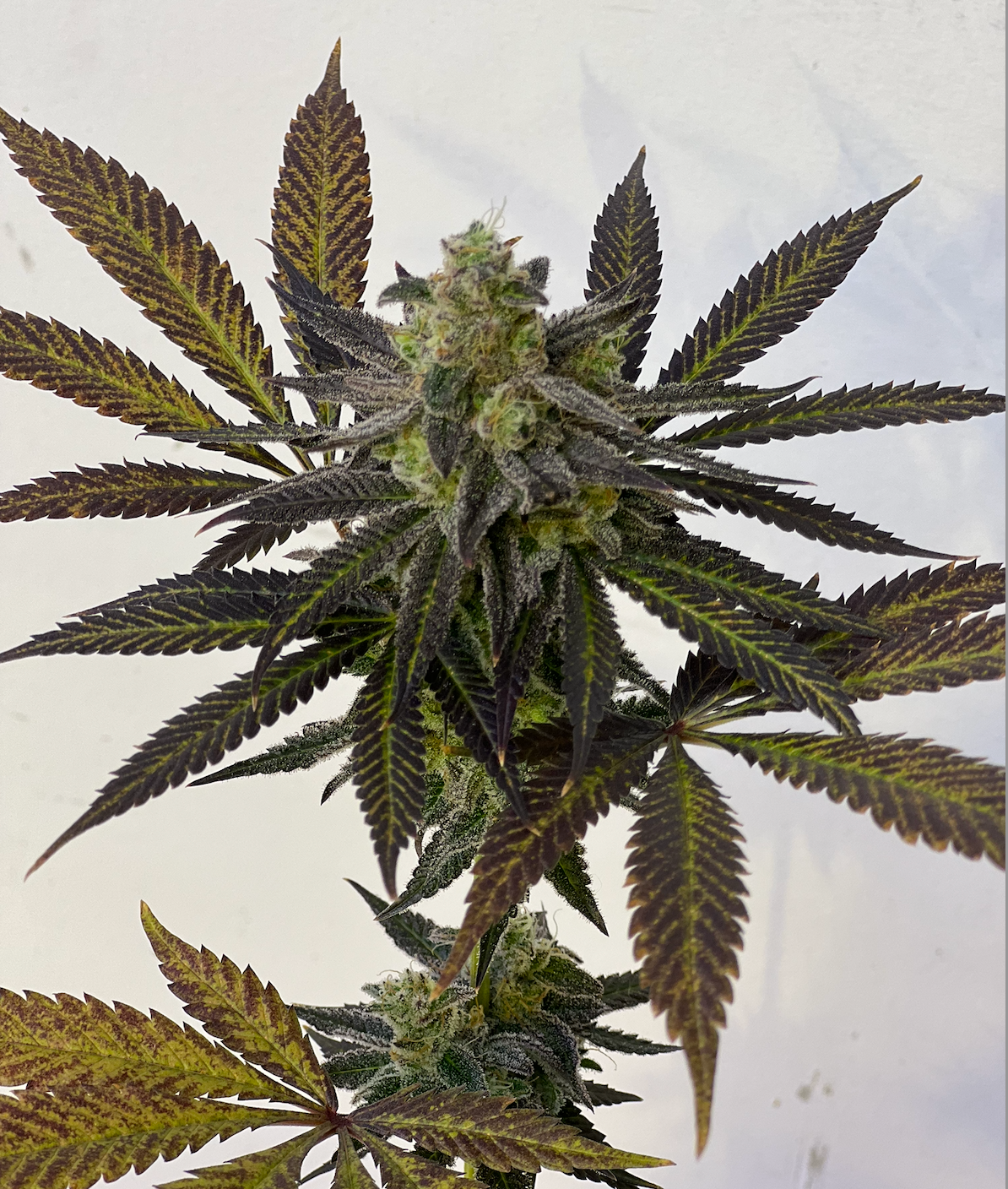
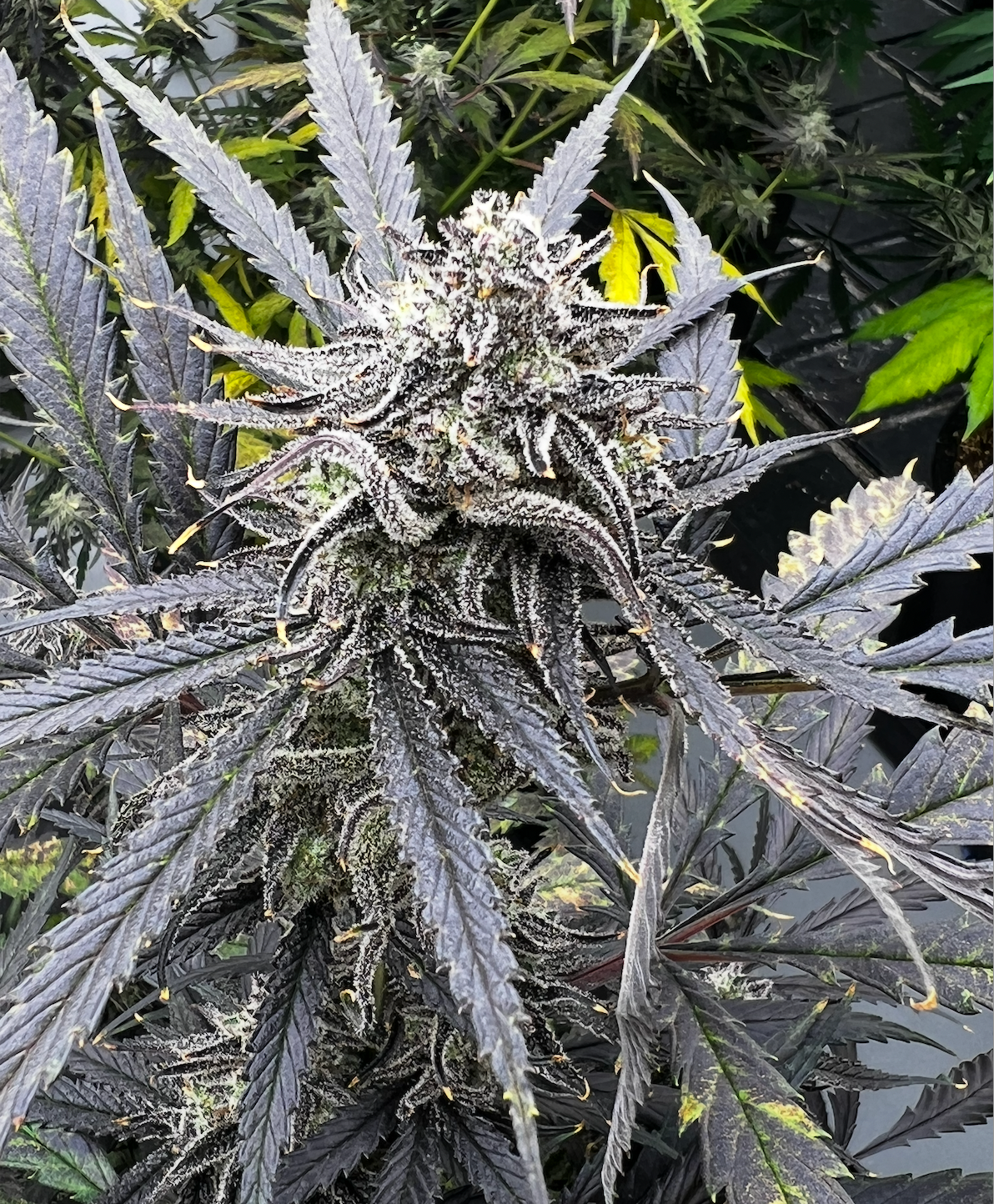
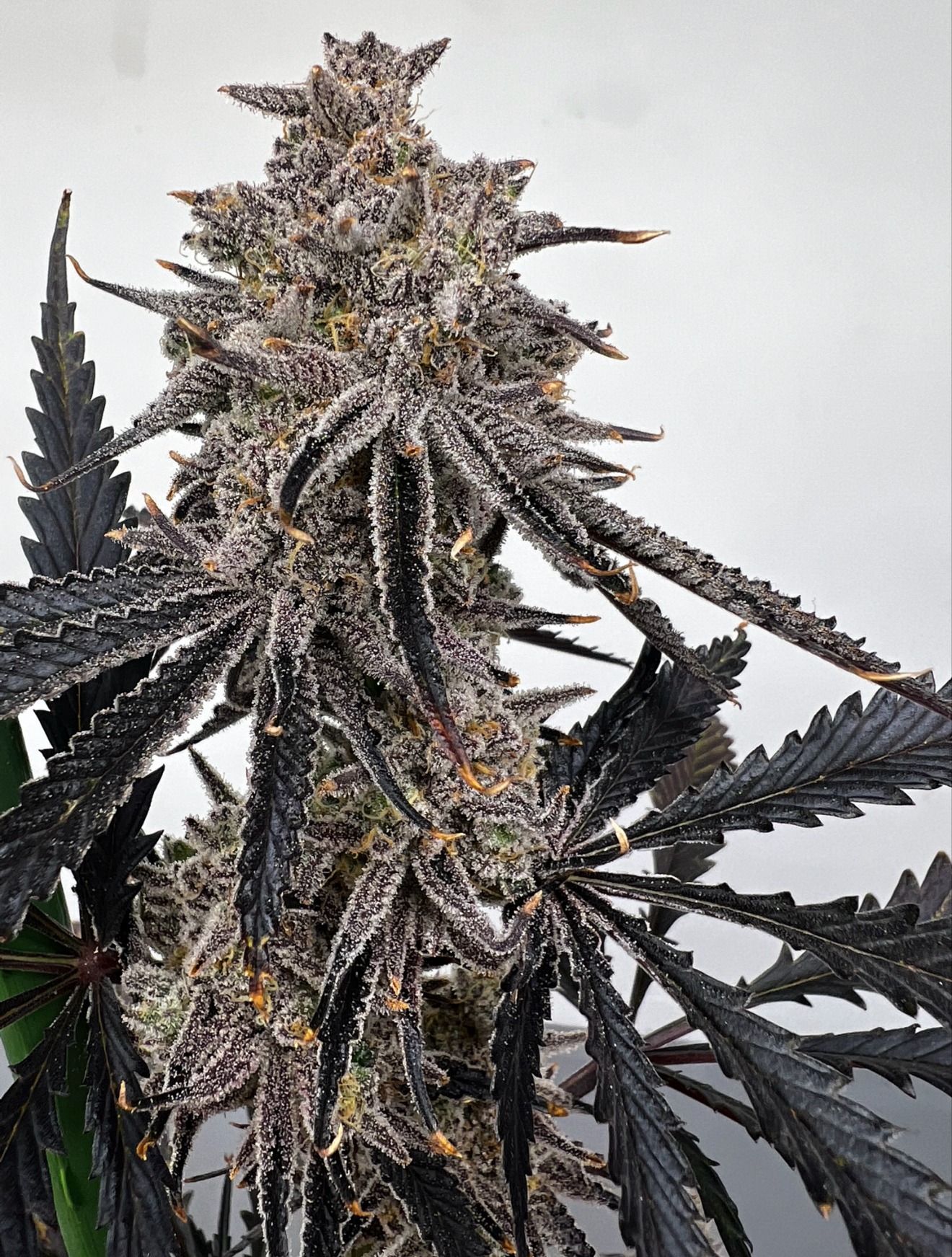
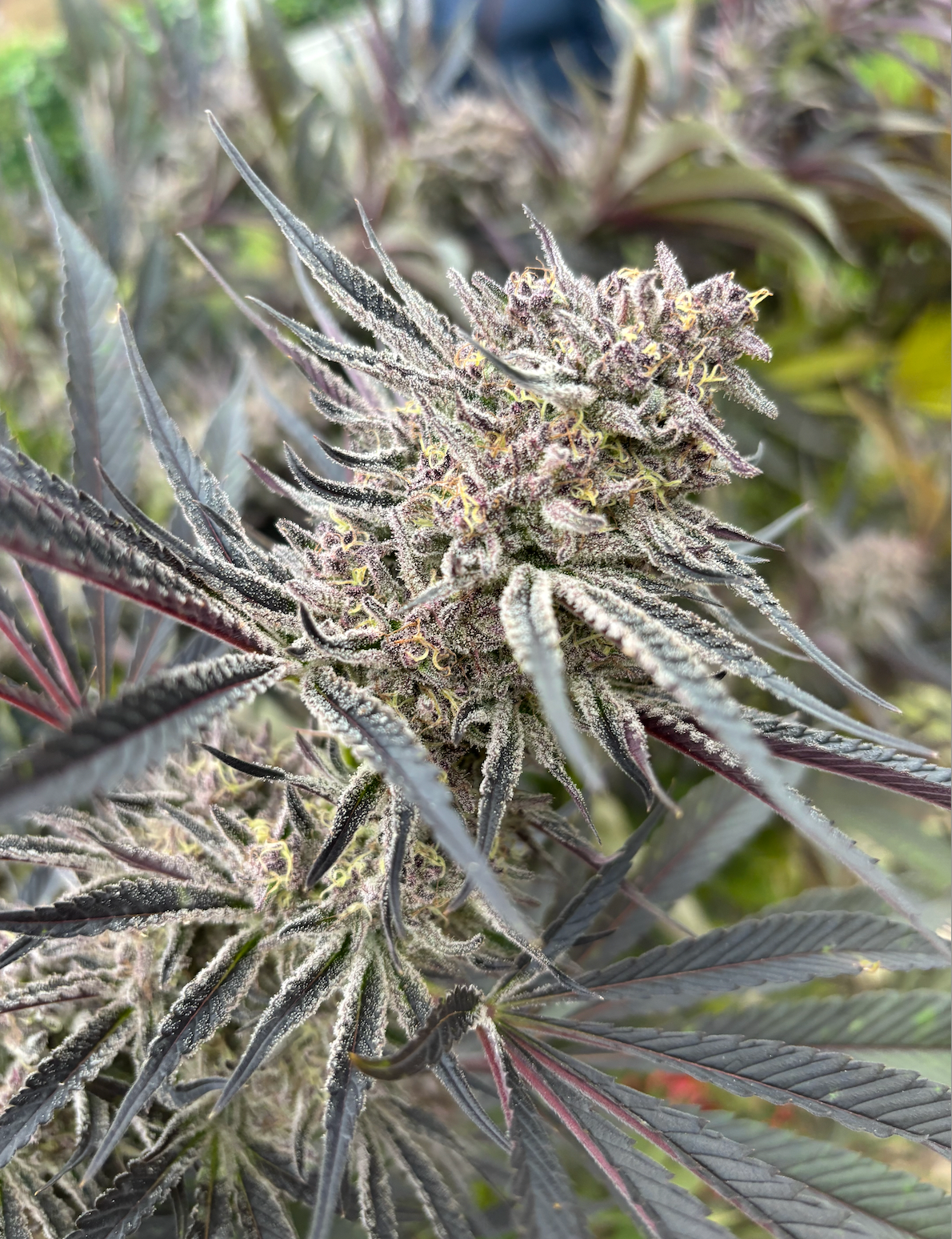
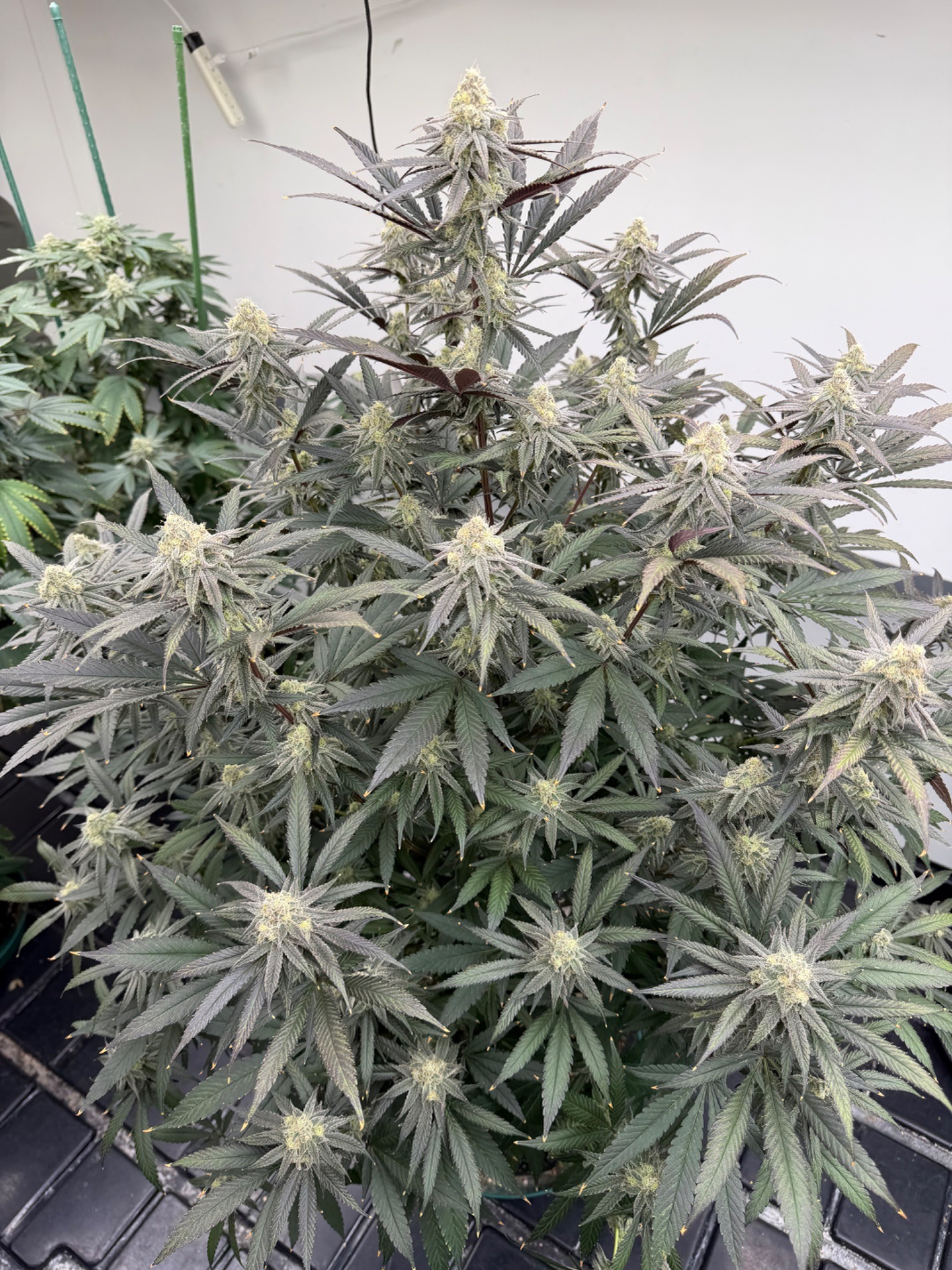
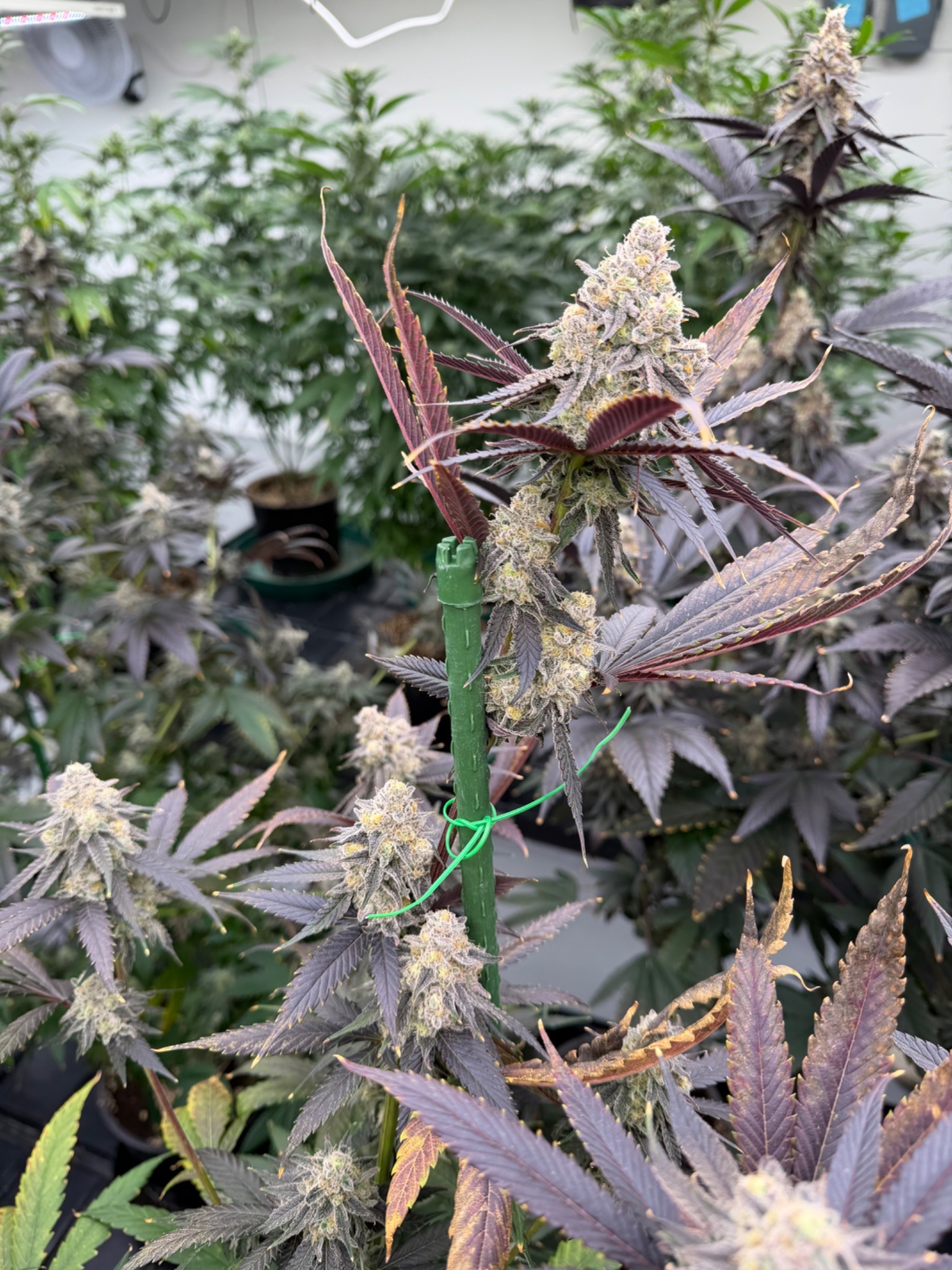
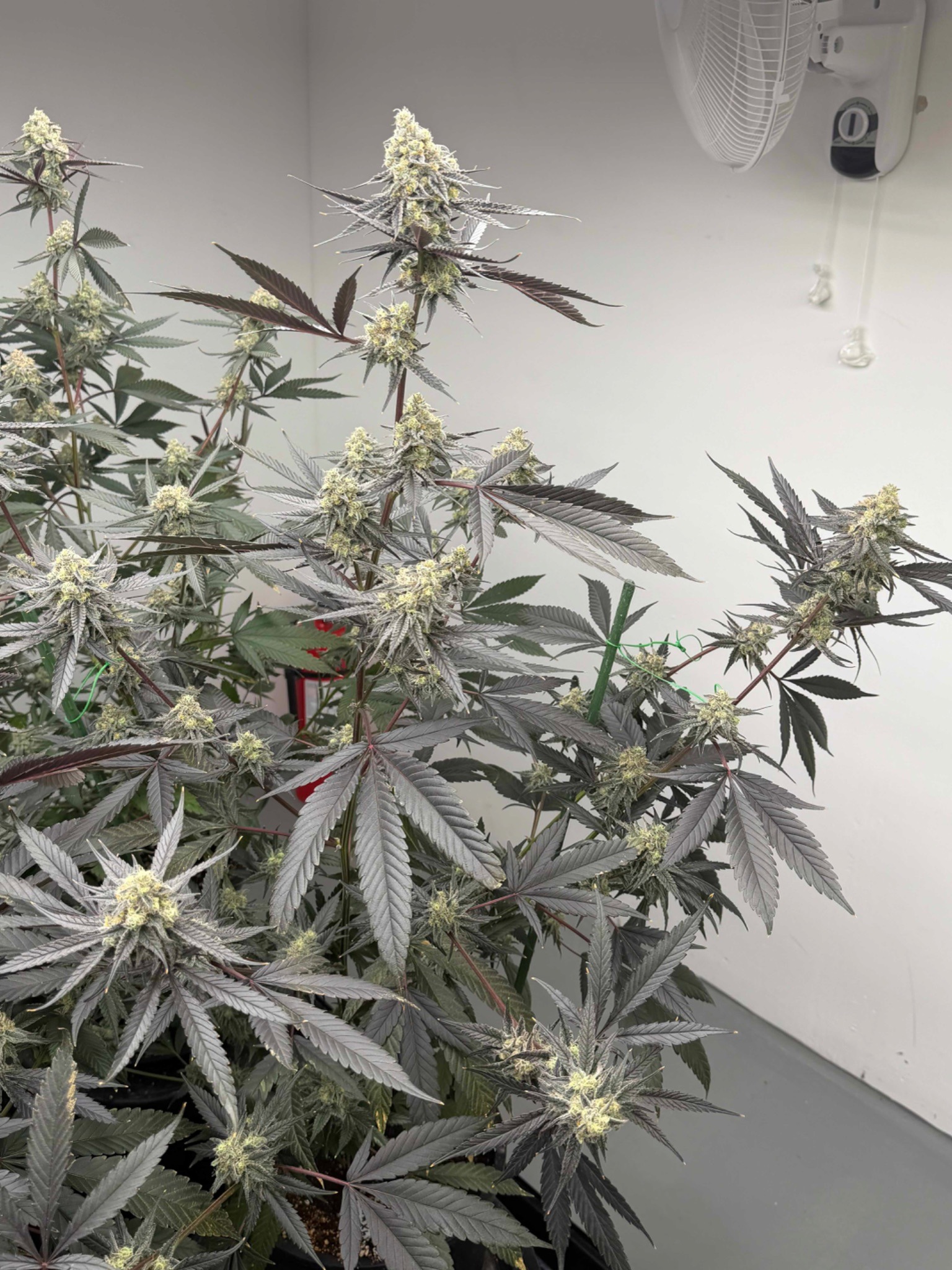
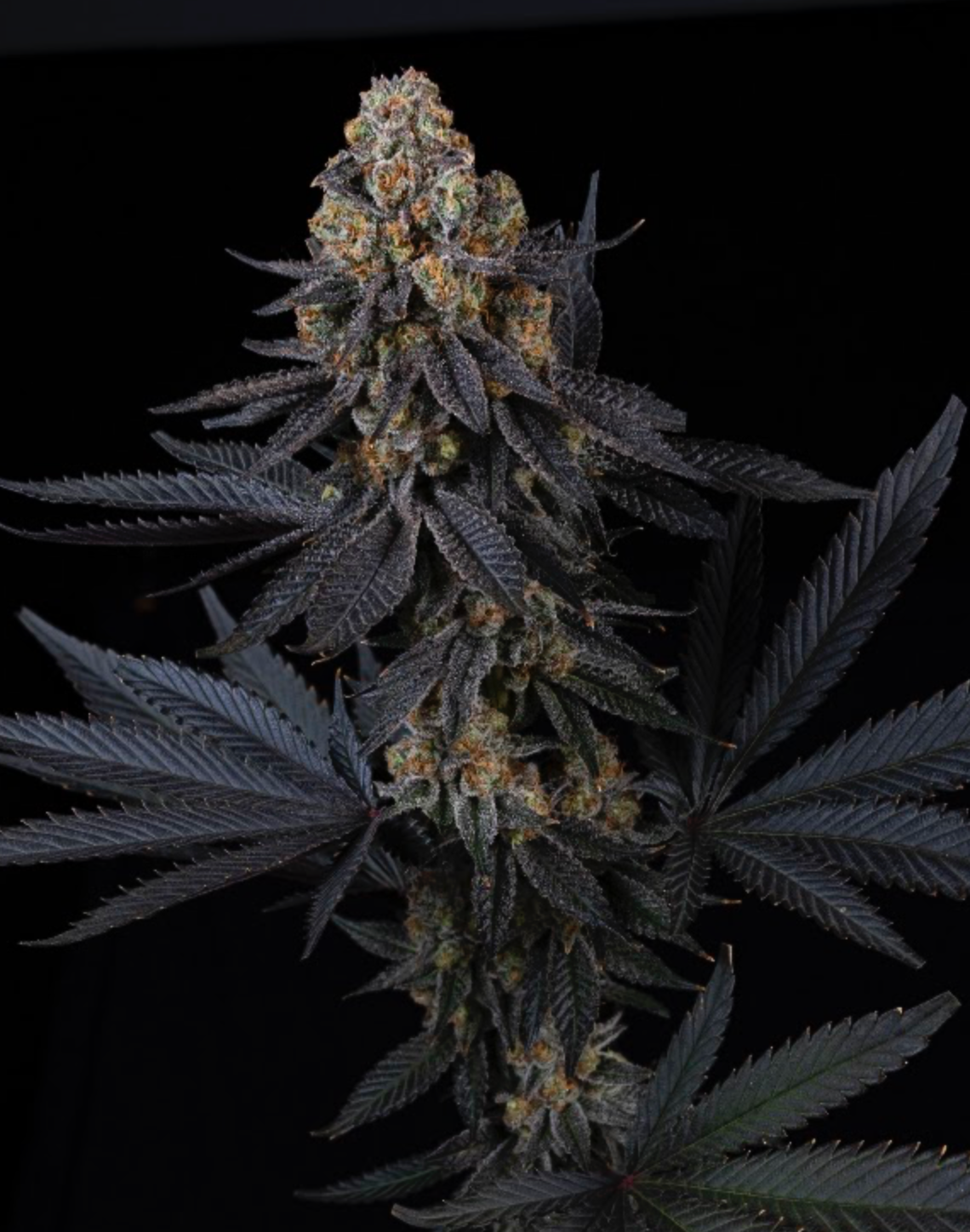
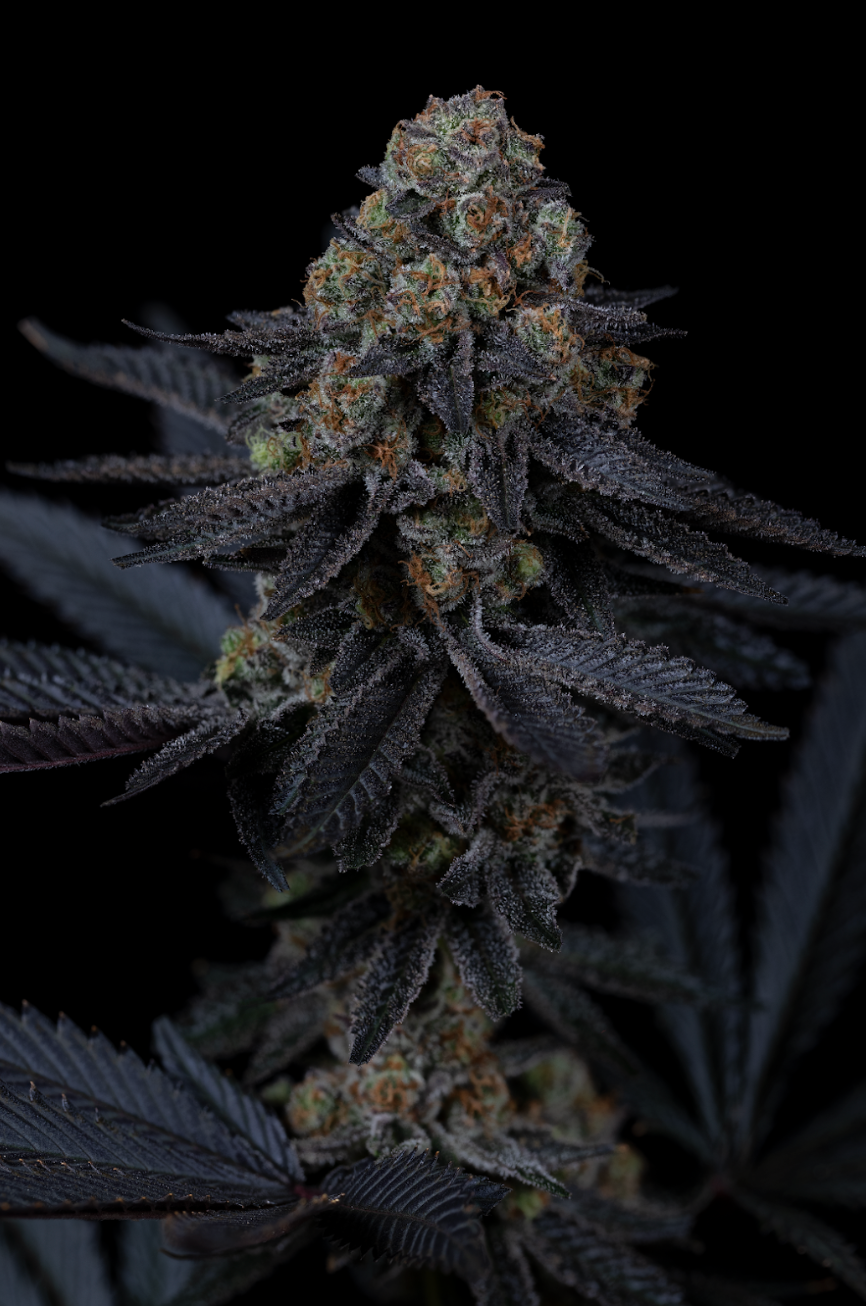
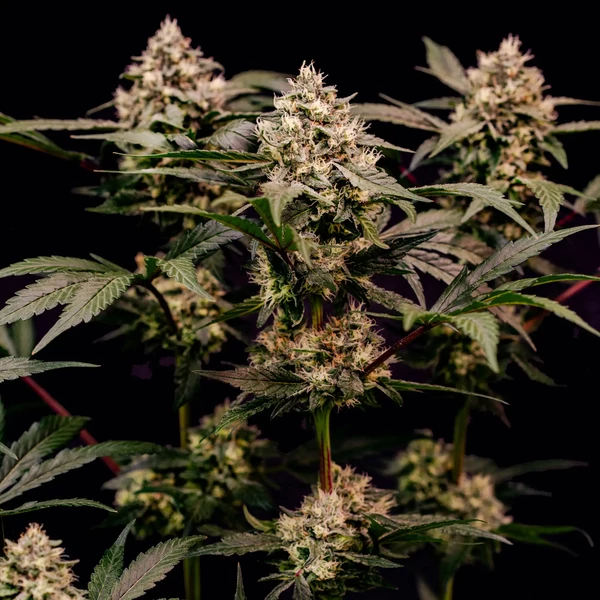
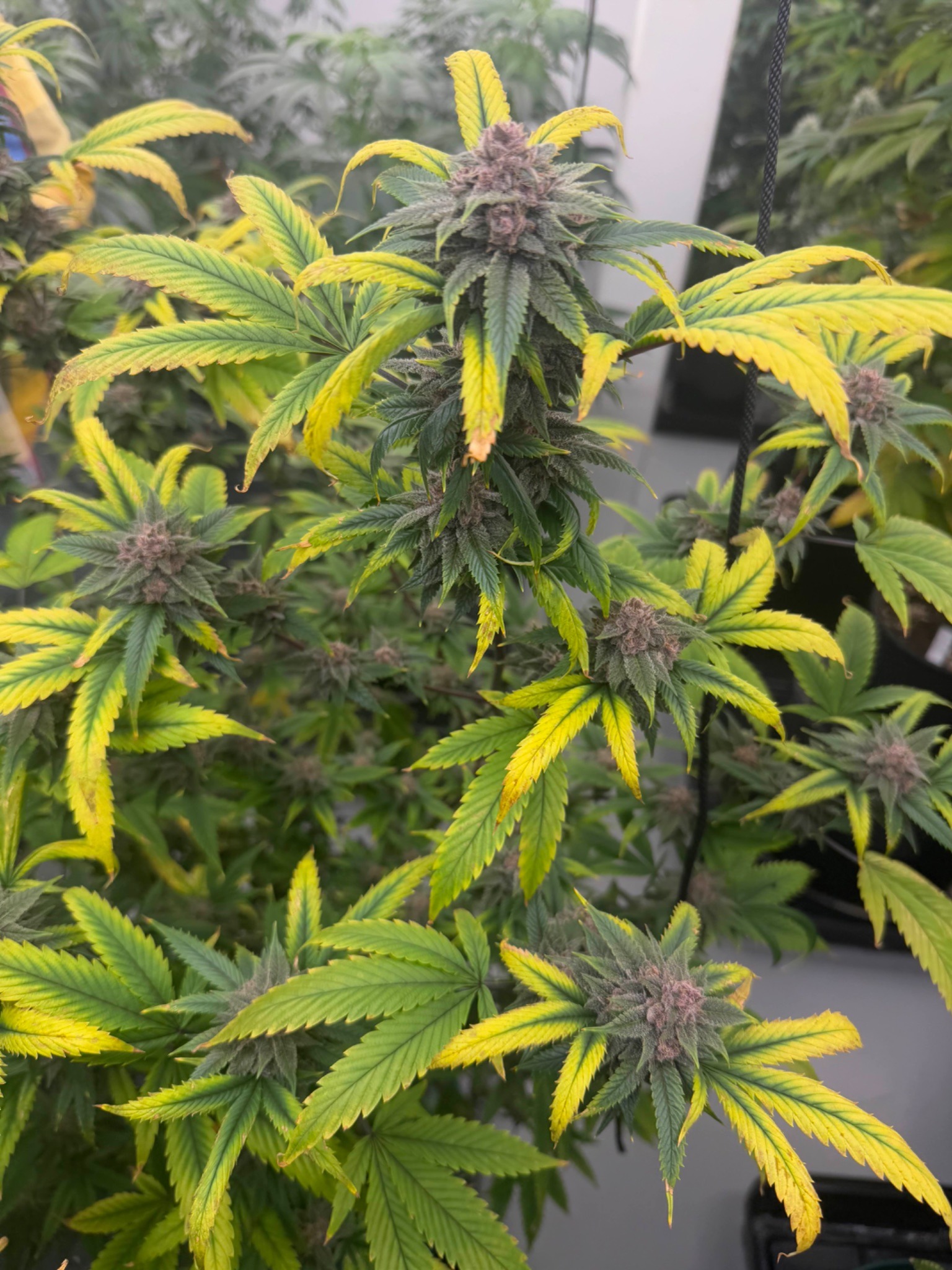
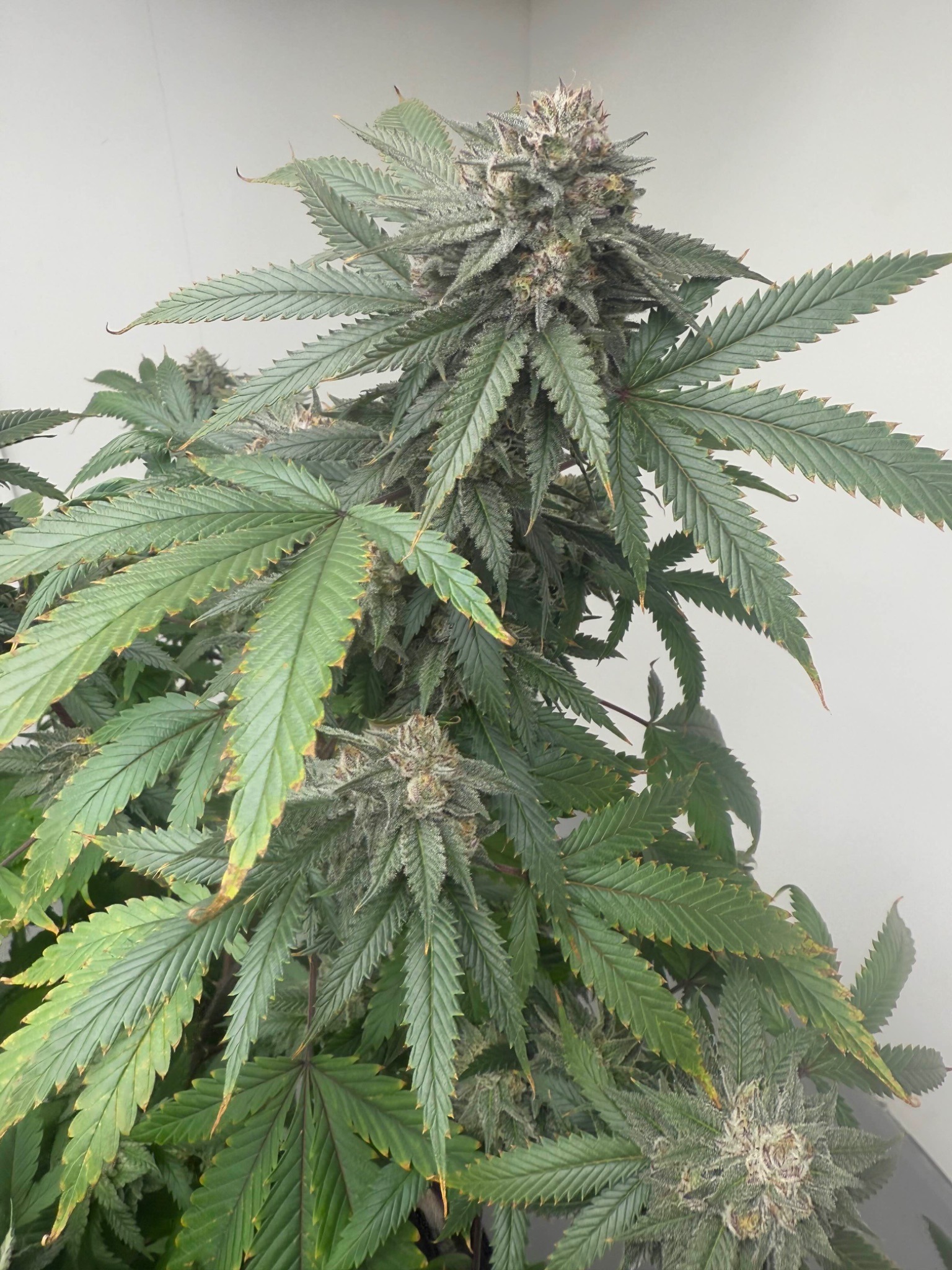
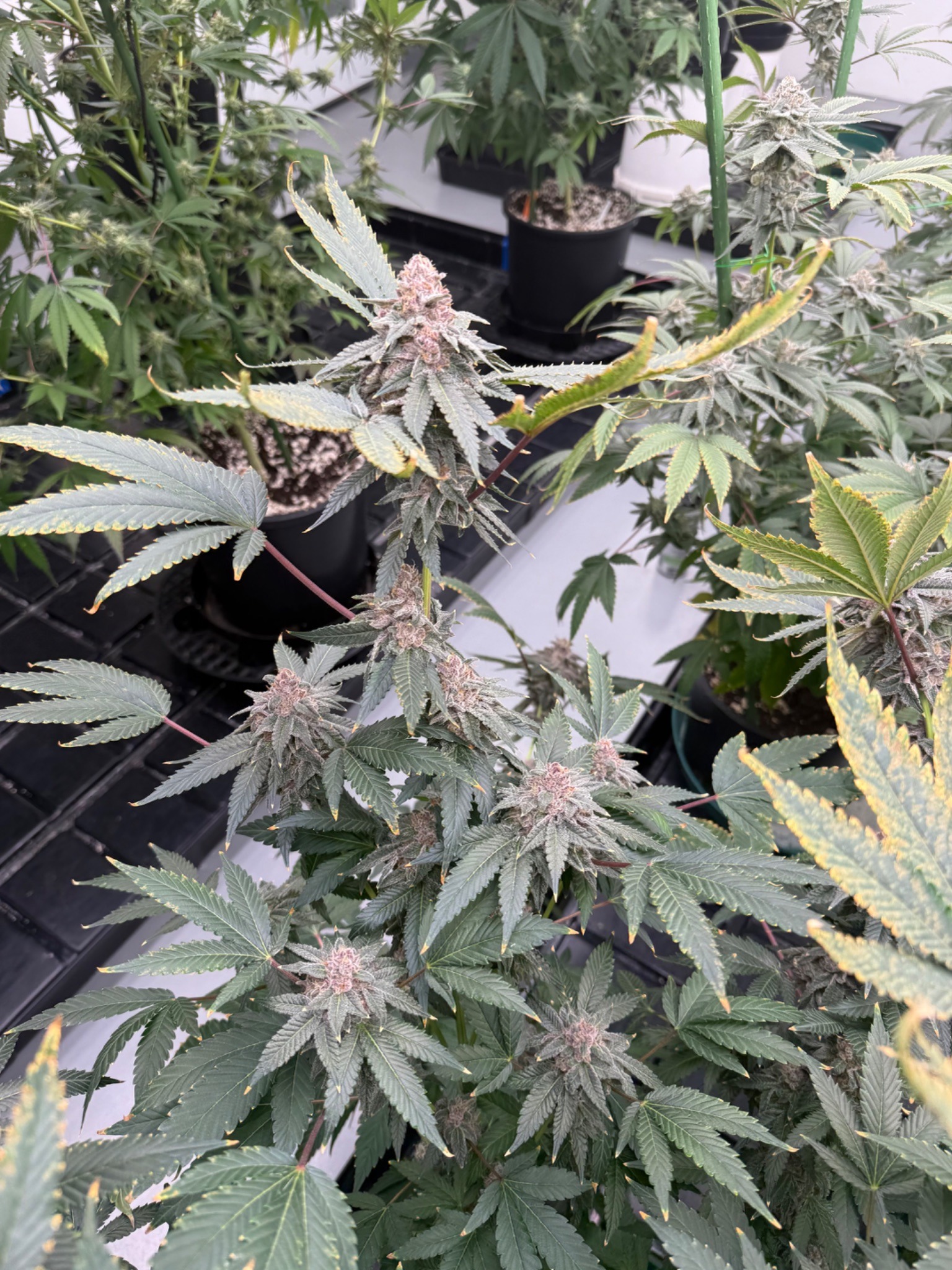
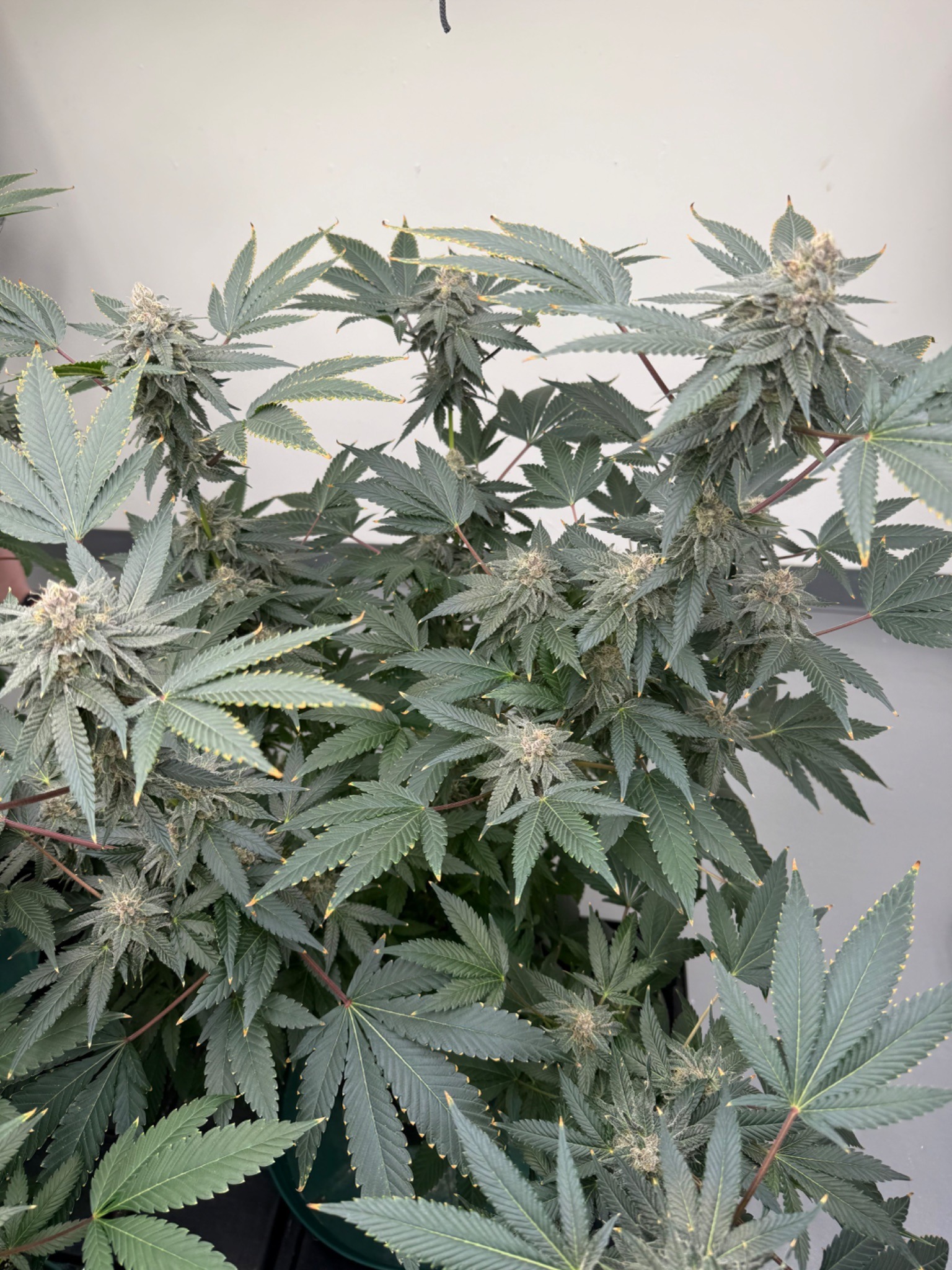
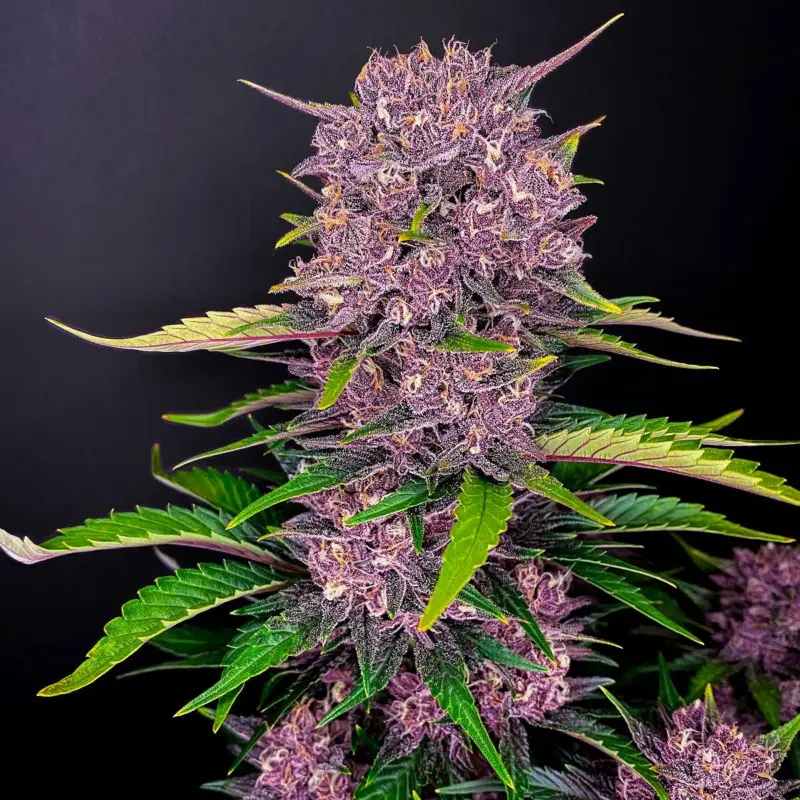
Purple City Genetics is one of the original cannabis nurseries in California—and the last one standing. We're the largest feminized seed producer in the state. We’ve also been on the ground in Barcelona since 2018.
We will always be guided by a few core beliefs: • We exist to match cultivators' dreams and ambitions. • The progression of cannabis requires audacious imagination. • One innovation can ultimately benefit the entire industry.
When it comes to serving cultivators, there's no problem too large or too small. We’re focused on amplifying farmers’ abilities, advancing the cannabis plant’s potential, and inviting everyone to experience growing cannabis for themselves.
Breeding at Purple City Genetics is both evolutionary and revolutionary. We are dedicated to continually improving demonstrated approaches as well as manifesting completely original ideas that force a reappraisal of what's possible. Every exploration serves the unrelenting pursuit of better cannabis. To that end, we are grateful to have been recognized with multiple collaborative State Fair and Emerald Cup wins. Our work is never over.
The NASC Cast Crew had the pleasure of sitting down with Auryn of Purple City Genetics. Listen to what he has to say below, and follow us on Vimeo for even more content!
Buried in the FY2026 Agriculture Appropriations Act, signed into law November 12, 2025 and coming into effect on November 12, 2026, is a provision that quietly redefines how cannabis seed is regulated under federal law. Section 781(1)(C)(i) would, in an unprecedented manner, disrupt the U.S. hemp seed supply chain by classifying seeds as a federally controlled substance based on the THC content of the parent plant, regardless of the chemistry of the seed itself. The provision is unnecessary to accomplish the stated purpose of Section 781, which separately restricts intoxicating cannabinoid products through targeted product-level limits. The seed provision would unnecessarily hamstring American farmers, researchers, breeders, small businesses, and medical patients by criminalizing seeds, ceding the global hemp cannabis genetics market to international competitors.
The provision regulates seed by lineage and traceback, not chemistry and subjects seeds to DEA jurisdiction.
Section 781(1)(C)(i) excludes from the federal hemp definition “any viable seeds from a Cannabis sativa L. plant that exceeds a total tetrahydrocannabinols concentration (including tetrahydrocannabinolic acid) of 0.3 percent in the plant on a dry weight basis,” with the result that seeds would be controlled substances (mandating seed destruction and DEA penalties). For the first time in U.S. hemp law, a material’s legal status is determined not by what it is, but by where it came from. Cannabis seeds do not produce THC — cannabinoid biosynthesis is localized exclusively to glandular trichomes, tissues that seeds do not contain. Yet under Section 781(1)(C)(i), even though a seed tests below the 0.3% total THC threshold, it can be criminalized and classified as a DEA Schedule I controlled substance because of the parent plant’s chemistry. No other agricultural commodity in active U.S. commerce is regulated this way. No federal regulation evaluates wheat seed by the alcohol content of the beer it could be brewed into; no federal regulation evaluates corn seed by the aflatoxin level of its parent field. Section 781(1)(C)(i) breaks from this established principle without precedent.
The compliance standard cannot be met.
The statute is too vague for USDA’s successful implementation. The statute requires traceback from the seed to the parent plant, and the parent plant must in turn be tested and shown to be below 0.3% THC by dry weight (as a living plant, testing is dependent on field location, temperature, days to harvest, etc., and is virtually impossible to enforce as part of a traceback system). A full traceback system would require, at a minimum, significant new regulations and appropriations for USDA. In addition, jurisdiction would be shared with DEA, which would have a role enforcing penalties and managing destruction of criminalized seeds, requiring new funding for DEA.
Implementation of the statute would result in the loss of U.S. seed banks and genetic material passed down for centuries. For germplasm already in lawful possession on the effective date, parental THC history cannot be reconstructed at any cost — the parent plant no longer exists to be tested. No regulation USDA could issue can supply a compliance pathway for material already in lawful commerce. Without congressional action, a seed bank or research institution that lawfully holds tens of thousands of seeds on November 12, 2026 becomes subject to the Schedule I framework.
The provision harms patients, veterans, and Americans.
Implementation of the provision would restrict access by patients, veterans, and Americans to the genetics needed for home and state-licensed cultivation. As of 2024, 47 states, the District of Columbia, and three territories allow medical cannabis use. Approximately 25 jurisdictions authorize home cultivation, where registered patients reproduce specific cultivars from seed to maintain consistency of cannabinoid and terpene profile — including CBD:THC ratios used in seizure management and low-THC, high-CBG cultivars used in inflammatory and neuropathic pain management. Section 781(1)(C)(i) withdraws the federally compliant pathway by which seed for those cultivars moves interstate, at the same moment that federal rescheduling under AG Order No. 6754-2026 expands medical recognition. Veterans accessing alternative therapies, patients treating seizure conditions, and Americans using cannabis for chronic pain and sleep lose access to the specific genetics on which their stabilized care depends. Implementation of the provision would interfere with state laws, federal laws, and the direction of policy to provide access for patients to needed inputs for home cultivation.
The provision cedes the global cannabis genetics market to foreign competitors and ends U.S. interstate commerce.
No global trade competitor’s jurisdiction regulates and criminalizes cannabis seed by parental plant THC traceability. At a time when other countries are opening up their seed markets and deregulating to obtain competitive advantage, the U.S. would impose a compliance burden no major trading partner imposes, hobbling our U.S. dominance. At the same time, the provision would balkanize our own U.S. market among 50 states, ending interstate commerce when a domestic market is needed. Federal law governs interstate commerce, and Section 781 will make seeds federally illegal scheduled products — based on a vague, unenforceable standard — thus chilling interstate commerce in seeds. Without a national market, investment in seed innovation and commercialization will be severely set back.
The economic stakes are real and growing.
Hemp grown specifically for seed production was valued at $41.5 million in 2021 (USDA NASS, 2022), contracted sharply in 2023 to $2.9M, and has since rebounded — reaching $16.9 million in 2024 and $49.7 million in 2025, surpassing the 2021 peak (USDA NASS National Hemp Report, April 2026). Total U.S. industrial hemp production value reached $739 million in 2025. Classification of seed as a controlled substance has deep-reaching negative impacts for small rural businesses, investments, financial institutions, credit card processing, and banking services. American breeders are well-positioned to lead the global cannabis genetics market. Section 781(1)(C)(i) hands that opportunity to international competitors at precisely the moment when U.S. operators are scaling to compete. The overarching result would be unnecessary job loss through misguided and excessive regulation.
Congress should act before the November 12, 2026 deadline. ASIGA’s proffered remedy is to strike Section 781(1)(C)(i) in its entirety. Seeds are already covered by the base hemp definition under the 2018 Farm Bill — if a seed tests at or below 0.3% THC, it is hemp under federal law. Section 781(1)(C)(i) is not needed to accomplish Section 781’s stated purpose; Sections 781(1)(C)(ii) through (iv) already restrict intoxicating products directly by regulating the final consumer product. Congress must take urgent action to protect America’s seed future for growth and innovation.
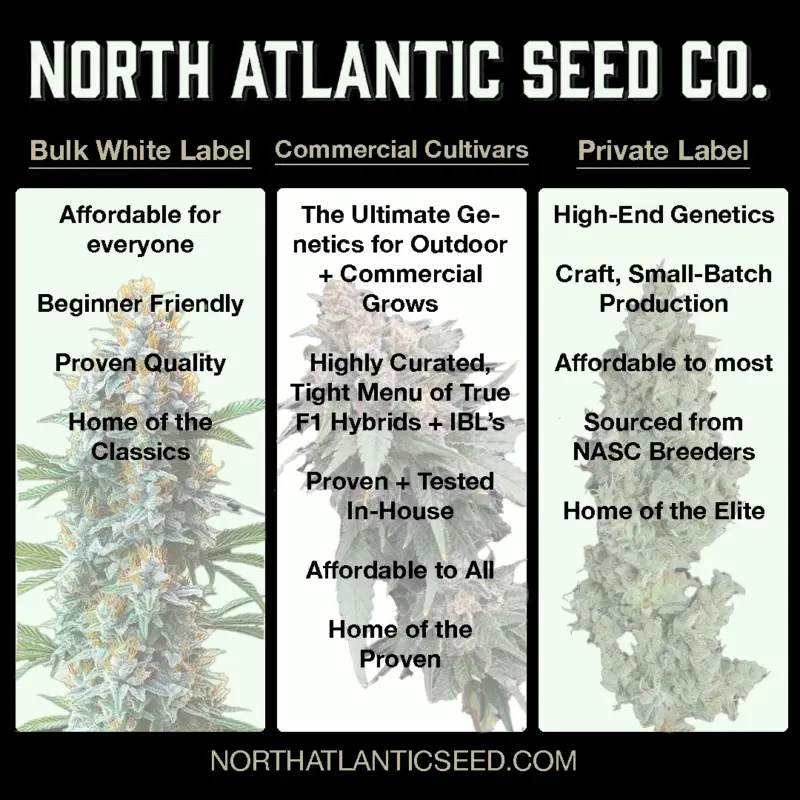
Ever wonder the difference between North Atlantic Seed’s BWL, Private Label and Commercial Cultivar lines? Beth is here to explain.
I swear, we didn’t make all of these “house” subcategories just to confuse you, but it is a bit confusing. For those of you who have been wondering, I’m here to set the record straight. Below, I will highlight how our team conceptualized each of the North Atlantic Seed “house” menus, and I will explain the meaningful differences of each.
The NASC BWL menu is the oldest menu that bears the North Atlantic Seed name. It predates both Private Label and Commercial Cultivars. Our vision with the BWL menu is to bring affordable, trusted seeds to our community that are sourced from farmers and breeders who we feel good about supporting. What does that mean? We are always working on making this menu better, whether that means growing these seeds ourselves, or carefully listening to your feedback. These genetics were bred by breeders you know and love, as well as by breeders you will never know but who deserve our support. The common denominator here is proven, trusted quality at a price point everyone can afford. We really try to load this menu with as many of the classics and high-demand strains as we can source
The NASC Private Label line was created with a specific purpose in mind: We wanted to fill this demand we were seeing for high-end, craft genetics, but we wanted to do so as affordably as possible. There is something unsavory about paying $10,000 for a cut, or $500 for a pack of seeds. No judgement. I understand very well the amount of work, time, and money that goes into being a small-batch breeder, but is there a way to make these really innovative, cool genetics available to the seed-lovers who are on a budget? Does it have to be this elite thing? As it turns out, there is. As we explored this concept, we found that many of the breeders we work with had seed lots they were willing to part with at a reduced price if we were willing to buy them out in larger quantities. Everyone wins! And thus, NASC Private Label was born.
The Ultimate Genetics for Outdoor + Commercial Grows
Highly Curated, Tight Menu of True F1 Hybrids + IBL’s
Proven + Tested In-House
Affordable to All
Home of the Proven
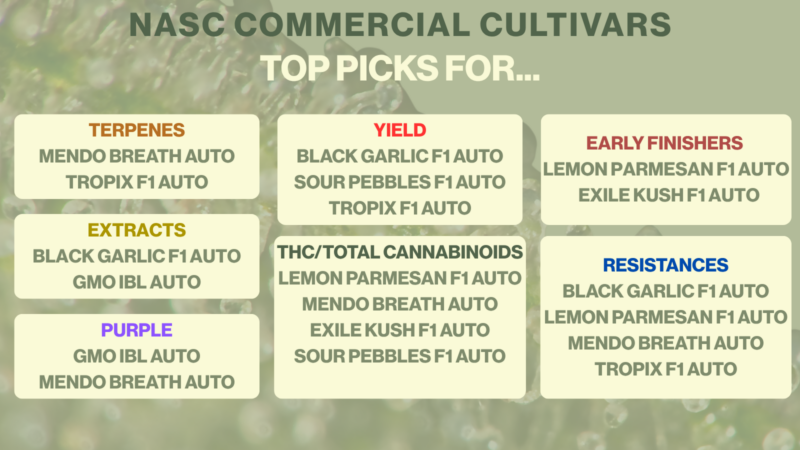
NASC Commercial Cultivars is the most recent house line that North Atlantic Seed has released, and it’s a line that we really took our time with. We needed to do our due diligence with these selections because it was very important that we get it really right on the first try. There is a lot of responsibility and trust that comes with telling a farmer that this is the seed they should plant acres of.
So, we started talking with farmers that had been breeding and making selections in-field alongside their commercial clients over the course of many years. We poured over the data, and we tested these genetics in-house because we wanted to see it with our own eyes. For all of these reasons, we feel incredibly confident in this tightly curated menu.
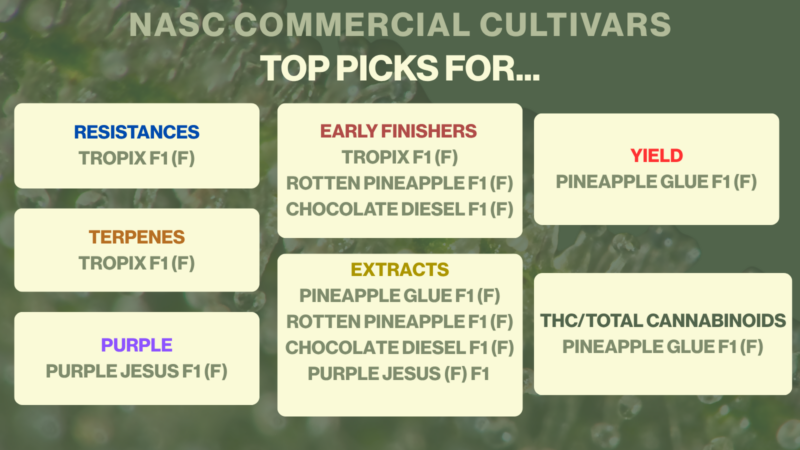
The genetics you will find in NASC’s Commercial Cultivars line have been carefully selected for their overall commercial crop viability. This includes outdoor resilience and resistances, early finishing times, complex terpene profiles, high performing test results, extract performance, overall bag appeal, overall plant and flower morphology, dependability and stability. These are genetics that have been proven to thrive in large commercial settings, and these are genetics that you can trust, at a price point that is reasonable.
Browse Bulk White Label, Commercial Cultivars, & Private Label:
Offensive Selections shares 3 tips for new growers, and more! Don't miss out on all the great deals from Offensive Selections for Breeder of the Week!
3 Tips for New Growers
Genetics are king and always have been It's critical that we're cultivating genetics (whether from clone or starting from seed), that are sourced from breeders/brokers that have a historical record working with authentic varieties. Achieving this is harder than it should be and genuine authenticity is less common in 2026 than you'd expect. Beware of who you let in to your garden, even indoors, our cycles/year and cycles/lifetime are precious.
If your ability to invest in infrastructure is limited, do not short yourself on your grow light(s) or your cooling ability If you have elite genetics with a great light (think of brands with historical success in this space like Gavita, Fluence, Phantom, etc) you are off to a better start than 60-70% of your peers.
Choose carefully who you tell about your exciting new journey Although laws against cultivation have softened around the world, the envy/jealousy type have not. I have always advised that jealous peers are more likely to result in the loss of your crop than the police.
Favorite Breeding Project Our current project with Currency (Blue Power x Runtz) x our flagship cultivar: Sourdough #1. This is a genuine improvement on Sourdough #1 in every category criticized and our prized champion: (Blue Power x Runtz). We have reversed Currency on to the industries most elite (Toad Venom, Red Hotz, VerZace/Black Magic), to name a few) and are slotted for a Summer 2026 drop.
Destigmatizing + Understanding White Label Seeds By Beth Mathieu
What is BWL Bulk/White Label?
BWL is an abbreviation that we use at North Atlantic Seed for Bulk/White Label, and it is how we source our own “house” seed menus: NASC BWL, Private Label, and Commercial Cultivars. White Label is a term that is commonly used among wholesalers, distributors and seedbanks within the cannabis seed industry and beyond, and all it really means is that the seeds were purchased from farmers under the pretense that we could sell them using our own brand and our own name: North Atlantic Seed Co.
Unfortunately, BWL has gotten quite the bad rep in forums and threads online, and that’s why we have always chosen to highlight “BWL” as transparently as we have: 1. We want growers to understand that we did not breed these seeds ourselves. Hopefully, this helps them make an educated decision about who they source their genetics from. 2. We want to destigmatize White Label seeds. Below, I am going to discuss why I think this topic is so important for every grower to understand.
Are BWL Seeds Bad?
Our perspective–as people who understand this industry quite well–is that BWL seeds can be just as great and just as terrible as any other seed. Shocking, right?
What matters is the intent and the breeding practices of the farmer who made the seeds. Like any industry, there are seed mills out there churning out millions of seeds a month purely for the profit; these businesses probably don’t have the grower’s best interests at heart. Conversely, there are craft operators that put a great deal of heart, care, time, and expertise into their breeds. Both types of farmer can supply BWL seeds, so sourcing is really what becomes important, and that is guided by our values as a business, and your values as a grower.
Agriculture and farming is an industry where it’s hard to make a good living nowadays. As farmers and breeders ourselves, we have lived this struggle, and we have no shame in supporting breeders who are creating and refining high-demand genetics for others to brand and sell.
There are many breeders in our community who are incredibly passionate and knowledgeable about genetics, but they have no interest in all of the other things that come along with running a front-facing business: They don’t want to sit behind a computer all day, or work on marketing campaigns, or become beholdent to social media. They want to be in their gardens. And yet that is the business of seeds; more and more, that is what it takes. For these types of breeders and farmers, White Labeling seeds gives them an opportunity to make a living doing what they love without having to be a great business-person at the same time. For this reason, we are not ashamed at all to source White Label genetics for our house brand, but in large part, that’s because we do our due diligence. We are intentional about the breeders we support and rely on in this way because we care about your experience as growers.
Where Does NASC Source BWL Seeds From?
At North Atlantic Seed, we are always trying to improve and refine the seed menus we are offering to our growers. And I’m not just saying that. We care so much about getting this right, and we recognize that this is what builds trust and integrity.
If you’ve been watching closely over the years, you might have noticed that the North Atlantic Seed BWL menu has undergone frequent changes. While we don’t have the ability to grow out every single strain ourselves, we try to grow out as many as we can, and we listen closely to what our customers are telling us about their experience with these seeds. We have turned our menus over many times, and we have tried the same strains from many different breeders. We are always whittling away, trying to make our BWL menu better. This is a process that will never stop because genetics will never stop evolving and getting better.
What we want you to know and hear is that NASC sources genetics from the breeders you already know and trust, as well as from other farmers who you might never know, but who deserve to have their genetics grown just as much as the next person. These are people who are doing good work and they are good people.
Ultimately, we understand that people are going to have opinions about breeders, genetics, White Label seeds, and virtually everything else. Have it. But we want to set the record straight as far as NASC’s relationship with White Label goes: A lot of the derogatory commentary we see tossed around online is so off the mark from the reality of the industry, and it gives people a bad taste about something that is very misunderstood. Yes, there are bad actors out there, but my hope is that our growing community is aware that there are a lot of good actors too, so let’s not stigmatize this category of seeds as a whole. That only serves to hurt the breeders and farmers who are doing hard work and trying to make an honest living just like you and I.
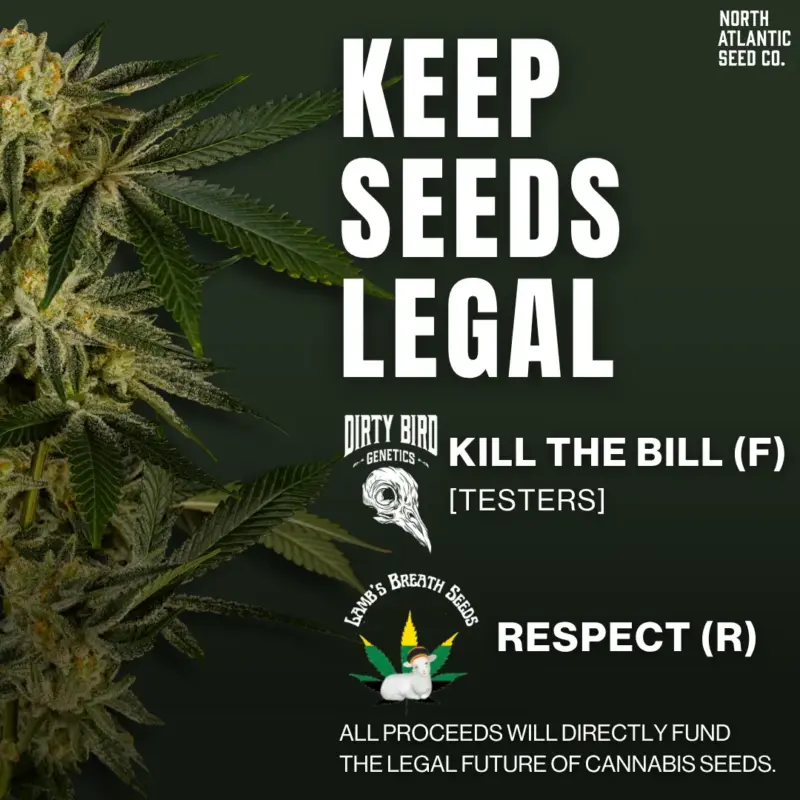
Thank you to everyone that donated to this important cause! Together we have raised over $20,000! Let's continue to fight and protect home growing for years to come. Read more for the latest updates on Keep Seeds Legal!
Happy Spring, Everyone!
I sincerely hope that you have all been keeping your chins up amidst the uncertainty that surrounds us right now, enjoying a beautiful spring (damn if that sun doesn’t feel so good), and gearing up for another growing season ahead.
For the last several months, we've been quieter with you than usual, and we feel that it’s due time for an explanation.
Behind the scenes, we've been working on something we believe will shape the future of the American seed industry: the launch of the American Seed Innovation & Growth Alliance (ASIGA) – www.asiga.org.
ASIGA is a coalition we’ve built to challenge the legislative changes scheduled to take effect in November 2026. We deliberately chose not to ring alarm bells in your inbox until we had something real to show you. Now we do.
What this fight is — and what it isn't:
We want to be clear up front about how ASIGA is positioned, because framing matters so much in Washington.
ASIGA's political case rests on three pillars: Innovation, genetic diversity, and American leadership in plant science and breeding. The legislation moving toward November 2026 threatens all three. It risks narrowing the genetic pool that U.S. breeders can legally work with, slowing the pace of innovation that has put American breeders and banks at the front of a global industry, and ceding ground to overseas competitors who will happily fill the gap.
This coalition is a big tent, fighting for an agenda that affects every arm of the US hemp industry: Industrial hemp, seed banks, plant scientists, breeders, and home-growers alike. The case we are making on the Hill is about protecting an American industry, American jobs, and American scientific leadership. That's the case that wins votes, and that's the case ASIGA is built around. We feel optimistic that we have a winning and compelling position if we maintain a narrow focus: Preserving access to seeds, a non-intoxicating agricultural input that is at the heart of a multibillion dollar industry.
What we've been doing:
For months, we've been meeting at the highest levels in Washington — quietly, persistently, and with a team built specifically for this fight. ASIGA's lobbying and communications group brings together experienced hemp policy advocates, former USDA officials, and seasoned operators who know how the Hill actually works. Alongside a number of other independent businesses, and industry organizations, we're funding this effort monthly — structured for the long haul, not a one-off campaign. We need a voice in DC representing seeds, an often-overlooked, but foundational part of the industry.
The work is unglamorous: briefings, redrafts, relationship-building, education, and the slow grind of getting the right facts in front of the right people. It's also the only thing that moves the needle on legislation of this scale.
What's at Stake:
If the November 12 law takes effect this fall, it will restrict access to essential genetic material, undermine breeding innovation and new cultivar development, damage legitimate operators, and push activity underground to the black market.
Criminalizing hemp seeds will reduce consumer and patient safety, destroy small businesses and jobs across the supply chain, inhibit access to the medicine that works for you, stifle critical research and development, and hand global leadership in hemp and cannabis genetics to Europe, Latin America, and emerging Asian markets.
The United States has the science, the agricultural infrastructure, and the entrepreneurial base to lead this industry for the next decade if our leaders cultivate a safe environment to do so. This law would foreclose that future before it begins.
Where you come in:
We held back from asking until we had earned it. We now have an active coalition, a strong team, and meetings happening that simply wouldn't have happened six months ago. To carry this through to November 2026, we need our customer base with us.
This community has shown incredible generosity already in donating to the Keep Seeds Legal campaign that we’ve run on the NASC website over the past two months. We’ve raised over $14,000 dollars for this cause already thanks to each and every one of you who donated. We plan to continue this campaign until this fight is resolved.
There are two other things you can do right now:
1. Contribute to the GoFundMe. Every dollar goes directly into ASIGA's lobbying, legal, and communications work. We chose the GoFundMe infrastructure specifically so that donors receive ongoing, transparent updates on where the money is going and what it's accomplishing. In addition, 100% of funds donated at checkout to NASC’s Keep Seeds Legal campaign will go directly to this fight as well.
2. Watch for the white paper. We're finalizing a detailed white paper that lays out the specific legislative threats, the policy alternatives ASIGA is advancing, and what each scenario means for the American seed industry.
One last thing…
We're sorry we haven't brought you in sooner. The honest answer is that we wanted to wait until we had something concrete; something worth standing behind. We do now — and we'd rather have you with us than reading about it after the fact.
Thank you for being part of this community and fighting the good fight alongside us. We know you all care about this issue as much as we do. We'll be in touch again soon, and far more often.
With Gratitude,
Beth + the entire North Atlantic Seed + Dirty Bird Genetics Family
By purchasing one of the following items, you can help fund the legal future of cannabis seeds! Donation options also available at checkout!
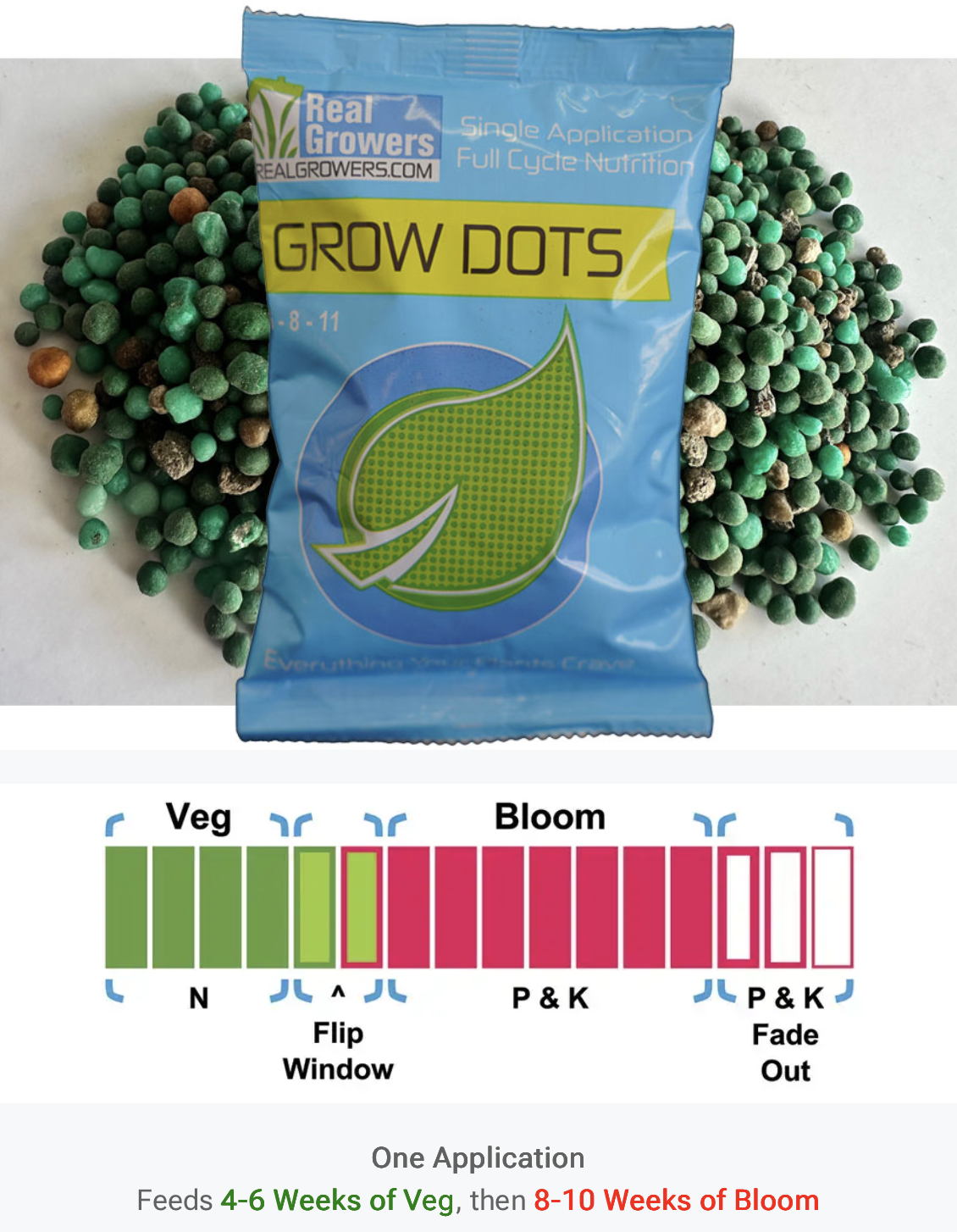
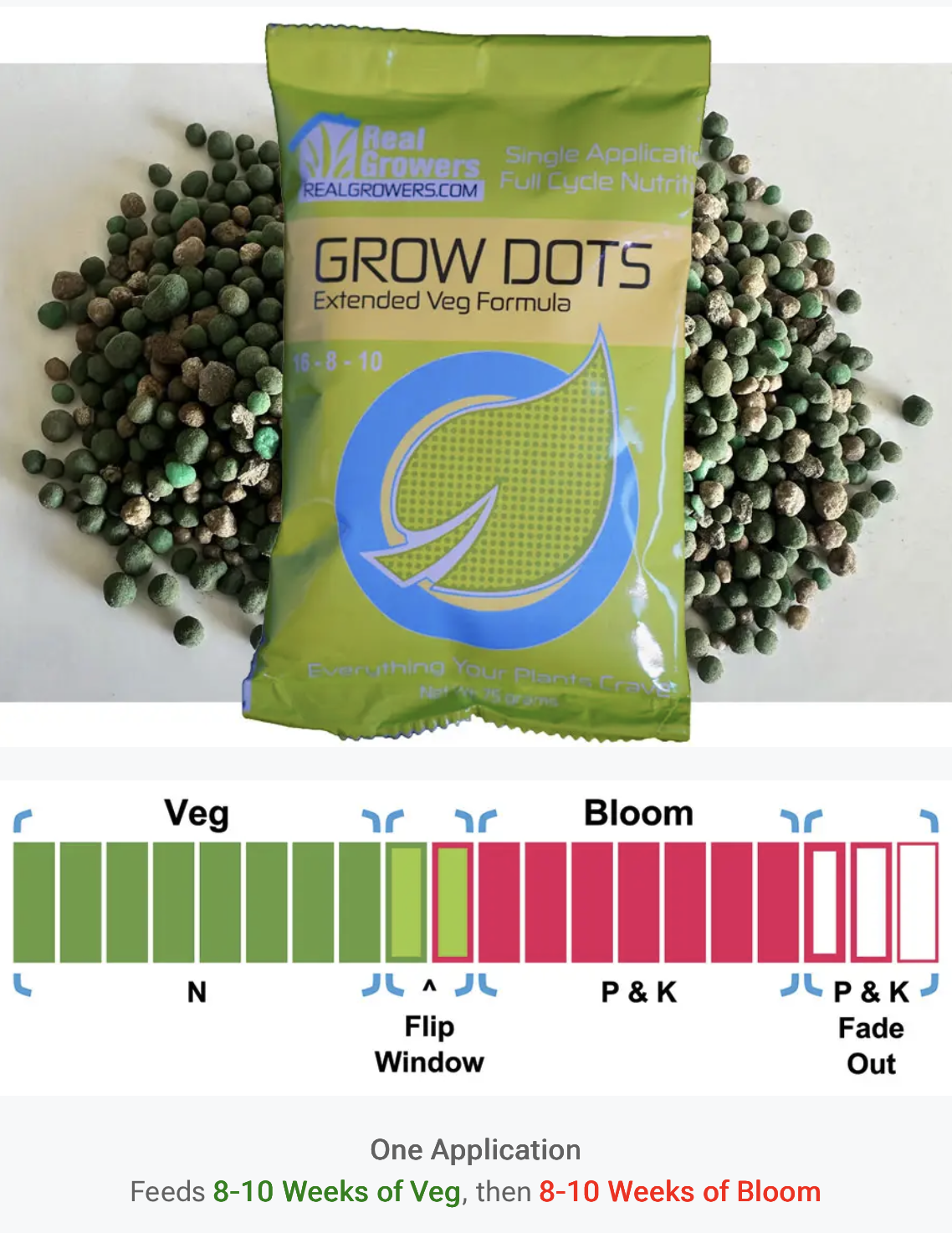
We are extremely excited to now be carrying Grow Dots. You can now leave all of your worries and wonders about nutrients behind with this programmed Released Fertilizer. They make growing easier and achievable for anyone. Continue reading below to learn more about Grow Dots.
Grow Dots Classic Formula Perfect for Indoor and Autoflowers
Grow Dots Extended Veg Great for Indoor and Outdoor Grows
With Grow Dots, you feed once at the beginning — and your plants stay fed all the way to harvest.
Grow Dots are made for growers who run a 4-5 week veg cycle and an 8-week bloom. They’re designed for a quick veg and flip grow style, making nutrient management effortless.
Features & Benefits
Two-Stage Nutrient Release — Automatically transitions from veg to bloom nutrients.
One-Time Application — Mix into soil or coco once, and you’re set.
Slow-Release Micronutrients — Keeps plants healthy for the full grow cycle.
Eliminates Daily Feeding — No need for constant adjustments or mixing.
Reduces Nutrient Runoff — Saves money and protects the environment.
Best Results in Coco — Works in all mediums but performs best in coco coir.
Unexpected Benefits
More Free Time — No daily nutrient mixing means less stress for you.
Great for Beginners — No complicated feeding schedules to figure out.
Travel-Friendly — Grow Dots keep feeding your plants even if you’re away.
More Cost-Effective — Costs less per plant than traditional liquid nutrients.
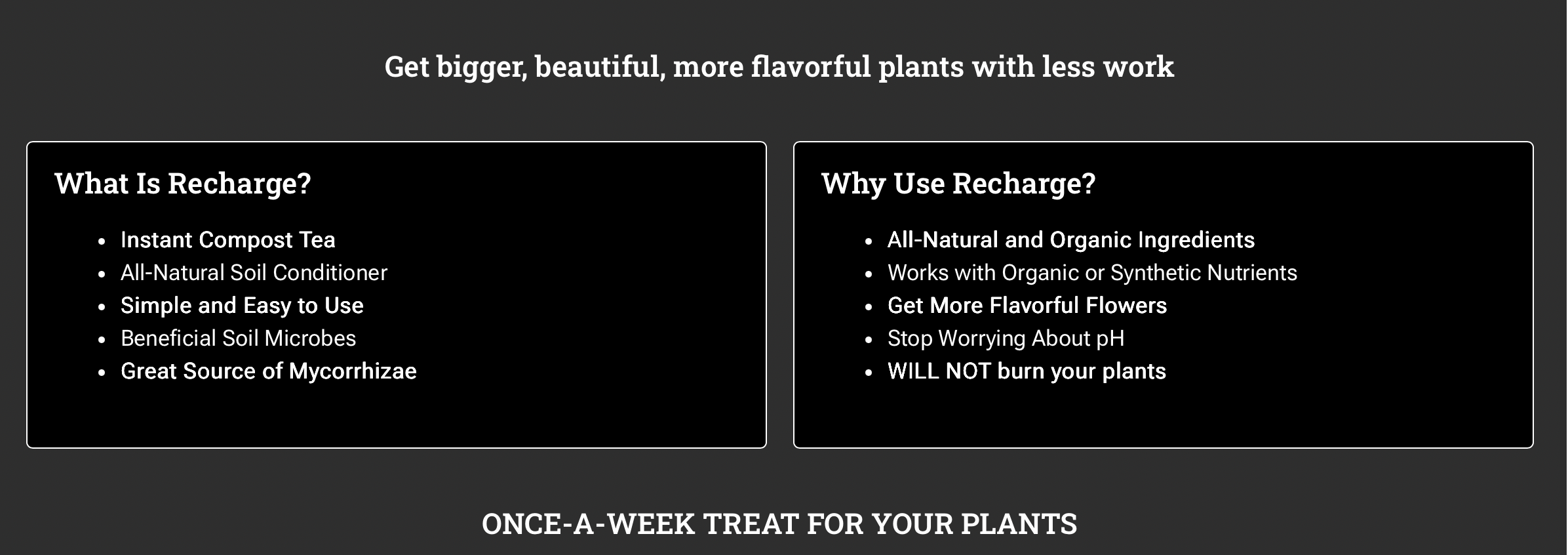
Why Growers Swear by Recharge
Grow bigger roots. Grow better plants. Grow with less stress.
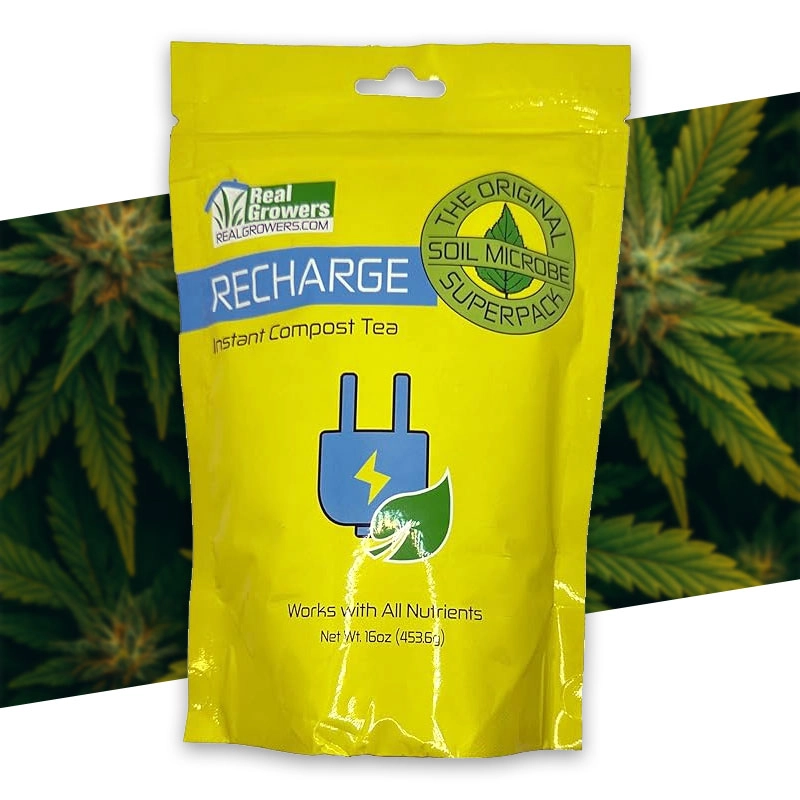
Recharge is an instant compost tea in a pouch. Just mix with water, pour on your plants, and let billions of beneficial microbes go to work.
These living microbes grab nutrients in your soil, break them down, and deliver them straight to your plant’s roots… so nothing goes to waste.
What that means for you:
Faster-growing, more resilient plants
Bigger roots = bigger yields
Reduces pH headaches and nutrient lockout
Lower risk of nutrient burn and root rot
Stronger plants that resist pests and stress
And it all happens in days, not weeks.
Buy or browse Grow Dots and other grow supplies here!
Moroccan Peaches and the Rise of the Sativa Hash Plant, story provided by Purple City Genetics
Hash has lived in a narrow lane for a long time. Heavy. Sedative. Indica-dominant. The plants that wash well are almost always the ones that put you down. Dense resin, strong returns, predictable results. And for years, that tradeoff was accepted. If you wanted yield, you gave up energy. If you wanted lift, you gave up washability. Two different worlds.
The Constraint
Sativa plants have always carried some of the most compelling terpene profiles in cannabis. Citrus, tropical fruit, bright, volatile expressions that jump out of the jar. They also tend to fail where hash begins. Loose trichome structure. Lower return. Poor mechanical separation. So they get pushed out of the category. Distillate inputs. Flavor contributors. Not centerpiece hash. Meanwhile, the hash world optimized around what worked. The result: technically strong, but creatively limited.
El Krem: A Different Objective
El Krem was built to break that constraint. Not by chasing THC. Not by chasing yield alone. By selecting for expression first. The goal was to create plants that could sit on a table with dozens of jars and still stand out. Lime, orange, peach. Layered terpene profiles that don’t flatten out after extraction. At the same time, every cultivar had to function in the real world. Flower or hash. Jar or wash. Because growers don’t get to specialize anymore. They need optionality. This is what defines the El Krem line: dual-use genetics built for both flavor and function
Moroccan Peaches
Moroccan Peaches didn’t arrive quietly. From the start, it stood out for combining two traits that rarely coexist: Effect and washability. A sativa-leaning hybrid with loud lemon, orange, and peach terpenes. Bright, expressive, immediately recognizable. But what made it different wasn’t just the flavor. It was how that flavor behaved. Across crosses, peach showed up consistently. It held its signal. It carried through different pairings without collapsing into sameness. More importantly, it didn’t flatten everything around it. It organized it. Part of what makes that possible is structural. The peach-leaning expressions we’ve selected tend to carry dense, uniform resin heads and a terpene profile that reads clearly even after processing. That combination matters. It means the signal doesn’t just. of stability is present, it stops behaving like a note and starts behaving like a framework. That’s when you can actually build around it. Peach became a baseline strong enough to pressure-test everything it touched. Traits paired with it had to hold their ground. The ones that did started to define the edges of the expression: citrus on one side, gas on another, candy and sour filling in between. The ones that didn’t got absorbed. That’s how the range sharpens instead of getting muddy. Underneath that, structure. Resin that actually separates. Trichomes that hold. A plant that returns when you wash it. That alone would have made it notable. The effect made it different. Upward. Energetic. Engaging. Not the slow descent most hash delivers. That combination changed how people thought about what hash could be.
Why It Stuck
Most hype strains fade. Moroccan Peaches didn’t. Because it solved a real problem. It gave extractors something new to work with. It gave smokers a different kind of experience. It gave growers a plant that could perform in both lanes. That’s rare. And when it shows up, you build around it.
The 2026 El Krem Peaches Collection
For 2026, Moroccan Peaches became a foundation. Not a single release. A breeding block. The goal was to expand its core traits across a wider spectrum without losing what made it work. Each cross explores a different edge of the same structure: ● Fez: peach nectarine layered with incense and citrus depth ● Habibi: peach and Z-driven structure with strong bag appeal ● Moroccan Zowah: extraction-forward with candy and sour gas undertones ● Saffron: shorter cycle while holding the peach-forward identity ● Cheri Granada: full-spectrum fruit expression with floral and wood notes Different directions. Same backbone.
Beyond the Pack
Seedlings and clone releases pushed the work further. Different pairings. Different environments. Different outcomes. Some leaned tropical. Some leaned gas. Some sharpened citrus. Others pulled deeper into kush structure. Not every expression needs to last. But every expression adds resolution. This is the same philosophy behind the seedling program: early looks into where the line is going, not just finished products
The Shift
El Krem represents a change in how hash is evaluated. From yield to experience. From output to expression. Moroccan Peaches sits at the center of that shift. Not because it’s louder. Because it expands the range without losing structure.
The Point
Cannabis isn’t supposed to exist in one lane. Not in flower. Not in hash. Not in experience. El Krem is built to preserve that range on the extraction side of the plant. Because once you start narrowing what works, you don’t just lose options. You lose entire categories of experience. Written by Eric Rosen, Purple City Genetics
Temperature, relative humidity (RH), and vapor pressure deficit (VPD) are three major variables that growers must monitor and control, if possible, to maximize their cannabis yields and keep their grows clean from mold. In this article we will discuss all three variables and how they relate to one another in the context of growing cannabis.
Temperature: This is a variable everyone is very familiar with. It is the measure of ‘hotness’ or ‘coldness’ (i.e. the average kinetic energy of particles in a substance) expressed in terms of one of many scales (e.g. Fahrenheit, Celsius, Kelvin, etc.). The scale most people in the U.S. are familiar with is the Fahrenheit scale. Outside of the U.S. the Celsius scale, based on the freezing and boiling points of water, is more commonly employed. Regardless of the scale you use, it is important to know that cannabis prefers certain temperature ranges to maximize growth and plant health.
Vegetative Stage: Cannabis, like many plants, enjoys moderately warm temperatures usually in the range of 70-850F (~21-300C). During the vegetative stage of cannabis’ life, it prefers the previously mentioned temperature range during the day (lights on) and 65-750F (~18-240C) during the night (lights off). This temperature range will promote fast and lush growth as well as efficient nutrient uptake. Temperatures above 850F can cause heat stress and may lead to leaf tips burning. Higher temps can also invite pests such as spider mites who reproduce faster in higher temperature ranges. Temperatures below 650F during the day, or during the period when grow lights are on, can limit cannabis growth and can reduce nutrient absorption.
Flowering Stage: During the flowering stage a slightly lower daytime (lights on) temperature range of 70-800F (~21-270C) is recommended, with 75-770F (~23.8-250C) being the optimal day time temperature range. The optimal nighttime temperature range for the flowering stage is 60-700F (~15.5-210C). A 10-150F drop in temperature at night (lights off) can stimulate resin production and can even bring out purple/pink hues in certain strains. The 70-800F temperature range during the day helps to promote vigorous growth without the risk of degrading and evaporating off a large percentage of the terpenes that makes your plant(s) so special. This temperature range also encourages dense flowers as high temps during flower can lead to airy, fluffy buds.
If using CO2 to enrich the grow area, it is possible to raise the daytime temperature range to 80-900F (27-320C), although we still recommend not exceeding ~820F to avoid any chance of buds becoming too airy or “fluffy.” The reason for the ability to raise the temperature when supplementing CO2 is due to the higher rate of plant metabolism caused by higher temps. This allows the plant to consume more light and nutrients as well as create sugars at a faster rate of photosynthesis due to excess carbon availability. If you are not treating your grow space with CO2 it is highly recommended to keep daytime temps as close to 75-770F as possible.
Temperatures under 550F (~130C) can stall growth and induce shock in your cannabis plants so avoid letting your grow get under this temperature.
In the last 2 weeks of flower, many growers have reported increased terpene retention, as well as increased resin production, when lowering the daytime grow room temps to a range of 65-700F (18-240C).
Relative Humidity: Humidity refers to the water vapor held in the air. Absolute Humidity is the total amount of water vapor held in the air regardless of the temperature. Relative Humidity (RH) is a measure of how much water vapor is held in the air as a percentage of the maximum amount of water vapor that could be held in the air at a given temperature.
Absolute humidity is not temperature dependent as it is simply a measure of the total amount of water vapor in a mass of air.
Relative humidity is temperature dependent as warmer air can hold more water than colder air can. This means that when the temperature drops at night, the air may feel “stickier” or “denser” despite having the same amount of total moisture as it contained during the day. As the air cools, the molecules that make up the air get closer to one another and this leaves less room for water vapor to be held. This doesn’t raise the absolute humidity but does raise the relative humidity of a mass of air. This is important to remember as it means the RH of your grow space will increase when the lights go off, even if no new moisture is added to the environment. Ensuring proper air flow in your grow space can help prevent micro-climates with excess moisture from building up.
Having the right relative humidity in your grow room is paramount for plant health and for suppressing pest and fungal infections. If RH is too high, it can invite mold that can ruin your crop before or during harvest. If RH is too low, it can create drought stress in the plant and invite pests such as spider mites that thrive in drier conditions.
Optimal RH ranges for cannabis vary depending on what stage of growth the plant is at.
Seedling/New Clone Stage: 60-80% RH to help plants absorb water as they grow their root system.
Vegetative Stage: 50-60% RH is usually a good range for the vegetative stage. Not so high that it invites quick mold infections but also not so low that it risks stressing your plant(s) out.
Some growers use a range of 55-65% RH for early veg and then a range of 45-55% for later veg.
Flowering Stage: 40-50% RH for early flower with a range of 35-40% RH for late flower (last 1-2 weeks before harvest). The plant has well established roots at this stage and doesn’t require as high a relative humidity for water absorption. The lower RH range also helps to prevent bud rot (botrytis) and other fungal infections in the flowers as they finish. Take care to balance low RH with appropriate temps to not evaporate or degrade the terpenes generated by your cannabis.
Vapor Pressure Deficit (VPD): In simple terms, Vapor Pressure Deficit (VPD) is a measure of how much “space” there is for water vapor in the air at a given temperature. This is different from relative humidity as RH is a % whereas VPD is measured with units of pressure, usually kPa or PSI (kilopascal or pounds per square inch). RH measures how much water vapor is in the air compared to the maximum amount of water vapor the air could hold at a given temperature. VPD is the difference between how much water vapor is currently in the air and how much moisture the air could hold at a given temperature, essentially measuring the remaining "space" for water vapor.
Why is this important? It is important to understand VPD as it is a primary driver of transpiration in plants which also means it is a primary driver of nutrient uptake. Plants pull water and minerals through their xylem cells from the roots to the leaves of the plant and the VPD of the surrounding environment drives this “pulling” (like sucking liquid through a straw). Too high a VPD can cause plants to dry out too quickly and can cause their stomata to stay closed, which does not allow for good CO2 intake from the leaf. It can also cause wilting on the leaves as well. Excessively high VPD can also cause potential nutrient burn from nutrients being pulled too quickly in too high a concentration to the leaves. Too low a VPD can decrease nutrient uptake and can lead to mold as there may be too much water vapor in the air. This can stunt a plant’s growth and diminish the final yield if not remedied. Low VPD can also cause calcium deficiencies which can further lead to stunted growth of your cannabis.
VPD is related to temperature and to relative humidity in the following ways:
As temperature increases, the air’s ability to hold water vapor increases exponentially. This means the potential for high VPD increases with heat (assuming RH stays constant).
As relative humidity increases, the air becomes more saturated with water vapor, reducing the deficit, and thus the potential for low VPD increases with increasing humidity (assuming temperature stays constant).
If temp increases and RH stays constant or decreases, VPD increases. (Hot/dry air)
If temp decreases and RH stays constant or increases, VPD decreases. (Cool/wet air)
If temp and RH increase, it can lead to moderate or to high VPD. This is because the air heating up allows more water vapor to be held but increased humidity decreases the space for water to evaporate from plants, thus keeping the VPD moderate to high. The resulting VPD will be most affected by whichever variable is increased to a greater degree. If temperature is raised much more than humidity, then a high VPD will be achieved due to more space in the air for water vapor. If humidity is increased much more than temperature, then a moderate, or even low, VPD can be achieved due to more water vapor being added to the air.
The same is true if temp and RH are both decreased. Depending on which variable is decreased to a greater extent, the VPD will respond accordingly. If temp is lowered much more than RH is lowered, VPD may decrease due to less space in the air for new water vapor to be held. If RH is lowered much more than temperature is, then a higher VPD may still be possible due to the removal of water vapor from the air.
Optimal VPD for cannabis changes as the plant matures. It generally increases from lower levels in the cloning/seedling stage (to inhibit dehydration and wilting) to higher levels in late flower to encourage transpiration and prevent mold. The generally accepted VPD range for the veg stage is 0.8–1.2 kPa. The generally accepted VPD range for the flowering stage is 1.0–1.5 kPa to promote flower health and resin production. These values can be achieved at a few different temperature/relative humidity combinations. That is another reason why VPD is such an important factor in the health of your plants. It is not always about having an exact temperature and/or RH but about having the right balance between the two. As an example, if you are having trouble with humidity throwing off the VPD in your grow space, and if dehumidifiers haven’t been effective in reducing said humidity, then raising the temperature of the space (as long as it isn’t above 82-850F) can still allow you to achieve an optimal VPD for your plants.
Pulse Grow, a company focusing on data-driven monitoring solutions for indoor and greenhouse cultivation, has an amazing reference article if you wish to delve deeper into the concept of VPD which can be found at https://pulsegrow.com/blogs/learn/vpd. On this site, there is a VPD calculator growers can use to determine if the temp and RH of their grow space is creating the optimal VPD for your plants. They also have pre-made charts that make determination of VPD very fast and easy and can be an essential tool in dialing in your grow space.
One last important tip to remember when determining the VPD of your room is to use the leaf surface temperature rather than the room temperature as the surface of your plant’s leaves will be 2-50F cooler than the surrounding environment. Even without a device to measure this quantity, it is easy for one to look at the room temp and simply subtract 2-50F from that value to be used when determining the temperature portion of the VPD equation.
Below is a chart summarizing the optimal temperature, relative humidity, and vapor pressure deficit ranges for cannabis at various stages of growth.
Atlas Seed shares indoor growing tips & strain recommendations! And don't miss out on Atlas Seed Breeder of the Week deals!
Are you interested in cultivating cannabis indoors on a home scale?
Growing cannabis indoors provides an opportunity to have full control over the growing environment and produce high-quality yields year-round.
In this comprehensive indoor cannabis home grow guide, we will walk you through the step-by-step process of setting up your indoor cannabis garden.
From choosing the right equipment and selecting the ideal strains to mastering essential cultivation techniques, we’ll equip you with the knowledge you need to embark on a successful indoor cannabis growing journey.
If you’re looking for a super simple step by step guide, we have prepared a beginners guide to growing cannabis DIY list that you can read in just a few minutes; and for a more in depth exploration, see the table of contents to our expanded guide below:
Easy Home Grower’s Guide for Feminized Autoflowering Cannabis Seeds
Direct sow seeds into the pot at a depth of ¼” that the plant will finish its life cycle in. No need to transplant as shock during this phase can be detrimental to plant growth. Although transplanting can occur with precision .
28-35 days will be Veg and 30-40 days will be Flower. Feed your plants the nutrient mixtures that are appropriate for the stage of growth.
You can pinch/top your plant right before it initiates flowering if you would like a more even canopy and desire multiple kolas at the top of the plant. Only top/pinch 1-2x and DO NOT top/pinch after flowering phase has begun
Use high end light fixtures, either HPS or LED with a PPFD between 650-1000 over the entire canopy for best results.
Trellis your plants with netting or bamboo stakes for best results with even ripening. Remember that plants that are flopped over will not ripen as well as plants standing tall and erect.
Harvest when >50% of trichomes are milky white. Use our flowering times as guides.
Simple Beginners Growers Guide for Feminized Photoperiod Marijuana Seeds
Seeds can be sown directly into pots or placed in a soil plug and transplanted.
Plants can be pheno hunted and cloned when a unique “winner” is found.
Light cycles should be at 18/6 for Veg and 12/12 for Flower
Use high end fixtures, either HPS or LED with a PPFD between 650-1000 over the entire canopy for best results.
Indoor flowering times are between 63-75 days depending on strain
Harvest when >50% of trichomes are milky white.
Table of Contents: Expanded Indoor Growers Guide
1. Planning your Indoor Cannabis Grow: Local Cultivation Laws
A. Know Your Local Laws for Cannabis Growing
2. Choosing the Ideal Cannabis Strain for Beginner Home Growers
3. Cannabis Equipment for Indoor Marijuana Cultivation
A. Lighting for Indoor / DIY Beginners Marijuana Growing
B. Climate Control for Home Grower Cannabis Cultivation
C. Automating Cannabis Home Grows
D. Water Management for Indoor Weed Growing
4. Choosing the Right Growing Medium for DIY Marijuana
5. Nutrients for Indoor Cannabis Cultivation
6. Integrated Pest Management for at Home Cannabis Growing
7. Nursery Management for DIY Indoor Cannabis Growing
Our next toke is Nuclear True Blood by Dirty Bird Genetics. She is a cross of Nuclear Forest x Maui True Blood. Read on to learn about our experiences.
I'm reaching for the Nuclear True Blood when I am ready to unwind for the night. It brings on a very pleasant, mellow relaxation. I was still alert and able to engage, but I definitely didn't want to participate in anything that required hard concentration. It was perfect for a card game with my spouse, followed by an SNL rerun. There were also snacks involved because this one definitely brought on some munchies. Fans of pine and citrus will appreciate Nuclear True Blood's profile.
- Crystal
This strain from Dirty Bird is a fun one! The buds are sugary and dense and have little orange hairs. It has a lovely piney, citrusy aroma and grinds up well. It was fresh and spongy when I got it and burned nice in the bowl. I would consider this a hybrid for sure. It mellows you and calms your mind but doesn’t zap your energy. The effects are relaxing and motivating at the same time. If you smoke it, definitely have some snacks ready!
- Mariah
Read another smoke report featuring Dirty Bird Genetics!
Before their seed bank was created in 2007, RQS had long-time knowledge and passion for cannabis breeding. Following enormous interest in their strains, they opened our first shop in Amsterdam, the Damstraat location, in 2010. In 2011 they launched the Royal Queen Seeds website. In 2016 they welcomed first clients in our shop at Carrer dels Tallers in Barcelona, Spain. In 2022, they opened their newest location in Bangkok, Thailand. In 2023, they started operating in the United States and launched the first true F1 Hybrid Cannabis seeds in the market! Today, RQS operates in the US and in 28 countries in Europe and offers 100+ high-quality strains, growing equipment, growing advice, knowledge, tips and more!
The NASC Cast Crew had the pleasure of sitting down with Max of Royal Queen Seeds. Listen to what he has to say below, and follow us on Vimeo for even more content!
Breeding Cannabis from F1 to IBL with Dirty Bird Genetics
by: Beth Mathieu
First and foremost, I want to send a heartfelt Happy Mother’s Day to all of the mothers here at NASC + Dirty Bird Genetics, to our own mothers, grandmothers, and maternal figures, and to all of the beautiful mothers out there who have been a part of this community with us for the past 10+ years. We see you, we appreciate you, we LOVE you, and we want to acknowledge and celebrate how beautiful the maternal instinct is.
Last year for Mother’s Day, I sat down to write a blog about a plant mother that is near and dear to me personally, and to our NASC/Dirty Bird family: The Brunch. As someone whose career was built upon plant mothers, it seemed fitting on Mother’s Day. The article detailed the filial evolution of this flagship strain that the Dirty Bird Genetics team had created. It was the very first cultivar we bred that really shined, and it really propelled us into this new venture breeding. Looking back now, it’s fascinating to consider how much those first creations (like the Brunch) influenced the genetics to come, much like the generational connections that run through families. The Brunch now sits atop many Dirty Bird Genetics family trees; she’s a mother, a grandmother, and even a great grandmother to many.
This Mother’s Day 2026, I want to pick up where I left off one year ago today, filling in another year of progress as we work our way to the end goal of creating a Brunch IBL (In-Bred Line).
The Brunch F1
The original Brunch F1–a regular, male/female iteration of the F1 strain still found on our menu today–will unfortunately never be recreated because we lost the Peanut Butter Breath mother that was used in the original project back in the early 2020’s. It was a mother I had preserved for almost a decade prior, selected from a revered pack of seeds made by Thug Pug Genetics. These seeds were gold back in the day, and this cut was a favorite of many clone customers I worked with. She created incredibly dense, striking flowers with vibrant greens, dark purples, and bold oranges. Her bud was as top shelf as it comes–easy to manicure, high test, colorful and dense–but her morphology left a few things to be desired. While she wasn’t prohibitively tall, she did have very long internodal spacing, and she was definitely a plant that wanted to grow vertically. Her floral sites were spread out across long stems, meaning she wasn’t the best yielder. Her terpenes were self-referential: Nutty and earthy. We knew there was likely more to draw out here.
The Peanut Butter Breath cut #3 by Thug Pug used to create the Brunch F1
The Mimosa father, selected from a pack of Mimosa by Symbiotic, had beautiful morphology and strong, tangy terps that came through even on a stem rub of the vegetative male plant. He was vigorous, sturdy, and a well-suited, well-proportioned match to compensate for the Peanut Butter Breath’s shortcomings.
In our first test run of the Brunch (PBB x Mimosa) progeny, we selected two keeper phenotypes: the Brunch F1 #5 and the Brunch F1 #8. They weren’t perfect, but they stood out as special to us for several reasons. They were dripping in trichomes, testing between 25-30% THC / 1-3% CBG, they had insane, dark purple coloring with a gorgeous yellow fade, and to our surprise and delight, a unique apple terpene profile was seeming to emerge. We knew there was still work to do–we needed to bulk her flower up, and we needed to tighten her internodal spacing–but this was now a much stronger palette to work from than what we’d had previously.
The Brunch F1 #5
The Brunch F1 #8
The Brunch S1 (Feminized Iteration)
In order to create our first release, we knew it’d be beneficial to feminize our work, and that would also give us the opportunity to take the first step toward locking in some of the features we loved in the male/female test stock. To do this, we took the Brunch F1 #5 and the Brunch F1 #8 and we crossed them and selfed them across several different breeding projects, testing the progeny of each to determine who was the strongest, and which genetics we would move forward with. When all was said and done, and all of the seed lots were tested, we selected two cuts to mother in order to breed the Brunch lineage further. These cuts were named the Brunch - Dark Horse Cut (#8 x #8 - #3) and the Brunch - Lover’s Cut (#5 x #8 - #5) (aka the Arugula Cut).
The Brunch 88 #3 - Dark Horse Cut
The Brunch 58 #5 - Lover’s Cut aka “Arugula Cut”
Breeding and feminizing our favorite phenotypes of the Brunch F1 created some drop dead gorgeous feminized Brunch S1 genetics. The coloration had darkened from purple to almost black, and the yield and morphology was beginning to trend in the right direction: Less stretch and more flower. It was very hard to choose our keeper cuts from these seed lots, but we realized that was a good problem to have. It was at that time that we decided that the Brunch S1 would become our first Dirty Bird Genetics - Volume 1 release. Exciting! You’ll still find these seeds on the Dirty Bird Genetics Volume 1 menu today (although I’ll warn you guys, when they sell out, they will almost certainly be gone for good). You’ll also find this s1/f1 iteration of the Brunch in many of our genetic family trees, including staff favorites:
Dirty Mimosa: A Brunch backcross and outdoor champion that clocks in with a lightening fast 43-47 day flowering time
Dirty Mimosa pictured outdoors in a local Maine garden.
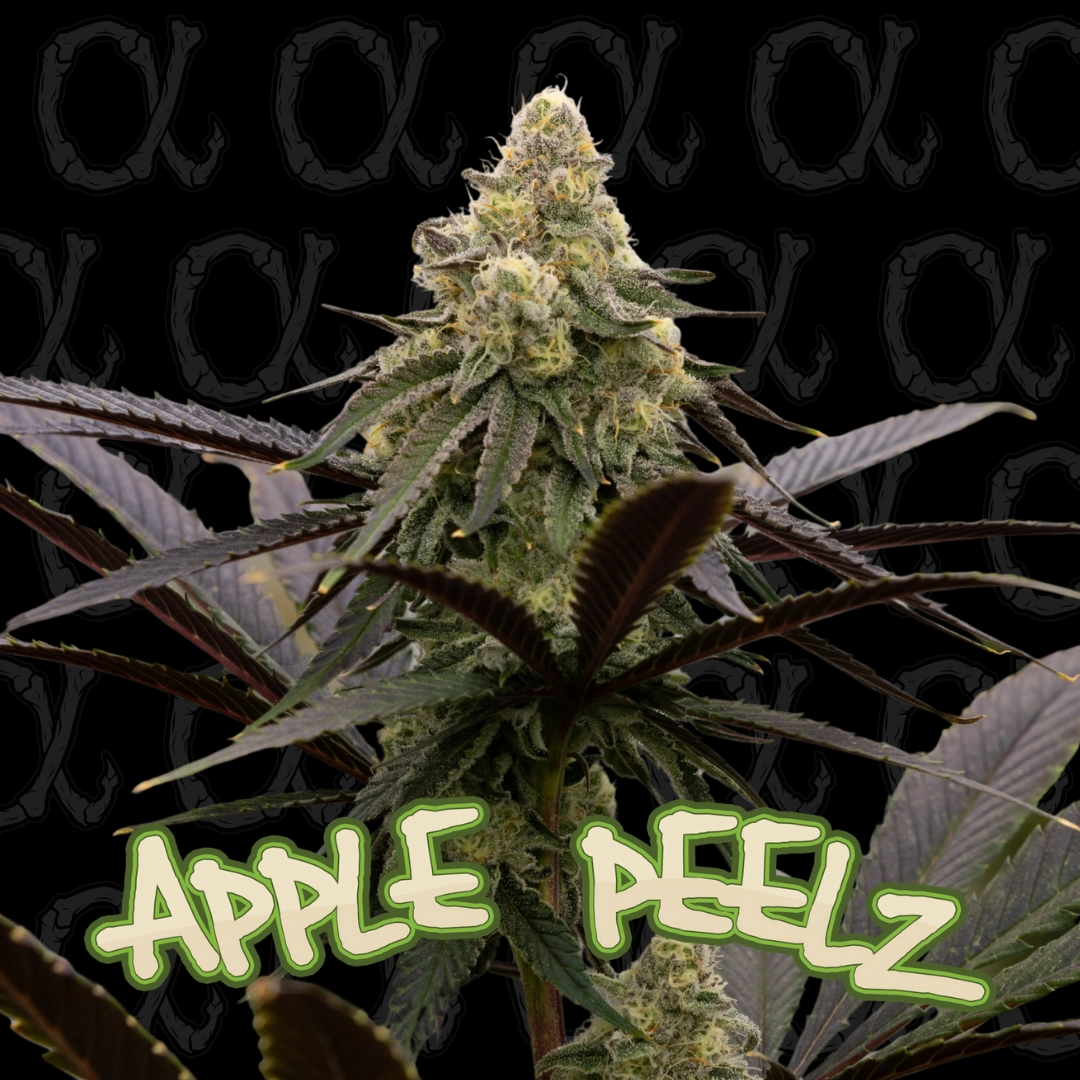
Bad Apple: Probably my personal favorite Brunch-related strain, and a cultivar that has only continued to impress me more as we’ve bred with it. The Bad Apple has pungent terpenes that range from rotten Apple to gym sock funk, and our keeper “Sugar Mill” cut is the single most trichome-laden plant I’ve grown in my 15 year career. In 2026, this Brunch-child created two of my favorite strains we’ve bred to-date: Apple Peelz and Candy Apple Kush.
Bad Apple - Sugar Mill Cut (Day 42)
Apple Peelz (Day 49)
Candy Apple Kush (Day 44)
The Brunch F2
We knew early on that the Brunch was a project that we wanted to fully realize the potential of by creating a stabilized Brunch IBL (in-bred line). Now that we’d created and tested several iterations of the Brunch genetics, we were able to formulate a set of goals for the project:
Preserve Apple Terpene Profile: It’s unique to the Brunch and we love it.
Morphology: Shorten internodal spacing, select for lateral growth, preserve high calyx-to-leaf ratio, and retain a foliage volume that is ideal for air flow, light penetration, and outdoor cultivation.
Yield: Improve yield by selecting cuts that stack well, have dense flower, and yield respectably.
Flowering Time: Ideally, under 56 days.
Color: Preserve the dark purples and maroons that are signature to the Brunch.
Effect: Retain the social, happy effect that is signature to the Brunch.
Using the Brunch F1 #5 and a Brunch F1 male that we labeled #12, we made the Brunch F2. In cannabis breeding, the F2 filial generation is known to contain the largest number of phenotypes and the most genetic diversity of any other generation. We found this to be true with the Brunch F2. We saw divergence in color (purple/green), terpenes (apple/earthy meh), and in both flower and plant morphology. Speaking generally though, these plants grew much more laterally than their F1 counterparts thanks to our parental selections. We were also able to eliminate the “scraggly” phenotype that appeared in about 10% of our F1 seed population. These F2 plants had stronger, more bushy structure as a whole, accompanied by a higher volume of foliage, more compact, golf ball shaped flowers, and tighter internodal spacing.
After carefully watching our F2s grow, we whittled our selection down to two winning cuts that we would use for our F3 breed: The Brunch F2 #7 and #13. They each had something we loved, but neither had everything. The #7 had the most incredible, vibrant, apple terpene profile; there was something that smelled distinctly more “appley” about this plant than any we’d smelled previously, and we were confident this was the direction we wanted to go with the terpene profile. The #7 plant wasn’t perfect though: it stayed vividly green way longer than we would have liked, purpling in the final week of flower, long after we’d written it off as a green pheno. This was something we felt cautious about because color was one of the goals we’d set for the project. The #13, on the other hand, took on a beautiful, deep purple color early in flower–something we loved–but it lacked an exciting terpene profile, leaning more towards the subdued, nutty, earthy profile of the Peanutbutter Breath.
The Brunch F3
Brunch f3
V79 have better floral mass . Long intermodal spacing and classic brunch nugs, small leaves
139 #1 - Apple terps.
**V79 #1 - stacking the most - best floral mass. Striped maroon and purple and yellow leaves.
V79 _#2 - shorter but similar burgundy and purple and sugar/ apple terps
V79 #5- Apple gas Peanutbutter - very purple but not a great yield
Brunch 139
Biggest nugs yet. long and skinny and tie together up the stem
*3- Apple cheese. Tall. Long stacked buds. Very impressive stacking and yield - double floral mass of what we normally see, and very high calyx to leaf ratio
4- more arugula look. Apple smell.
When it came time to make our Brunch F3 seeds, we had a choice to make: We had to decide whether to breed our F2 #9 male with the wonderfully appley #7, or the spectacularly purple #13. This choice proved to be an impossible one, so we decided we would take the more intensive path and breed in both directions. Over the course of the next year, two Brunch F3 seed lots were created: The Brunch F3 v79 (made with our #9 male and our purple F2 #7 cut) and the Brunch F3 v139 (made with our #9 male the wonderfully appley F2 #13 mom).
In testing these two Brunch F3 lines we’d created, we saw the genetics take the most marked strides forward to-date. Most notably, the plants were stacking better than ever before, yields were improving, colors were popping (though continuing to diverge a bit between green, maroon and purple), and we were really starting to hone in on a consistent terpene profile. While the apple terpenes were predictably more dominant in the v79 seed population, we ultimately chose a cut from the v139 population to move the line forward to F4 (see pictured below). The Brunch F3 v139 #3 boasted the biggest colas we’d seen in a Brunch to-date. They were long, dense, and they tied together beautifully up the central stalk creating a long, beautiful arm of purple, funky, apple Brunch. The #3 cut had close to double the floral mass of any Brunch we’d seen before. It had an incredibly high calyx-to-leaf ratio, purple flowers, and its terpene profile was pungent and unmistakably apple. It checked all of the boxes, so the choice was a remarkably straight forward one.
Brunch F3 v139 #3
Brunch F3 v139 #3
The Brunch F4
In early 2026, we were able to test the Brunch F4s that we had made using only the F3 v139 #3 cut. This was the first time we had chosen to advance the Brunch line through a process called selfing (crossing a plant with itself through reversal). The v139 mother cut had so much to offer, and we were curious to see how this choice would evolve the line, so we created and tested our first population of feminized F4 seeds.
It has only been a month since we harvested our Brunch F4 test plants, and the project is still fresh in my mind. The F4s were easily the most exciting yet. The diversity we saw in the F4 generation was markedly different from what we’d seen previously. To use an analogy, imagine crossing a black lab with a poodle. The Brunch F2 + F3s were what I’ll call Bloodles; they were mutts. Their traits were messy and indistinguishable, resembling their parents in some ways while also blending together to form strange iterations of curly, black-and-white Bloodle soup. We saw countless combinations of traits–some that we liked and some that we didn’t–all unpredictably smooshed together. The F4 population was different. The traits we were selecting for were finally segregated in an easily observable way. Phenotypes were so much more identifiable. To circle back to our genius analogy: The Golden Doodle was born, alongside pups that looked remarkably black lab, and pups that looked remarkably Poodle.
While we did observe a little bit of inbreeding depression in our F4s–which is to be expected–overall the plants had several consistent qualities: They had an extremely short 50-day flowering time, a remarkably high calyx-to-leaf ratio, very compact, long, conical flowers, medium internodal spacing, 1.5x stretch, ideal foliage volume for air flow and light penetration, high trichome density, balanced vertical and lateral growth, and overall they were healthy, self-supporting, easy-to-grow plants.
One of the most interesting things about the Brunch F4 was that we finally saw a purely green phenotype emerge in 20% of the population. The 80% majority were purple: 50% solid, dark purple in both foliage and flower, and 30% predominantly purple with a little green fade. The terpenes were consistently apple-dominant–exactly what we wanted–and we were so excited to find that the apple smells were only deepening further, evolving into more of a complex, warm-yet-tart apple pie. For the first time, we did note some sour gas smells coming through on a slim minority of plants, with one plant exhibiting sour gas only; no apple.
The biggest obstacle we’ve faced in choosing our winning cut(s) of the Brunch F4s has been deciding what to do with the visual feast that is the green phenotype. We’d been very intentionally selecting for purple coloring from the outset of this multi-year project, and yet these green plants were hard to turn away from.
Thank you so much for reading about the journey we’ve gone on to create the Brunch, one of our most beloved plant-mothers. I’d like to wish all the mothers out there a very Happy Mother’s Day. Know that you are seen, loved, and celebrated every day!
Royal Queen Seeds shares 3 tips for new growers, and more! Don't miss out on all the great deals from Royal Queen Seeds for Breeder of the Week!
3 Tips For New Growers
Know Your Water Quality Water quality affects plant health. Test pH and EC regularly, especially with tap water. Poor sources may contain contaminants. Use simple kits if unsure, and filter, treat, or switch sources if needed.
Measure Your Environment Precisely Use sensors to track temperature, humidity, light, CO₂, pH, and EC. Human senses are unreliable. Accurate, calibrated measurements help you understand conditions and make better adjustments for consistent plant growth.
Inspect Plants Regularly and Thoroughly Check plants often to catch issues early. Inspect leaves, stems, and substrate for pests or disease. Regular scouting helps prevent small problems from becoming serious threats to your crop.
Favorite Breeding Project My favorite breeding project is a secret collaboration combining very different lineages. It will only proceed if both partners meet a strict “fire-only” standard, highlighting strong international cooperation and fully formed bridges between continents.
The F1 Hybrid program is another favorite, achieving photoperiod-quality in automatics with real consistency. It challenged my skepticism and showed me the value of staying open to change and innovation.
Story From The Garden
As a teenager in New Caledonia, I got lost for about 45 minutes in a huge guerrilla cannabis field while spotting the best plants. I had red tape and a flashlight, but the battery died, leaving me in near-total darkness, surrounded by thousands of plants. I kept whistling until my friends finally found me. Back to camp my hands were covered in fresh trichomes—some of the best charas I’ve ever had.
by Ben Morris, Head Breeder of Dirty Bird Genetics
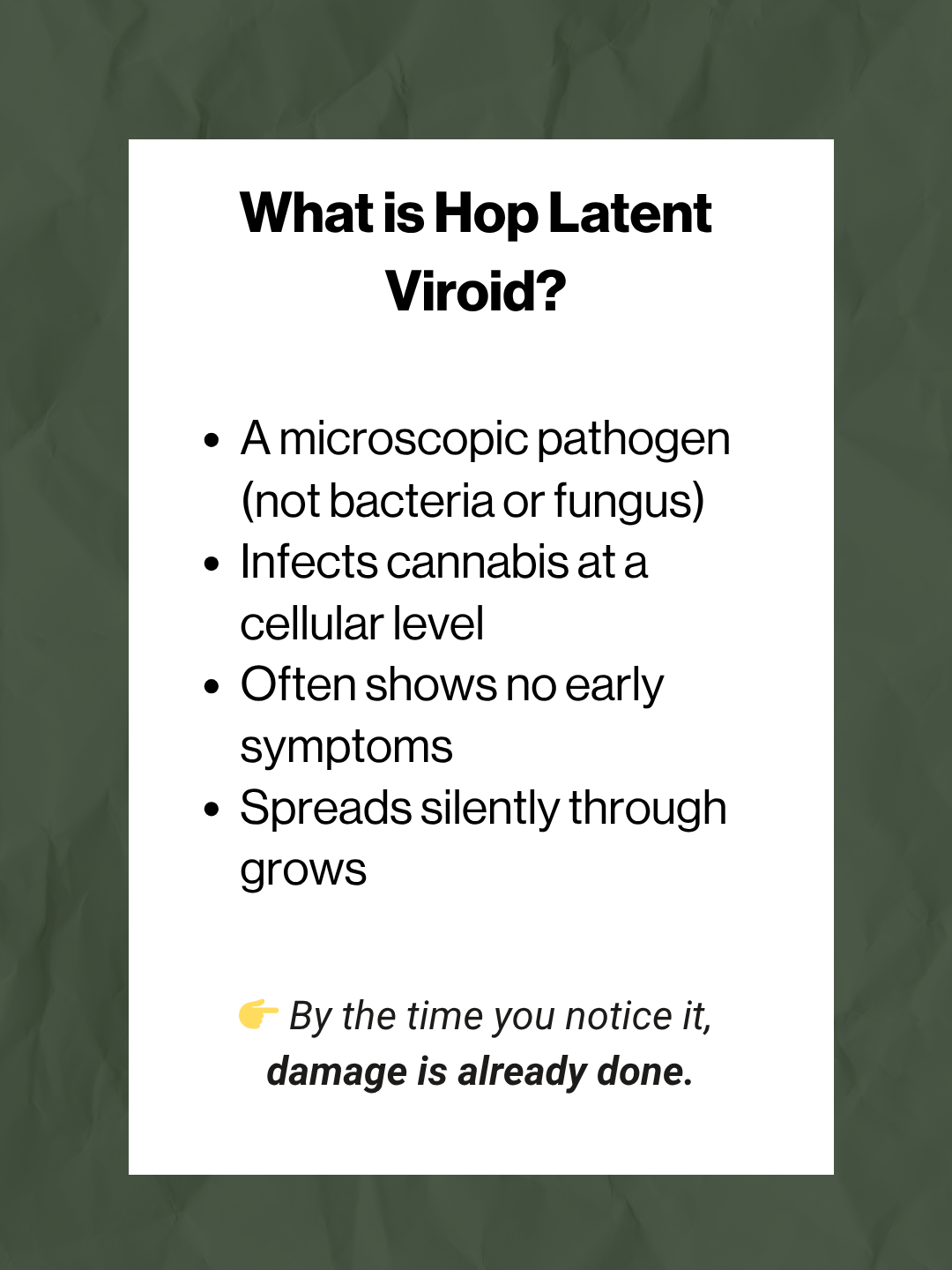
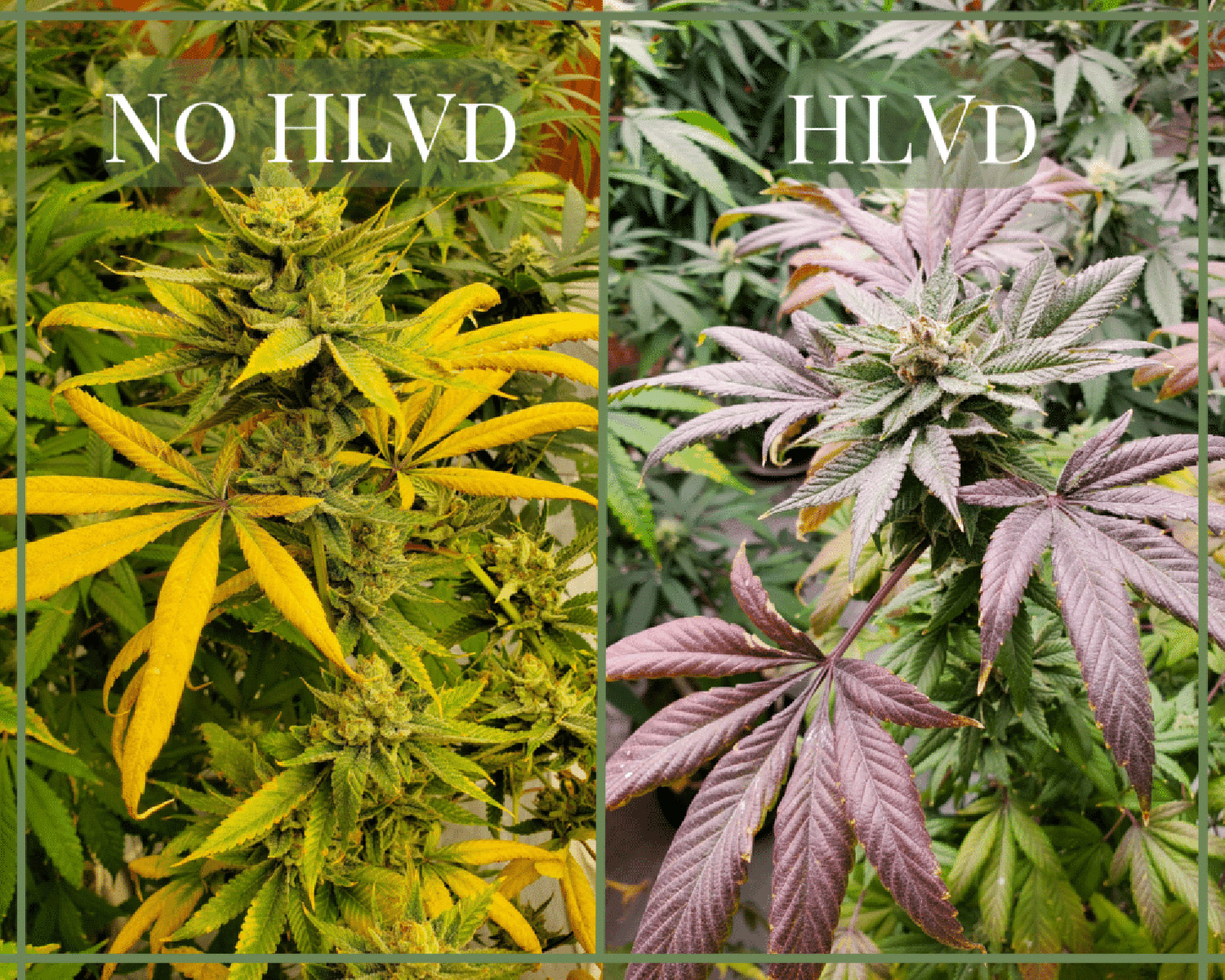
Hop Latent Viroid (HLVd) is a highly infectious pathogen that consists of a single stranded loop of RNA.1 It is many times smaller than a typical virus and is actually a “Viroid.” It is also known as “dudding” or the “dudding disease.” HLVd was first discovered in Hops in 19872 and has since then been discovered in Cannabis.3 One study has shown that up to 90% of grow facilities in California have tested positive for HLVd at some point and that the infection has spread across cannabis in the US.8 Other sources have stated that up to 40% of flower from retailers and dispensaries in Canada have also had positive test results for the pathogen.6
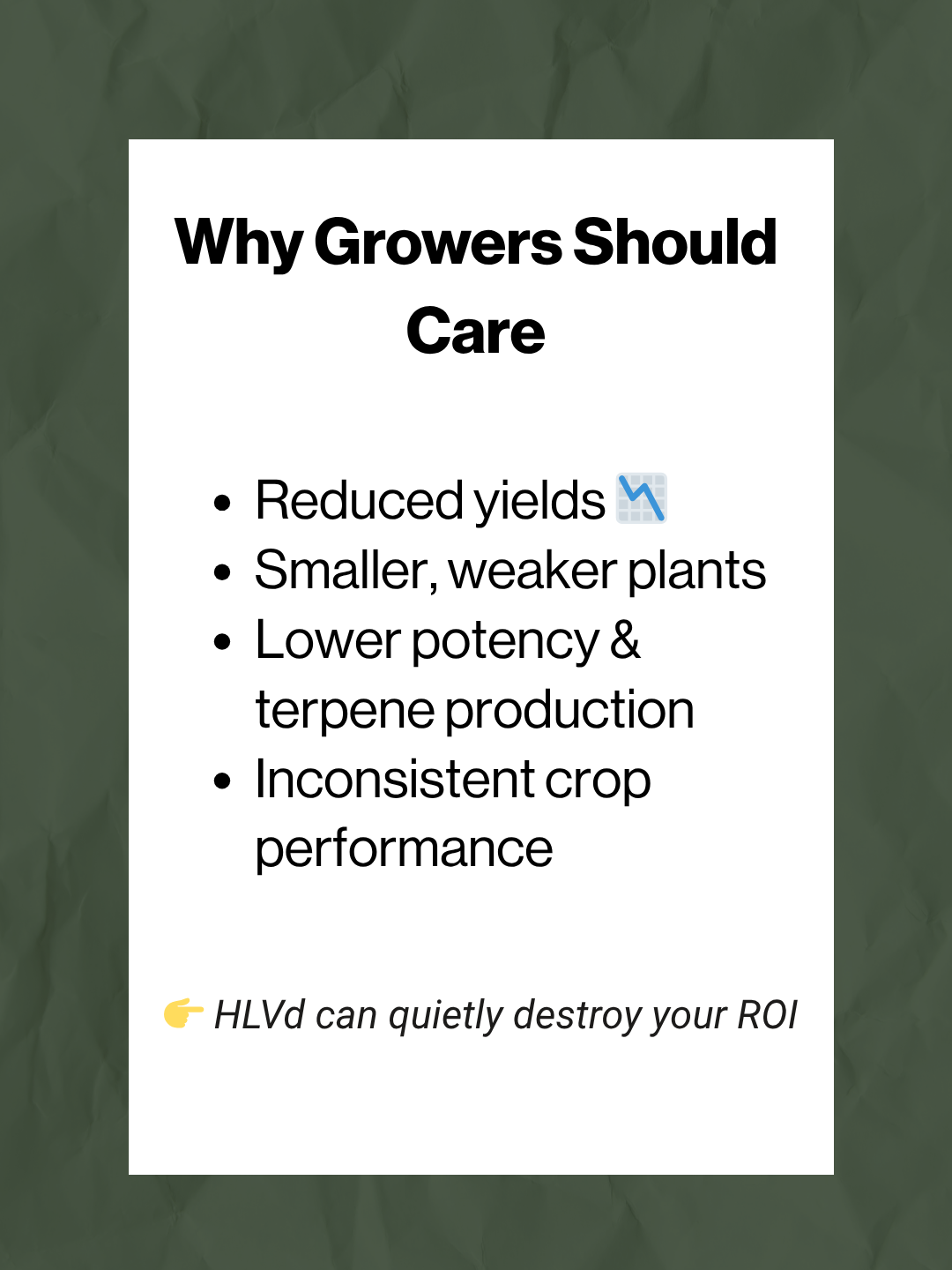
HLVd has caused significant crop loss for Cannabis farmers in the form of lower yields (translating to a possible 33% loss financially across some state markets),8 lower trichome content, and reduced terpene profiles.3
HLVd is not only highly infectious but it remains hidden or dormant (latent) to observation until the cannabis plant experiences a secondary stress such as heat, over watering, pest infestation etc. that causes visual symptoms to occur.4
Sometimes HLVd can start showing symptoms during the flowering stage, even if not visually detectable during the entirety of the vegetative growth. It can cause the plant to develop small, abnormal (sometimes spiky), and less potent buds all over resulting in loss of yield and potency.3,8
Some infected cannabis plants never show symptoms throughout their entire lives and this is another reason why HLVd can be spread so easily as growers may sell or trade cuttings or clones with others and not have any suspicion that those pieces of plant material may be harboring the viroid.4 Improper sterilization of cutting tools and the reuse of gloves across different plants can quickly spread the viroid throughout your grow room as well.3,5
HLVd can exist in most of a plant’s tissues (stems, leaves, roots, etc.) but largely resides in the roots of cannabis plants. This does not mean leaves, stems, and buds are unaffected. The Viroid can take time to migrate through the entire plant as it enters the phloem (the vascular tissue responsible for conducting sugars and other metabolic products downward from the leaves) through a cut or tear in a stem or leaf, travels to the roots, and then spreads throughout the rest of the plant.6
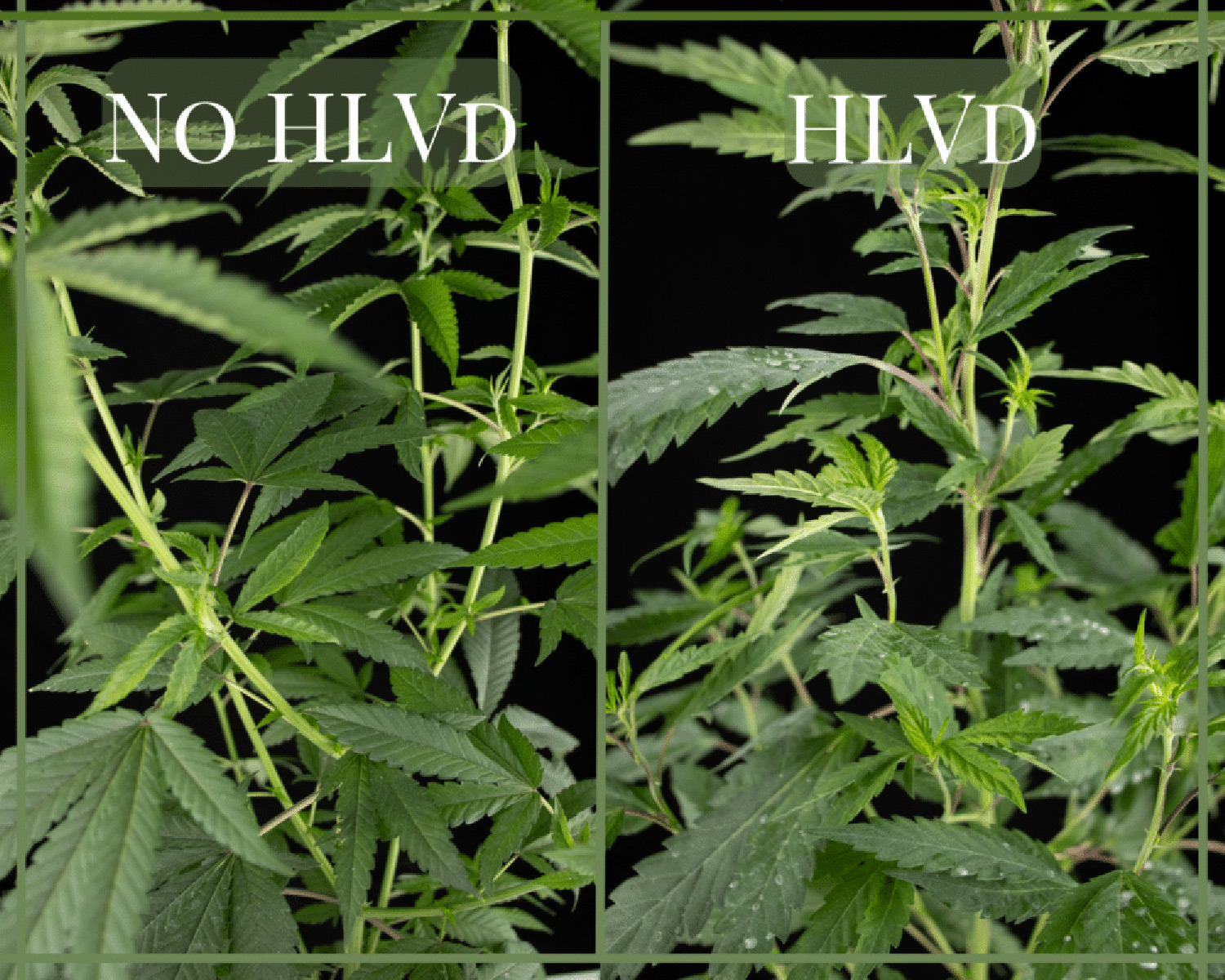
Left: a young veg plant showing normal leaf distribution with common morphology. Right: An HLVd positive plant early in its vegging stage, showing clustering of new leaf growth and aberrant leaf morphology.
Symptoms
Shorter internodal spacing
Smaller leaves (sometimes with higher rates of chlorosis)
Stunting of bud size and morphology
Reduction of trichomes
Reduction of terpenes
Reduced overall plant vigor (weaker apical/main and lateral stalks)
How to Identify
As previously stated, visual observations of HLVd can include smaller buds with reduced trichome and terpene content during flower as well as abnormal leaf formation and stunted growth during all stages of a cannabis plant’s life. However, visual observations can occur too late after a grow has already invested significant time and money into flowering many plants which results in loss of crop and profit.
The most accurate way to assess the status of cannabis plants is through one of two processes known as Reverse Transcription PCR (RT-PCR) and Quantitative PCR (qPCr) which can be performed by many commercial labs across the US.3,9
Routine testing of mother plants, as well as any new clones or mothers introduced from outside your facility, is highly recommended. A schedule of up to 4 tests per nursery plant over a period of a month and a half has been suggested by one source.8 Another source has suggested isolating new plants for 30 days and testing on the third week of isolation.3 Regardless, testing is critical to ensuring the prevention and/or spread of existing HLVd in your grow facility.3,6
Left: A plant from the same pack of seeds at the same time in flower (week 7). Note the greater yield and more normal spacing on the leaves. This is closer to the normal presentation for this strain when uninfected by HLVd. Right: A plant late in flower (week 7) showing greatly reduced yield from the norm. Note the small bud size and the tight spacing on the clusters of leaves. Reduced yield and leaf bunching are two of the most common observable effects of HLVd or the ‘dudding virus.’
Transmission
HLVd is mainly spread by mechanical transmission.5,6 This refers to dirty cutting tools, unwashed hands, dirty gloves, and any other contaminated objects coming in contact with a plant’s tissue.
HLVd can also be spread through aqueous transmission (through water). For example, a non-infected clone can become infected if it is in the same cloner as an infected clone. Even if the two clones never have root-root contact, HLVd can move through the water from one infected plant to the roots of all the other clones in the same cloner. This also means plants that share drip trays or saucers could potentially end up infecting healthy plants when water run off from the bottom of an infected plant’s pot can mix with the roots and soil of the healthy plant.5,6
There are no published reports currently that show insect transmission of hop latent viroid in cannabis. However, many other viroids are spread by insects, making insect transmission of HLVd a high possibility. It is good practice to limit your cannabis plants exposure to bugs (best pest management practices, healthy plants, good environmental controls, etc.) as many other viruses and pathogens are spread by insects.7
Best Practices for Prevention
Isolate any new cuttings or established plants coming from outside of your facility. Make sure to test these plants before integrating them with the rest of your grow.
Change gloves when working with multiple plants. One pair of gloves per plant.
Clean cutting tools with at least a 10% solution of bleach that contains 5.25% sodium hypochlorite for at least 10 seconds in between taking cuttings from one plant to the next. Also clean any work surfaces that come in contact with plant material. 3,4,5 Isopropyl alcohol will not kill the viroid so bleach is required for efficient removal of HLVd from cutting/workstation surfaces.10
Avoid having plants share drip trays/saucers if possible (due to aqueous transmission).5,6
Destroy any plants that are infected or remove them from your grow to be treated for HLVd through tissue culture (only recommended if the cultivar is critical to your business due to time and financial cost of tissue culture).
Summary
HLVd can be a devastating issue for any grower whether it’s the home or commercial cultivator. HLVd can remain dormant for a long time and may never show symptoms while it spreads throughout a grow. Mechanical transmission through dirty/used cutting tools and gloves is the number one method of transmission of the viroid. Through routine testing, via RT-PCR or qPCR methods, and employing best practices in cleanliness all growers can limit the spread of this pernicious pathogen and get the quality flower we all love.
3: Adkar-Purushothama C.R., Sano T, Perreault J.P. (04 March 2023). Hop Latent Viroid: A Hidden Threat to the Cannabis Industry. MDPI. doi: 10.3390/v15030681. PMID: 36992390.https://www.ncbi.nlm.nih.gov/pmc/articles/PMC10053334/
9: Punja, Z K (2021). Emerging diseases of Cannabis sativa and sustainable management. Pest Management Science 01 February 2021. https://doi.org/10.1002/ps.6307
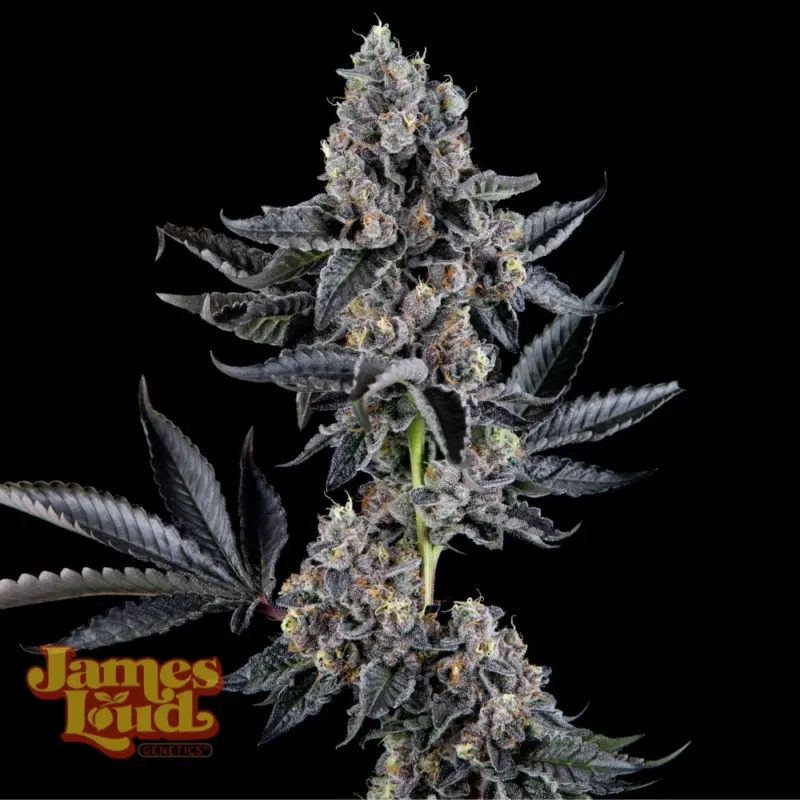
James Loud Genetics shares 3 tips for new growers and their top recommendations! Don't miss out on all the great deals from James Loud Genetics for Breeder of the Week!
3 Tips For New Growers
Start small and stay consistent Fewer plants mean less complexity and faster learning. Start with four to six plants max, and grow the same cross rather than mixing multiple varieties. This allows you to identify patterns in growth, nutrition, and structure, while also teaching you how individual plants express differently, even among sisters.
Genetics set the ceiling Start with proven, stable cultivars. Varieties with Blue Dream, LCG, Runtz, or Tangie lineage tend to be more forgiving and easier to manage, which builds confidence early. More finicky lines like OG Kush or Cookies can require multiple cycles to dial in and often frustrate beginners. Set yourself up for early success.
Follow one system and track everything Do not combine multiple sources of advice. Pick one approach and follow it precisely. Document your full process, and when making adjustments, change only one variable at a time. Track yield and quality, with quality as the primary metric. Real skill comes from repetition and problem solving over time, not guessing. Everyone starts somewhere, consistency is what separates average from exceptional.
Favorite Breeding Project
My favorite breeding work right now is my upcoming 420 release built around the Double Lemon Cherry crosses, along with several Runtz-based projects. What excites me about this work is the level of diversity I brought into it. I am incorporating a wide range of unique cultivars, including Dream Candy, RBK OG Kush, GMO, NL5 Haze, 24k, Chem91, Oregon Blueberry, and Bananaconda, to create new expressions of what is popular right now while still pushing things forward.
What makes this project stand out for me is not just the genetics, but the process. It is the first full run I have completed in Rockwool, where I was able to precisely steer the crop using Grodan’s Gro-Sense system. That level of control gave me a much deeper understanding of irrigation strategy, VPD, and dew point, and how those variables directly influence plant performance and final expression.
Story From The Garden
I’ve been doing this long enough to remember when charcoal filters weren’t standard. Back in 1997 to 1998, we were building our own with five gallon buckets and loose carbon.
The first run I ever did of Oregon Blueberry with those homemade filters barely smelled. I thought we had it figured out. Then came the next run, a Chemdog variety in my garage under six lights. The smell was overwhelming, completely uncontrollable. Neighbors over 200 feet away were convinced there was a skunk loose in the neighborhood. They kept asking me and my wife if we had seen it. We told them yes, of course.
We tried everything to manage it. Strong smelling companion plants, orange oil sprays, anything we could think of. Nothing worked. The plant just overpowered it all. Somehow, we got lucky and avoided any real issues, but at that time people were getting serious time for far less.
We were among the early wave of people with medical cards in California, but back then that card was not something you could rely on to protect you. You had to be sharp, resourceful, and a little lucky. That run taught me quickly that some varieties don’t just grow, they announce themselves whether you are ready or not.
Our next toke is the Alpha Series' Apple Peelz by Dirty Bird Genetics. She is a cross of Sex Melon x Bad Apple. Read on to learn about our experiences.
The unique smell took me back to a stroll down a row at an apple orchard during a New England Fall. It has the fragrant and sweet aroma of a discarded apple core that has been sitting in the sun. I love the sweetness of this strain. It brings on a very functional and smooth high, which I found to be a great afternoon pick-me-up. This one will not lock you down or make you feel heavy. She would be a great companion for a walk on a beach or in the woods.
- Crystal
Apple Peelz (Sex Melon x Bad Apple) by Dirty Bird Genetics is a fast favorite! This plant is beautiful, smells sweet like apples, and has stunning deep purple leaves. The buds are dense and covered in crystals. It’s a great sativa-dominant hybrid that provides a lovely daytime high. It will calm your nerves and melt away your worries but won’t deplete your energy. I smoked this in the morning and then spontaneously deep cleaned and rearranged my dining room and kitchen. I would highly recommend this strain for when you want to take the edge off but still feel energetic and functional.
- Mariah
Read more about the differences between Alpha Series, Limited Series, & Tester packs.
The Battle of the Trop Cherry OG and the Double Cherry Pie
By Beth Mathieu
Owner of North Atlantic Seed + Dirty Bird Genetics
I’ve been a long time fangirl of Ethos’ work. They were one of the first breeders I had the privilege of working with when North Atlantic Seed was in its infancy, and up until 2023, I had personally grown virtually their entire menu strain-by-strain as it was released. When NASC had its 1st annual Discord Photo Contest last fall, I was struck by one plant in particular that I had yet to grow. The Trop Cherry submissions were striking, and interestingly, we received several submissions which told me there was likely something special here. The knuckly, dense, large purple colas in the photos were a great example of ideal flower structure as far as I’m concerned, and I was impressed by the size of the flowers. It’s not often that you see colas as large as these with such minimal leaf and such high quality. I wasted no time. I immediately sent a text over to Ben–our head Breeder at Dirty Bird Genetics– and we added Ethos’ Trop Cherry Duet to our 2025 “pop list.”
Within the Trop Cherry Duet pack, the Trop Cherry OG came paired with another eyecatching selection: The Double Cherry Pie. Both strains featured the Trop Cherry genetics in their lineage, so we decided we would germinate them both and do a “grow off” to find out which of the two strains captured the deep purple coloring, chunky flower structure, and the cherry chapstick terpene profile we were after.
While both the Trop Cherry OG and the Double Cherry Pie had their strengths, there could be only one winner. Continue reading to find out which of the Trop Cherry crosses we decided to keep a cut of for the Dirty Bird Genetics library...dun dun dun.
The Line Up:
6x Double Cherry Pie R1: (Trop Cherry x Cherry Pie)
5x Trop Cherry OG R1: (Trop Cherry x SFV OG)
TROP CHERRY OG by ETHOS
Of the five Trop Cherry OG seeds we grew, we observed three phenotypes, making for a relatively high PVI. This cohort showed divergence in color, terpenes, and flower structure:
Color: Three of 5 were green and 2 of 5 had purple flower
Terpenes: The purple plants had no observable terpenes, whereas the green plants had mild orange/cherry/gas smells come through.
Flower Structure: Flower structure was spear shaped with granular bracts versus stella form and more dome-shaped.
Herms: One of the five plants showed signs of hermaphrodism in the first three weeks of flower so we had to toss it.
All of the plants had medium internodal spacing, great lateral branching, and grew as rounded bushes with moderate foliage and moderate calyx-to-leaf ratio. Morphologically, they were well proportioned plants with self-supporting stalks; we did not have to stake the plants at all. One plant in particular had notably heavy flowers. Yields and stacking were moderate overall. One of the purple plants was a bit finicky and yellowed dramatically toward the end of flower, which can be normal, but the majority were easy to grow and remained healthy through harvest. All of the plants turned out well, but none were show-stoppers for us, so we did not choose to keep a mother plant from this lot. That said, I have seen some photos of truly beautiful plants that have come from these seeds, so I wouldn’t dissuade anyone from trying them or hunting them. If I were to re-hunt these myself, I would be looking for a pheno that has the beautiful purple coloring paired with a stronger terpene profile.
The finicky Trop Cherry OG purple plant.
Trop Cherry OG with dome/stelliform flowers
DOUBLE CHERRY PIE by ETHOS
Similar to the Trop Cherry OG, the Double Cherry Pie showed divergence in color, terpenes, and flower structure; however, as a whole they appeared more uniform, and the terpenes we observed in this grow were stronger and more consistent. These factors really tipped the scales in the Double Cherry Pie’s favor.
Color: One out of six of the DCP plants we grew had purple flowers and green foliage and the remainder were deep green.
Terpenes: Mandarin orange/cherry chapstick terpenes were pungent on the purple pheno that became our keeper cut. As a whole, the rest of the cohort leaned more cherry than citrus/orange/tangie.
Flower Structure: The majority of plants had spear-shaped flowers that came to a point at the apex of the cola. One out of six had rounder, dome-shaped flowers.
Herms: 0/6
Overall, I would rate the terpenes in the Double Cherry Pie as moderate with the one purple pheno being a stand out both in color and smell. Moderate-high yield was consistent across the board on the Double Cherry Pie, as well as strong, self-supporting stalks. Morphologically, the plants were quite similar to the Trop Cherry: They grew as bushes with great lateral branching making for a beautiful, even canopy. The Double Cherry Pie’s foliage was slightly less dense than the Trop Cherry OG’s was with more room for air flow, and the calyx-to-leaf ratio was notably higher. On top of these factors, we didn’t observe any signs of hermaphrodism in the DCP, and the trichome production was observably superior.
The Double Cherry Pie was the clear winner here for the Dirty Bird team. This seed cohort was where we found our keeper cut. If you couldn’t guess, it was the sole purple Double Cherry Pie plant that exhibited fantastic tangie and cherry chapstick terpenes. This cut will be appearing in an upcoming Cherry AK breeding project that we have maturing behind the scenes as of this writing. Overall though, I think both of these strains are worth your time; thank goodness since they’re sold together! Both exhibited beautiful purple flowers in at least 20% of the plants we tested (for those of you who love purple like us Mainer’s do), and both had great internodal spacing and that classic-bushy morphology that’s hard not to love. We didn’t find any duds. All of the plants yielded well and produced high quality flowers. Feel free to send us some pics if you find any fun keepers in your own hunts!
Stay tuned for more Grow Reports as Dirty Bird continues hunting great genetics from the NASC breeder family!
A Comprehensive Shopping Guide By Growers, For Growers
Looking for recommendations that you can trust this 4/20? Look no further. At North Atlantic Seed, not only do we have the unique opportunity to work closely with our breeders and our customers, but we also love to grow as many genetics as we can each year. This year, we’ve taken all of this anecdotal breeder and grower experience and we’ve combined it with NASC Here are the standouts we’ve identified this 4/20:
BEST SELLERS 2026
Below are NASC’s Best Selling Autoflowers + Photoperiods of 2026 pulled directly from our Q1 2026 sales data.
NASC Best Sellers: Top 3 Autoflowers
Purple Lemonade Auto by 420 Fast Buds
Blue Dream Auto by 420 Fast Buds
Acapulco Gold Auto by Auto Seeds
NASC Best Sellers: Top 3 Photoperiods
Acapulco Gold (F) by Barney’s Farm
Mandarin Cookies V2 (F) by Ethos Genetics
Blueberry Muffin (F) by Humboldt Seed Company
BEST OUTDOOR STRAINS 2026
This year NASC set out to curate a line of genetics that commercial farmers and outdoor home growers could rely on for uniformity, resilience, quality and performance. We are asked for outdoor recommendations every day, and because we live in one of the harshest climates in the US for growing, we know the struggle it can be to find reliable genetics. The NASC Commercial Cultivars series was sourced from US breeders and tested and bred on a commercial scale to meet the needs of the home grower and the commercial grower alike. For that reason, this line of True F1 Hybrids and IBLs are our picks for outdoor 2026:
NASC GROWERS CHOICE - COMMUNITY-VOTED FAVORITES:
The strains below are YOUR favorite strains of 2025. These results came directly from the Grower’s Choice survey that NASC conducted in Jan 2026.
Strain of the Year - Autoflower:
Gorilla Cookies by Fast Buds
Banana Purple Punch Auto by Fast Buds
Banana Jealousy Auto by Ethos Genetics
Frostbanger Auto by 420 Fast Buds
Gorilla Zkittlez by 420 Fast Buds
Purple Lemonade Auto by 420 Fast Buds
Strawberry Milk and Qookies by Night Owl Seeds
Grape Gas by Twenty20 Mendocino
Double Grape Auto by Mephisto Genetics
Guava Auto by 420 Fast Buds
Strain of the Year - Photoperiod:
Blueberry Muffin by Humboldt Seed Co.
Slurricane #7 by In House Genetics
Dirty Mimosa by Dirty Bird Genetics
Mandarin Cookies V2 by Ethos Genetics
Orange Cream Pop by Humboldt Seed Co.
Bubba Whip by Twenty20 Mendocino
Chem Funk by Ethos Genetics
Chicken N’ Wafflez by Humboldt Seed Co.
FX3 by Solfire Gardens
Irie Maiden by Romulan Genetics
Strain of the Year - Extract:
Blueberry Muffin by Humboldt Seed Co.
Honey Banana by Lovin In Her Eyes
Trich Beast by Solfire Gardens
Orange Cream Pop by Humboldt Seed Co
Golden Sands by Humboldt Seed Co.
Irie Maiden by Romulan Genetics
Maui Wowie Squared by Dirty Bird Genetics
GENETICS FOR A CAUSE:
This year, we have been hard at work behind the scenes trying to educate lawmakers and influence positive policy changes for cannabis seeds and genetics in DC. We’ve recently started a campaign called Keep Seeds Legal! When you purchase the strains on this menu, 100% of proceeds go towards fighting the “hemp ban” set to take effect this Nov 2026.
We are a family-run farm in southern Virginia just east of the Blue Ridge Mountains. We use natural farming practices that go beyond organic methods and we strive for a closed-loop regenerative agriculture system utilizing what is available on our property and foraged from local surrounding areas to benefit the soil and plants we grow. -Jolly Pond Farm
We are very excited for this new addition to the NASC menu, Jolly Pond Farm. For this smoke report, I smoked Tropighani, which is (Trop Cherry x White Afghani F3). Mariah tried Trop Cherry x Garlic Grove. Read on to learn about our experiences.
White Afghani S1 (parent strain to Tropighani)
Tropighani She can definitely be your partner in crime if you're looking for a fun and goofy time. The intense euphoria that immediately started was great! I felt like I was put into a spacey and giddy trance. I became so forgetful that my dogs were almost fed second-dinner by mistake. Overall, I'd say this strain is balanced, but because of the intense head-lift, I didn't want to move far from my couch or be active. With causing such heightened senses, I think this would be great for watching a movie or listening to music. It could also assist with bouts of laughter in a laid-back social setting. The taste and smell toggled between a representation of both parent strains. It had this sweet and earthy flavor from the Trop Cherry side, but a strong note of herbal spice from the Afghani lineage. I would absolutely smoke this again and I look forward to trying more from Jolly Pond Farm! - Crystal
Trop Cherry x Garlic Grove I enjoyed this strain from Jolly Pond Farm! It really does smell like cherries with some peppery undertones. It’s definitely grown with care; the buds are dense and frosty with flecks of purple. I felt immediately relaxed as soon as I smoked it. It tastes great, and the high is super mellow and uplifting. The stress of the day melted away, and I was able to get out of my head and just chill. I tend to smoke in the evening before bed and this strain definitely helped me to relax before falling asleep, however I think it would provide a great daytime high as well if you had the day off. 10/10! - Mariah
Before 2019, the world was a much different place. Our team was scattered throughout Maine doing different jobs and still trying to find purpose in our careers. The owner of North Atlantic Seed Co, Beth Mathieu, was working as a medical care giver in central Maine. Providing clones and care to her patients opened her eyes to the need for accessible genetics in the United States. Maine Clone Company was already established and connected her with locals that reaffirmed that need.
North Atlantic Seed Co. launched in 2019 and Beth started to find a few breeders to work with and distribute their genetics. We were fortunate to work with a few that had proven quality including Ethos Genetics, Barney’s Farm and a few more. As demand grew, Beth hired me to help with marketing and expand our reach domestically so she could continue to balance her other businesses. Back in 2020 when I first got my start, Covid forced people to stay at home and many were looking for a new hobby as well as alternative forms of self-care. I quickly discovered how fortunate we were to launch when we did. Word of mouth was the most important marketing we could do so we put all our focus into top-notch customer service and improving the customer experience with our website. We still have that mentality today because we understand that builds loyalty in our community and will continue to set us apart.
As time went on we started working with more breeders, hired more friends and family, got a payment processor to work with us and customers helped build trust online about our business. Marketing cannabis online has always posed a challenge. Our industry has never had access to common marketing tools like GoogleAds, social media sponsored content, text marketing and standard SEO tools so we have had to get creative. Seeds have been legal since the 2018 Farm Bill but algorithms and community standards have been unable to differentiate our legal business from the illegality of cannabis at the federal level. We adapted our approach to each platform and learned some lessons the hard way.
Meta (Facebook and Instagram)
These platforms have a large audience for our target demographic but can be the most restrictive in reach. Facebook flags bud pics and removes our content more than any other platform so we use it more as a re-direct for our customers these days. There are also scammers on Facebook that pretend to be us so we try to manage that as much as possible. We will never ask for money on any social platform so be aware of these common scams!
Instagram used to allow more than it does currently. They have started to remove cannabis accounts altogether. Our original account went down when we had 11k followers. The backup account had 30k followers and all content archived or deleted when it went down. This was incredibly frustrating when our account was removed based on content that could not be reported. Meta was completely incompetent when providing ‘support’. They refused to provide the report of what content triggered the removal. Their community standards are intentionally vague stating that they don’t allow the sale of illegal goods - even though seeds are legal and they are wrong. This allows scammers to thrive on Instagram and we see more scam accounts here than any other platform. Meta often won’t remove these scam accounts when they are reported. Further proving that their platform is broken.
We still have accounts on both platforms today. For Instagram we have started leaning towards more educational and lifestyle content than cannabis or promotional content. Even now, giveaways trigger the algorithm, most content is not populating followers feeds and we run the risk of losing our accounts at any moment.
X and BlueSky
X and BlueSky are the least restrictive but have a smaller audience. We can post more promotional content here compared to any other social platforms. Follow us HERE and HEREto stay up to date on all our best drops and promotions.
YouTube and RSS
YouTube recently tightened restrictions and has consistently taken down our content. We have seen this happen to many other cannabis YouTube channels as well. This is unfortunate because YouTube has a lot of reach potential. All the video content can be found on an alternative platform - Vimeo. Most of our video content comes from our NASC Cast team where they interview breeders and learn their backgrounds, what they love to grow and what the future looks like for their brands. NASC Cast has interviewed some of the best in the industry like Solfire Gardens, Twenty20 Mendocino, Gnome Automatics, Brothers Grimm, Dirty Bird Genetics and MORE! If you haven’t checked the NASC Cast out, you can listen or watch anywhere you get podcast content or watch on Vimeo.
Email Marketing
Email marketing is our best way to get our drop info and promotional info directly to you. Plus you get a 10% OFF code when you sign up! If you want to stay up to date and be the first to hear about things like 4/20 specials, please sign up!
Reddit
Reddit has proven to be valuable from the very beginning. Long before we had an account, customers would advocate for North Atlantic Seed Co. on Reddit when people would ask where to buy seeds. We are grateful for everyone that ever gave us a shoutout on Reddit and sent customers our way.
Follow us on Reddit to stay up to date on our blog, educational content and see what others are growing! We will be more active here in the months to come so make sure to join and engage with the community HERE!
Discord
Up until recently, Discord was a fantastic community building platform. We lost our Discord channel twice and decided to pivot towards other options. Getting our community to move to a new platform every few months is not ideal but we remain optimistic and hope you all continue to find ways to stay active in our community.
Patreon
Today we launch our newest community option on Patreon. We are so excited about this FREE to join Patreon that allows cannabis content and should prove to be similar to our Discord. Please join us on Patreon for educational content, a growing community and so much more!
Here’s a word from Jaden, Marketing Associate, on both Discord and Patreon.
“Discord was a platform that was a major back and forth battle for us. The community aspect of Discord was something far different than traditional social media and it was amazing to see so many people from so many different places come together and share their love for growing. Getting to know the members of our community was always one of my favorite parts of my job. Whether it be through them sharing plants, pets or some of their other favorite activities, I was always interacting with the NASC community in one way or another. Unfortunately on the other side of the coin there was an increase of action taken against cannabis servers on the platform. With constant violations being given to both us and our members, our server being taken down multiple times, and the majority of other cannabis servers facing the same issues as us, we ultimately decided to move away from the platform for the foreseeable future.
With all of that being said there was a light at the end of the tunnel. After once again losing our Discord server I started to look for alternative platforms that have a strong emphasis on building a community, that we also wouldn’t face as many struggles with. So, I am excited to announce that as of today we have launched a free Patreon page that utilizes the platform's community chats feature to allow a similar experience to Discord and the ability to share your plants freely. Along with that we will be using the posts section to keep you updated on all of our future educational content. Blogs and NASC Cast episodes will be posted there, allowing us to have a strong emphasis on education. Also be on the lookout for future paid tiers for more exclusive content available on Patreon, as we plan to expand what we offer while always keeping the community free to access. I am excited to dive back into the NASC community and see faces both new and old. Please visit https://www.patreon.com/cw/NorthAtlanticSeedCo and join for free today!”
2026 will prove to be a pivotal year in our industry. Cannabis rescheduling and the potential hemp ban will shape the future of genetics in the United States. Please support our efforts in Keeping Seeds Legal by purchasing packs HERE or making a donation at checkout. All proceeds will directly fund the legal future of cannabis seeds.
Thank you for reading and for your continued support! We wouldn’t be here without you. Please follow us anywhere and everywhere you engage online. We want to hear from you and grow with you!
As a small token of our appreciation, please use this 10% OFF code on your next order:
MattSentMe
Good for one time use. Exclusions apply. $25 min. Expires 4/17/26.
Dirty Bird Alpha Series (Apple Peelz Fem Photo and Gas Berry Auto Fem)
Offensive Selections New Breeder
HUGE Mephisto Genetics Drop (40+ New Strains)
Barney's Farm New Strains
Cannarado Grape Pie Drop (4/10)
Romulan Genetics Garlic Fever F1 (4/17)
Dirty Bird Nuclear True Blood Volume Drop (4/17)
, Compound Genetics Black Amber Drop (4/20)
Offensive Selections Exclusive Atlantica Drop (4/20)
In House Genetics Drop TBD
Purple Caper x Ed Rosenthal Drop TBD
Royal Queen Seeds New Drop
& MANY MORE!
Angel's Rest (F) by Offensive Selections
505 Headbanger Auto (F) by Mephisto Genetics
Apple Peelz (F) by Dirty Bird Genetics
Discounts
Private Label 10% OFF
& MORE coming later this month!
BOGOs
Barney's Farm BOGO (Cont.)
Dirty Bird Buy 2, Get 1,
In House Genetics BOGO (Sugar Pie)
, Mosca Seeds New Drop BOGO (Creme Cartel)
& MORE coming later this month!
FREEBIES
Keep Seeds Legal Donation Freebies at Checkout
Purple Caper Freebies Updated to 7 FREE per pack
Rare Dankness Double Freebies
Sin City Seeds Sticky AF Drop Freebies
Mosca Seeds Drop Freebies (Creme Cartel 6pk)
Purple Caper x Skunk Magazine Collab Freebies
Romulan Genetics Freebies (Spiced Sugar F1)
Offensive Selections Freebies
Romulan Genetics New Drop Freebies
& MORE coming later this month!
BOTW
Ethos Genetics (Double Freebies / 10% OFF / Giveaway)
Barney's Farm (10% OFF / BOGO)
James Loud Genetics (Double Freebies / 10% OFF)
4/20 Preview
HUGE Breeder Freebie Bundle Starts 4/19 (Barney's Farm, Brother's Grimm and In House Genetics OR Fastbuds, Mephisto and Twenty20 Mendocino)
Purple Caper Sitewide Freebies
Lamb's Breath BOGO
Atlas Seed BOGO & MORE
Giveaways from Gnome Automatics Vault, Bomb Seeds and a HUGE 4/20 NASC Giveaway
Discounts on North Atlantic Seed Co BWL, NASC Private Label, NASC Commercial Cultivars, Sin City Seeds, Royal Queen Seeds, Purple Caper, Brother's Grimm, In House Genetics & MANY MORE!
Disclaimer: Cannabis seeds are sold as souvenirs, and collectibles only. They contain 0% THC. It is imperative that you check your state and local laws before attempting to purchase seeds, and we are not liable for what you do with seeds after receiving them. The statements on this website and its products have not been evaluated by the Food and Drug Administration. These products are not intended to diagnose, treat, cure or prevent any disease. Consult your doctor before use. North Atlantic Seed Company assumes no legal responsibility for your actions once the product is in your possession and is not liable for any resulting issues, legal or otherwise, that may arise.
Are you 21 or older?
You must be 21+ to enter this site.
Sorry, you must be 21 or older to enter this site.


 Tangieberto (F)-10%$45.00
 Sweetish Fish (F)-10%$45.00
 Stellar OG (F)-10%$45.00
 Spidey Sauce (F)-10%$45.00
 Skyline OG (F)-10%$45.00
 Red Light (F)-10%$45.00
 Pomegranate Lime Auto-10%$22.50
 PermaMints (F)-10%$45.00
 Papaya Plum Auto-10%$22.50